


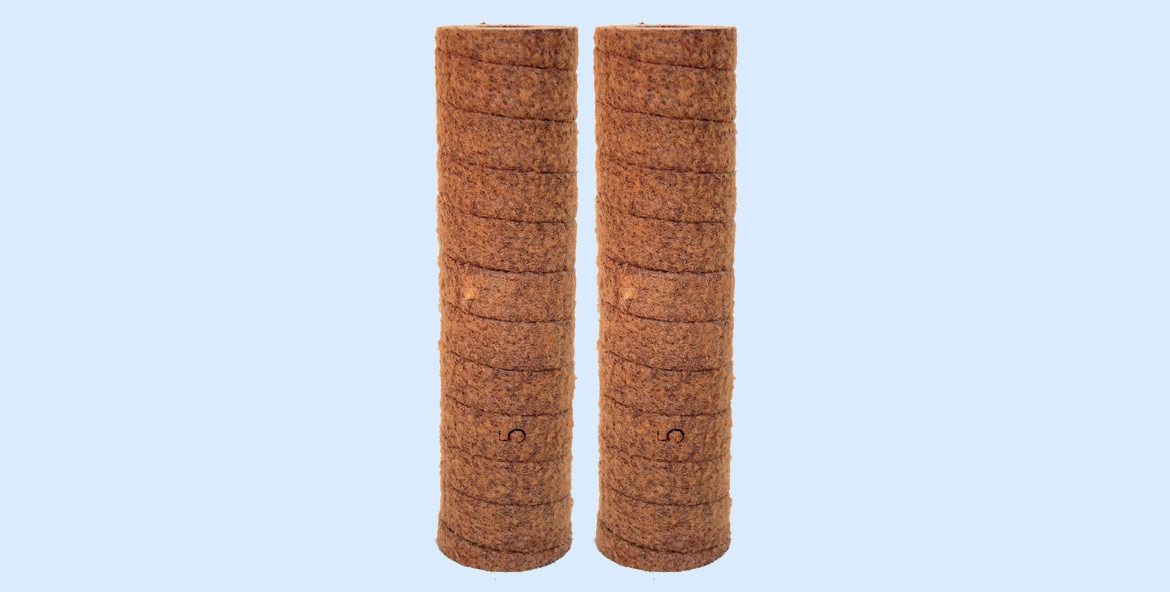
Resin Bonded Filter Cartridge Manufacturer in India — Praimo Industrial Filters & Spares Manufacturing Company
If you need resin bonded filter cartridges that hold their shape under pressure, cope with heat, and keep lines running, you’re in the right place. Praimo Industrial Filters & Spares Manufacturing Company designs and manufactures resin bonded filter cartridges for demanding industrial liquid duties—inks, paints, coatings, adhesives, lubricants, oils, and a wide range of solvents. In actual operation, buyers see the same thing: stable ΔP, clean product, fewer interruptions.
How they’re built (and why it matters). Each cartridge uses cellulose, acrylic, or polyester fibers bonded with phenolic or melamine resins. That rigid, depth-type matrix resists surge compression and minimizes unloading, so dirt stays where it’s trapped. You get high dirt-holding capacity and predictable performance in high-viscosity or solvent-rich streams.
Engineered for industrial performance (numbers that count).
- Differential pressure capability: up to 4.8 bar (70 psi)
- Continuous temperature: up to 121 °C, with high-temperature variants rated for 149 °C
- Result in most installations: uniform filtration, steady ΔP curves, longer service life—and, frankly, fewer headaches for maintenance.
Where they’re used (typical lines).
- Printing inks: pre-filtration and pigment stabilization
- Paints & coatings: removal of gels, agglomerates, insoluble residues
- Adhesives & resins: viscosity control and QA consistency
- Lube & hydraulic oils: varnish and particulate removal
- Solvent recovery: high-temperature, chemically aggressive circuits
Fit and sealing—kept precise. Cartridges are held to tight dimensional tolerances (OD/ID around ~65 mm / 27 mm) with length options from 9.75″ to 40″. End connections include DOE and 222/226, and elastomers are selected for the fluid: NBR, EPDM, or FKM (Viton) for leak-free, repeatable sealing.
Made in India, trusted worldwide. As a resin bonded filter cartridge manufacturer in India, Praimo supports OEMs, EPCs, and plant operators with in-house fabrication, QA, and export-ready documentation. Housings comply with ASME, PED, and CE scopes, and every shipment uses ISPM-15 packaging for global acceptance.
One overlooked detail: it’s not just the cartridge. It’s the whole system—sizing, ΔP margin, elastomer choice, and change-out discipline. That’s why Praimo couples manufacturing with application support, so your filtration train runs cleaner, longer, and with fewer surprises.
What Is a Resin Bonded Filter Cartridge? — Core Product Overview
A resin bonded filter cartridge is, in simple terms, a tough depth-type element designed to pull fine particles, gels, and contaminants out of industrial liquids. Instead of soft layers that compress or deform, the structure here is rigid — cellulose, acrylic, or polyester fibers tightly bonded together with phenolic or melamine resin. Once cured, this thermoset matrix doesn’t budge: it keeps its shape even at high differential pressures and elevated temperatures. In practice, that means consistent filtration where other media would buckle or channel.
Rigid Depth Filtration Mechanism
The filtration process isn’t limited to surface capture. A resin bonded cartridge filter uses a graded-porosity depth mechanism, allowing solids to embed through multiple layers of media. This depth capture extends operating life, stabilizes ΔP, and protects downstream stages. Because of the cross-linked resin matrix, trapped particles don’t “unload” during surges — a common issue with melt-blown or wound types. The cartridge remains structurally sound up to 4.8 bar (70 psi) differential pressure.
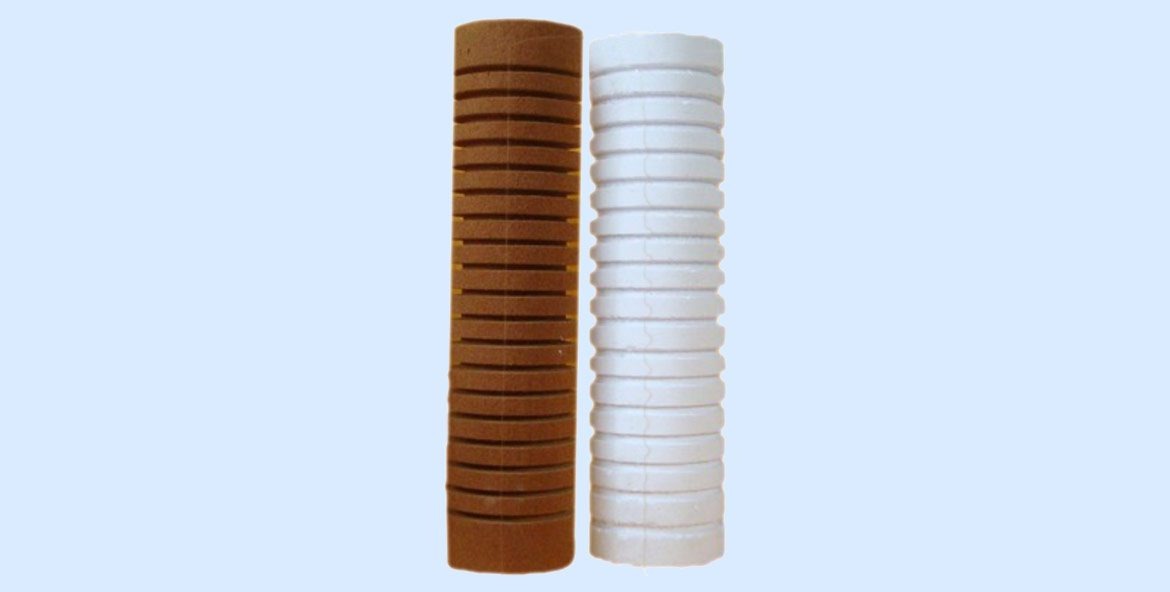
Most modern versions include a grooved outer surface, and that’s not cosmetic. Those grooves increase the external area by roughly 2.3 ×, boosting dirt-holding capacity and stretching change-out intervals by nearly half. Operators often note that ΔP climbs more gradually on grooved cartridges, helping them plan maintenance without process shocks.
Nominal Micron Ratings and Role in Filtration Trains
Available in 1 µm to 150 µm nominal ratings, these cartridges cover a wide spectrum of industrial fluids — from thin solvents to heavy oils. They usually sit mid-train in a filtration system:
- Bag Filter → Resin Bonded Cartridge → Pleated Cartridge, for progressive particle removal.
- Basket Strainer → Resin Bonded Cartridge, in solvent recovery or ink blending systems.
This setup balances flow capacity with precision, extending downstream filter life and cutting overall OPEX.
Key Advantages Over Conventional Depth Filters
- Rigid construction prevents collapse or fiber migration.
- Stable ΔP performance under surge or pulsing flow.
- Greater dirt-holding capacity, longer cycles between change-outs.
- Broad chemical compatibility with hydrocarbons, process oils, and solvents.
- Thermal resilience — standard units rated to 121 °C, high-temperature variants up to 149 °C.
In effect, a resin bonded filter cartridge bridges the performance gap between inexpensive melt-blown media and precision pleated filters. It gives engineers a reliable, cost-balanced choice for viscous or solvent-based applications — the kind that demand mechanical strength as much as filtration accuracy.
Performance Curves — Clean Pressure Drop (SPD) & Dirt-Holding Capacity
In real plant conditions, a resin bonded filter cartridge’s performance is defined less by lab numbers and more by how its pressure drop (ΔP) behaves across changing flow rates and viscosities. Engineers refer to this behavior as the Specific Pressure Drop (SPD) relationship. Understanding it allows you to predict system pressure loss, set change-out points accurately, and size housings for continuous-duty filtration — the small details that prevent costly downtime later.
Understanding SPD (Specific Pressure Drop)
The SPD represents the clean, initial ΔP across a standard 10″ element when tested with water at 1 cP viscosity. It’s the baseline engineers use to estimate pressure loss for other fluids or higher viscosities.
The calculation is straightforward:
ΔPactual=SPDgrade×(Flowper 10″×μ/1cP)ΔP_{actual} = SPD_{grade} × (Flow_{per\,10″} × \sqrt{μ / 1 cP})ΔPactual=SPDgrade×(Flowper10″×μ/1cP)
Where:
- μ = fluid viscosity (in centipoise)
- Flow₍per 10"₎ = flow rate through a 10" equivalent element
This allows you to approximate clean ΔP at start-up. Once ΔP rises above the baseline trendline, operators can estimate dirt loading and schedule preventive change-outs before bypass occurs.
Typical Clean ΔP vs Flow Rate per 10″ Element
| Micron Rating | SPD (bar @ 10 L/min, 1 cP) | Approx. Clean ΔP @ 20 L/min | Notes / Application |
|---|---|---|---|
| 1 µm | 0.17 bar | 0.35 bar | Tightest grade — final polishing |
| 5 µm | 0.10 bar | 0.20 bar | Balanced flow and retention |
| 10 µm | 0.07 bar | 0.14 bar | Common for inks, paints, coatings |
| 25 µm | 0.05 bar | 0.10 bar | Pre-filtration for oils, solvents |
| 50 µm | 0.03 bar | 0.06 bar | High-flow, low-ΔP services |
| 100–150 µm | 0.02 bar | 0.04 bar | Coarse screening, first-stage filters |
Field note: At 5 cP viscosity, expect approximately 2.2 × higher ΔP than at water conditions. Many engineers add this correction factor directly into sizing spreadsheets to avoid undersizing housings.
Effect of Groove Geometry on Performance
Praimo’s grooved resin bonded cartridges aren’t a cosmetic upgrade — they’re a mechanical advantage. The grooves add roughly 2.3 × the external surface area, letting the cartridge load solids more evenly and extend service life. In high-solids systems, that difference easily translates into one less shutdown per month.
| Parameter | Grooved Cartridge | Ungrooved Cartridge |
|---|---|---|
| Effective Filtration Area | 2.3× higher | Baseline |
| Dirt-Holding Capacity | +35 – 45 % | — |
| Service Life | 1.4 – 1.6× longer | Shorter under same load |
| Change-Out ΔP | 2.4 – 3.5 bar | 2.0 – 3.0 bar typical |
| Flow Stability | Consistent ΔP rise | ΔP spikes near end of life |
This geometry also slows blinding. The ΔP increases more gradually, giving maintenance crews time to plan change-outs instead of reacting to unexpected pressure alarms.
Interpreting Performance Curves
In practice, clean ΔP vs Flow curves for resin bonded filters start linear at low velocities (laminar flow) and bend upward at higher flows (partial turbulence). A 10 µm grooved cartridge typically shows:
- ΔP ≈ 0.07 bar at 10 L/min
- ΔP ≈ 0.15 bar at 20 L/min
- ΔP ≈ 0.25 bar at 30 L/min
Maintaining a clean ΔP ≤ 0.2 bar per 10″ element keeps the cartridge in its efficient zone and leaves enough headroom before the 2.5 – 3.0 bar change-out limit.
Flow Scaling in Multi-Round Housings
| Number of Cartridges (10") | Total Flow Capacity (@ ΔP = 0.2 bar) | Recommended Face Velocity |
|---|---|---|
| 1 cartridge | 18 L/min (≈ 1.1 m³/hr) | — |
| 5 cartridges | 90 L/min (≈ 5.4 m³/hr) | — |
| 10 cartridges | 180 L/min (≈ 10.8 m³/hr) | ≤ 0.2 bar clean ΔP |
| 20 cartridges | 360 L/min (≈ 21.6 m³/hr) | Ideal for high-flow duty |
Scaling is effectively linear; doubling cartridge count doubles throughput, assuming equal loading. Engineers typically size housings at 70 – 80 % of theoretical capacity to allow dirt margin.
Engineering Recommendations
- Use SPD curves early in design to right-size housings and pump heads.
- Monitor ΔP rise regularly; a smooth slope indicates balanced fouling, while sudden spikes often suggest bypassing or chemical degradation of resin.
- Stage micron ratings — for instance, 50 → 25 → 10 µm — to distribute solids across filters, improving overall system efficiency and extending total filter life.
- Maintain viscosity correction sheets within plant documentation; real-world oils and coatings rarely behave like water.
In the end, performance curves aren’t just lab data — they’re the backbone of system predictability. Experienced operators know that a steady ΔP rise means the system is doing its job. A flat line or sudden spike? That’s the signal to investigate before the downtime clock starts ticking.
Materials & Construction — Cellulose/Acrylic + Phenolic/Melamine Resin
A resin bonded filter cartridge owes its performance to the way it’s built—not just the materials, but how those materials are bonded and cured. At Praimo Industrial Filters & Spares Manufacturing Company, each cartridge is formed around a rigid, depth-type matrix created by thermally bonding cellulose, acrylic, or polyester fibers with phenolic or melamine resin under controlled conditions. The result is a tough, dimensionally stable filter element that holds its form even under heat, viscosity, and surge pressure—traits that softer filters simply can’t match.
In real-world operation, this construction gives operators the reliability they expect in demanding liquid filtration—whether running paints, coatings, lubricants, or hydrocarbon solvents. The rigid resin matrix acts almost like a molded composite: solid, predictable, and resistant to collapse or channeling.
Media Composition and Bonding System
The internal media structure is built on a graded layer of fibers, with the outer zones handling coarse solids and the inner matrix capturing fine particulates.
During fabrication, these fibers are evenly distributed and thermally cured with phenolic or melamine resin, forming a thermoset, cross-linked matrix. Once cured, the media becomes rigid and dimensionally locked—unaffected by temperature cycling or pulsating differential pressure.
| Component | Material | Function |
|---|---|---|
| Filter Media | Cellulose / Acrylic / Polyester fibers | Core filtration and contaminant retention |
| Bonding Resin | Phenolic / Melamine | Provides rigidity and structural integrity |
| Core (optional) | Coreless or reinforced polyester | Disposable or high-strength design |
| End Caps | Phenolic resin / Polyester / Nylon | Thermal bonding and mechanical closure |
| Seals / Gaskets | NBR, EPDM, FKM (Viton), PTFE-encapsulated | Leak prevention and chemical compatibility |
| Outer Surface | Grooved (standard) or Plain | Enhances filtration area and dirt-holding capacity |
This approach prevents fiber migration, media compression, and unloading, even after prolonged operation at ΔP up to 4.8 bar (70 psi) or exposure to 149 °C in high-temperature models.
Coreless vs. Sleeved Construction
Coreless Design:
Most Praimo cartridges are self-supporting, molded monoliths with no internal core. This maximizes dirt-holding capacity, simplifies disposal, and ensures full utilization of the depth media. Coreless filters are ideal for one-time use where ease of handling matters more than reusability.
Sleeved or Reinforced Design:
For high-pressure or long-duration operations, a polyester or phenolic sleeve can be inserted during molding. The sleeve strengthens the structure, allowing operators to remove the cartridge more easily from housings after extended runs—especially in viscous or cured-fluid environments.
Both designs maintain identical filtration efficiency; selection depends on plant conditions, system pressure, and maintenance schedules.
Rigidity and Pressure Resistance
The key to the resin bonded cartridge’s durability lies in its cross-linked resin skeleton. Under pressure, it behaves more like a composite material than a fibrous pad.
- Withstands surges up to 4.8 bar without collapse or channeling.
- Maintains pore geometry during start–stop cycles and reverse flow conditions.
- Resists media unloading—contaminants remain locked within the depth structure, even during rapid ΔP fluctuations.
In practice, this rigidity pays off most in coating lines, ink circuits, and adhesive systems where pulsation and heat cycles would otherwise cause conventional depth filters to deform.
Chemical Compatibility
The bonded media handles hydrocarbons, mineral oils, and organic solvents effectively. Still, proper fiber–resin pairing ensures optimum performance in each fluid type.
| Fluid Type | Recommended Media | Compatible Elastomer | Remarks |
|---|---|---|---|
| Hydrocarbons, Oils, Fuels | Cellulose + Phenolic | NBR or FKM | Excellent compatibility |
| Solvents (Aromatic/Aliphatic) | Acrylic + Phenolic | FKM or PTFE | High chemical resistance |
| Water-Based Fluids | Cellulose + Melamine | EPDM | Economical, low extractables |
| Hot Viscous Liquids | Polyester + Phenolic | FKM | Withstands up to 149 °C |
| Oxidizing Chemicals / Strong Acids | — | — | Not recommended — use pleated polymeric filters |
Note: Because phenolic and melamine systems may release extractables, resin bonded filters are not intended for food, beverage, or pharmaceutical use. For sanitary service, Praimo recommends PES or PTFE pleated filters certified to FDA / USP Class VI.
Seal and Elastomer Options
Each filter cartridge can be configured with seals matched to the chemical and thermal environment:
- NBR (Buna-N): General-purpose oils and hydrocarbons.
- EPDM: Water-based and mildly alkaline fluids.
- FKM (Viton): High-temperature oils, fuels, and aggressive solvents.
- PTFE-Encapsulated: For extreme solvent or mixed-chemical exposure.
These elastomers are precision-molded into DOE, 222, or 226 end connections, ensuring leak-free sealing under pressure cycling.
Engineering Advantages
- Rigid phenolic or melamine bonding prevents deformation under ΔP surges.
- Porosity gradient promotes full-depth contaminant capture and longer life.
- Grooved exterior adds surface area and dirt capacity.
- Minimal media shedding — ideal for fine coating and solvent loops.
- Fully incinerable coreless construction simplifies disposal after use.
Micron Ratings & Selection Guide (1, 3, 5, 10, 25, 50, 75, 100, 150 µm)
Selecting the right micron rating for a resin bonded filter cartridge is one of those small technical decisions that can make or break system performance. A mismatch here can shorten filter life, restrict flow, or compromise clarity. Each micron grade is engineered for a specific balance of retention, dirt-loading, and ΔP stability—so the key is to stage the grades properly across your filtration train.
Understanding Micron Ratings
A filter’s micron rating defines the nominal pore size of its media—the smallest particle it can effectively retain under typical conditions. In resin bonded cartridges, filtration doesn’t happen just at the surface. The graded-porosity depth structure allows coarser particles to lodge near the surface and finer particles to embed deeper into the matrix.
This internal gradient creates a controlled ΔP increase and maintains effluent clarity over longer service cycles. In practice, operators see:
- High dirt-holding capacity before ΔP rise
- Predictable pressure drop through the service life
- Stable outlet turbidity and consistent visual clarity
Typical Micron Grades and Their Applications
| Micron Rating (Nominal) | Typical Application / Fluid Type | Recommended Viscosity Range | Turbidity Target / Outlet Clarity |
|---|---|---|---|
| 1 µm | Final polishing of solvents, resin filtration | 1–2 cP | <1 NTU |
| 3 µm | High-finish inks, thin coatings | 1–3 cP | 1–3 NTU |
| 5 µm | Paints, emulsions, adhesives | 1–5 cP | 3–5 NTU |
| 10 µm | Printing inks, lubricants, hydraulic oils | 1–10 cP | 5–10 NTU |
| 25 µm | Pre-filtration of oils, coolants, coatings | 2–20 cP | 10–15 NTU |
| 50 µm | Coarse filtration before bag or pleated filters | 5–50 cP | 20–30 NTU |
| 75 µm | High-viscosity resins, varnishes | 10–100 cP | 30–40 NTU |
| 100 µm | Paint bases, thick oils, slurries | 20–200 cP | 40–50 NTU |
| 150 µm | Bulk liquid pre-filtration | 50–400 cP | 50+ NTU |
Note: Values are indicative and depend on solids load, viscosity, and flow profile. In practice, operators often adjust by one grade (±5–10 µm) after initial trials.
Staging Logic for Multi-Step Filtration
In most plants, the smart move is to stage filtration gradually—not jump from coarse to ultra-fine in one step. Staging extends filter life and spreads the ΔP load across stages.
Example Filtration Train:
Bag Filter (100 µm) → Resin Bonded (25 µm) → Resin Bonded (10 µm) → Pleated Absolute (1 µm)
This setup achieves:
- Coarse solids removal upfront (bag stage)
- Intermediate clarification via resin bonded stages
- Final polishing using a pleated or membrane-grade cartridge
The staged approach keeps ΔP progression linear, reduces bypass risk, and typically lowers total cartridge consumption by 20–30%.
Viscosity Corrections for Micron Sizing
Viscosity has a direct impact on ΔP and flow rate. As a rule of thumb, ΔP increases roughly with √μ, while flow rate drops inversely.
| Viscosity (cP) | Correction Factor (ΔP vs water) | Approx. Flow Reduction |
|---|---|---|
| 1 (Water) | 1.0× | — |
| 5 | 2.2× | 45% capacity |
| 10 | 3.3× | 30% capacity |
| 25 | 5.0× | 20% capacity |
| 50 | 7.0× | 15% capacity |
In other words, a 10 µm cartridge that handles 20 L/min at 1 cP will drop to roughly 9–10 L/min when filtering 5 cP oils. For fluids exceeding 10 cP, start at 25 µm or coarser to maintain stable ΔP and avoid premature blinding.
Turbidity & Clarity Targets
You can gauge system performance by turbidity (NTU) rather than just micron size. These are general clarity targets under clean service conditions:
- 1–3 µm: <1–3 NTU — high-polish solvent or resin lines
- 5–10 µm: 3–10 NTU — general process quality
- 25–50 µm: 10–30 NTU — utility or intermediate filtration
- 75–150 µm: 30–50+ NTU — bulk liquid or coarse pre-filtration
In actual plant audits, maintaining NTU within these bands correlates strongly with product quality and downstream equipment life.
Practical Engineering Recommendations
- Stage micron ratings progressively to balance system ΔP and filter longevity.
- Maintain change-out ΔP between 2.5–3.0 bar for stable performance.
- Select coarser ratings for viscous or solvent-heavy fluids.
- Keep face velocities below 0.2 m/s in high-viscosity service.
- Combine with pleated absolute cartridges downstream for critical applications like ink blending, fine coatings, or high-purity resin filtration.
Ends & Seals — DOE, 222/226, Elastomers (NBR/EPDM/FKM)
In filtration systems, the end connections and seals are the unsung heroes that decide whether a cartridge seats perfectly—or leaks under pressure. At Praimo Industrial Filters & Spares Manufacturing Company, every resin bonded filter cartridge is precision-engineered with standardized end configurations (DOE, 222, and 226) to ensure a tight, repeatable seal inside both domestic and export-grade housings. The right end fit not only ensures leak-free operation but also reduces maintenance time and protects downstream equipment from contamination bypass.
End Connection Standards
Each housing type demands a specific interface. The three most common standards—DOE, 222, and 226—cover nearly every industrial setup used today.
| End Type | Description | Typical Application | Remarks |
|---|---|---|---|
| DOE (Double Open End) | Open on both sides; sealed by flat gaskets against top and bottom plates. | Standard single-cartridge housings and general-duty systems. | Simplest, most economical, widely interchangeable. |
| 222 O-Ring Cartridge | Dual O-rings at one end; fits into a matching socket in the housing. | Multi-round or high-pressure housings. | Secure leak-free seal, even under vibration or temperature swings. |
| 226 O-Ring / Fin End Cartridge | Dual O-rings plus an alignment fin for bayonet-style locking. | High-temperature or high-pressure duty. | Enables positive engagement and quick change-outs. |
Seal Materials (Elastomer Options)
The seal between cartridge and housing must resist the process chemistry, temperature, and pressure—without swelling or embrittlement. Praimo offers several elastomer choices to match those variables.
| Seal Material | Temperature Limit | Chemical Compatibility | Typical Use Case |
|---|---|---|---|
| NBR (Buna-N) | Up to 100 °C | Oils, fuels, hydrocarbons | Lubricant and oil filtration, low-temp hydrocarbon lines |
| EPDM | Up to 120 °C | Water, mild chemicals, glycol blends | Cooling and process water systems |
| FKM (Viton) | Up to 200 °C | Solvents, aromatics, acids | Solvent-based or high-temperature processes |
| PTFE-Encapsulated FKM | Up to 230 °C | Aggressive solvents, corrosive fluids | Solvent recovery, chemical service, high-heat applications |
Selection tip: For oils and solvents above 120 °C, choose FKM or PTFE-encapsulated seals. For water or glycol service, EPDM remains the best balance of resilience and low extractables.
Sanitary & Hygienic Application Note
Although resin bonded filter cartridges excel in mechanical strength and chemical resistance, they are not intended for food, beverage, or pharmaceutical use. The phenolic and melamine bonding resins can release extractables that disqualify them from hygienic service.
For sanitary applications, Praimo Industrial Filters & Spares Manufacturing Company recommends switching to pleated PTFE or PES cartridges with 222/226 O-ring ends in 3-A or EHEDG-certified stainless housings. These meet FDA 21 CFR and USP Class VI compliance requirements.
High-Temperature End Configurations
In continuous-duty solvent or varnish lines exceeding 120 °C, standard end materials can soften or delaminate. Praimo resolves this with:
- Polyester or phenolic end caps engineered to stay dimensionally stable up to 149 °C.
- FKM or PTFE seals that maintain compression integrity despite thermal expansion.
- Reinforced end bonding to prevent delamination through start-stop or CIP cycles.
These details preserve sealing reliability through years of exposure to temperature fluctuation, vibration, and chemical cleaning.
Maintenance and Replacement Notes
Even the best seal materials degrade with time and heat. For consistent performance:
- Inspect O-rings at every change-out; replace if swollen, cracked, or flattened.
- Use silicone-free lubricant on O-rings before installation to ease insertion and prevent twisting.
- Tighten housing bolts or clamps evenly—localized torque can distort seals.
- Always confirm elastomer compatibility against your process fluid and temperature rating before reinstallation.
In practice, engineers often treat the end seal as a secondary component—but it’s not. A properly seated DOE, 222, or 226 cartridge with the correct elastomer can be the difference between a stable filtration run and a bypass event that forces an unplanned shutdown.
Sizing & Flow — Using SPD Curves Corrected for Viscosity
Accurate sizing of a resin bonded filter cartridge (RBC) isn’t guesswork—it’s engineering math balanced by real-world margins. At Praimo Industrial Filters & Spares Manufacturing Company, every sizing recommendation starts with the cartridge’s Specific Pressure Drop (SPD) curve, corrected for the viscosity of the actual process fluid. When done correctly, this approach delivers predictable differential pressure (ΔP), stable flow, and consistent filter life across single- and multi-round housings.
How to Calculate Clean ΔP at Your Target Flow
To calculate clean ΔP, engineers follow a structured five-step process. This combines SPD data (from the OEM performance curve) with viscosity correction and flow-per-element calculations.
Step 1 — Determine Flow per 10″ Equivalent
Convert total flow to a 10″-equivalent basis:
Flowper 10″=Total Flow# of 10″ EquivalentsFlow_{per\,10″} = \frac{Total\,Flow}{\#\,of\,10″\,Equivalents}Flowper10″=#of10″EquivalentsTotalFlow
(20″ = 2×10″, 30″ = 3×10″, 40″ = 4×10″)
Step 2 — Read SPD for the Micron Grade
From Praimo’s SPD table or performance curve, read the ΔP at the closest flow point in water (1 cP). Interpolate linearly between values if necessary.
Step 3 — Apply Viscosity Correction
ΔPactual=ΔPwater×μ1 cPΔP_{actual} = ΔP_{water} × \sqrt{\frac{μ}{1\,cP}}ΔPactual=ΔPwater×1cPμ
where μ = viscosity (centipoise) at operating temperature.
Step 4 — Sum Across the Vessel
When flow is evenly distributed, vessel ΔP_clean = ΔP_actual (per 10″ element).
Add 0.02–0.04 bar for housing internals, nozzle entry, and diffuser losses.
Step 5 — Verify Margin to Change-Out
Maintain clean ΔP ≤ 0.15–0.20 bar per 10″ so the system has ample headroom before reaching the 2.4–3.5 bar change-out threshold.
Worked Example — 10 µm RBC, Solvents at 5 cP
Duty: 12 m³/hr total flow through a 40″, 10-round housing
Micron grade: 10 µm
Viscosity: 5 cP
Reference SPD points (water, 1 cP):
- 10 L/min → 0.07 bar per 10″
- 20 L/min → 0.14 bar per 10″
Step A: Convert to 10″ Equivalents
12 m³/hr = 200 L/min total
Each 40″ = 4×10″ → 10 rounds × 4 = 40 equivalents
→ Flow_per10″ = 200 ÷ 40 = 5 L/min per 10″
Step B: Interpolate SPD (water, 1 cP)
Between 0 and 10 L/min:
ΔP_water = 0.07 × (5/10) = 0.035 bar
Step C: Apply Viscosity Correction (5 cP)
ΔP_actual = 0.035 × √5 ≈ 0.078 bar per 10″
Step D: Vessel Clean ΔP
≈ 0.078 + 0.02–0.04 (housing losses) = 0.10–0.12 bar total
Step E: Verify Margin
Clean ΔP ≈ 0.1 bar, well within the safe range below 0.2 bar.
This ensures predictable filter life and sufficient margin for ΔP growth.
Rule-of-Thumb Face Velocity & Operating Guidelines
- Keep clean ΔP ≤ 0.15–0.20 bar per 10″ element.
- For low-viscosity fluids (≤5 cP), start with 8–12 L/min per 10″ for 10–25 µm grades.
- For ≥10 cP fluids, derate flow by viscosity correction (√μ) and consider coarser grades (25–50 µm).
- Use micron staging (e.g., 50 → 25 → 10 µm) to spread ΔP rise and extend runtime.
- Prefer grooved resin bonded cartridges for up to 35–45% longer life at similar duty.
Multi-Round Scaling Table (Clean Design Point, 1 cP)
| Total Flow (L/min) | 10" Equivalents Required | Example Housing Builds |
|---|---|---|
| 50 | 6–8 | 10-round × 10" or 5-round × 20" |
| 100 | 12–16 | 5-round × 40" or 10-round × 20" |
| 200 | 24–32 | 10-round × 40" or 20-round × 20" |
| 300 | 36–48 | 15-round × 40" or 30-round × 20" |
| 400 | 48–64 | 20-round × 40" or dual 10-round × 40" vessels |
Adjustment for Viscosity
When viscosity increases, flow capacity per element drops proportionally to √μ.
| Viscosity (cP) | Multiply 10" Equivalents by… | Flow Reduction |
|---|---|---|
| 1 | 1.0× | — |
| 5 | 2.2× | ~45% capacity |
| 10 | 3.3× | ~30% capacity |
Example:
At 200 L/min (water), 24–32 equivalents are needed.
At 5 cP, multiply by 2.2 → ≈55–70 equivalents to maintain ΔP ≤ 0.15 bar.
Practical Checks Before Finalizing
- Confirm operating viscosity at actual temperature, especially for oils or resins.
- Verify elastomer compatibility (NBR, EPDM, FKM, PTFE-encap) against solvent type.
- Include nozzle, diffuser, and outlet losses from the housing vendor.
- Set change-out alarms at 2.5–3.0 bar and record ΔP vs. time for optimization.
Engineering Insight
In practice, many engineers undersize their systems by ignoring viscosity correction—resulting in early filter clogging. Using SPD data early in design avoids that problem entirely. Once flow per 10″ element is kept under control, system ΔP stays linear, and cartridge life becomes predictable—just the way industrial filtration should be.
Temperature & Differential Pressure Limits (121–149 °C, up to ~4.8 bar ΔP)
In continuous-duty plants—especially solvent recovery, varnish manufacturing, or hot-oil filtration—the temperature and differential pressure capacity of a resin bonded filter cartridge determines whether a line runs reliably or suffers media collapse mid-cycle. The cross-linked phenolic or melamine bond used in Praimo cartridges gives them the rigidity to handle both high ΔP and elevated temperatures without structural distortion or fiber migration.
Standard vs High-Temperature Variants
| Variant | Media Composition | Operating Temperature | Continuous Pressure Limit (ΔP) | Typical Applications |
|---|---|---|---|---|
| Standard Resin Bonded Cartridge | Cellulose + Phenolic Resin | Up to 121 °C (250 °F) | Up to 4.8 bar (70 psi) | Oils, lubricants, cooling water, low-temperature solvent filtration |
| High-Temperature Acrylic/Phenolic Cartridge | Acrylic / Polyester + Phenolic or Melamine Resin | Up to 149 °C (300 °F) | Up to 4.8 bar (70 psi) | Solvent recovery, hot varnish, ink, and resin filtration |
| Extended-Life Grooved Cartridge | Polyester + Phenolic | Up to 149 °C (300 °F) | Up to 4.8 bar (70 psi) | Continuous-duty coating or adhesive plants |
The high-temperature variant combines acrylic or polyester fibers with a melamine-phenolic binder. This hybrid maintains rigidity and pore stability even under repeated heating cycles or solvent attack—conditions that usually deform melt-blown or wound filters.
Both versions are structurally stable up to 4.8 bar ΔP, but for operational safety, cartridges should be changed at 2.4–3.5 bar ΔP to prevent unloading or bypass.
Recommended Change-Out & Surge Control
- Change-Out ΔP: 2.4–3.5 bar (35–50 psi) Replace cartridges in this range to avoid fatigue or resin-bond fracture.
- Maximum Allowable ΔP: 4.8 bar (70 psi) Exceeding this limit risks internal delamination and sudden collapse.
Startup & Surge Mitigation:
- Ramp up system pressure gradually—avoid rapid valve opening.
- Use duplex housings or parallel lines to maintain flow during change-out.
- Add ~20–25 % design margin in high-viscosity or thermally cycled systems to absorb ΔP spikes.
Proper surge control helps maintain pore structure integrity and prevents the resin matrix from compacting irreversibly.
Effect of Temperature on Pressure Drop
As temperature increases, fluid viscosity decreases—so ΔP typically falls. But thermal expansion introduces other concerns: resin creep and elastomer softening.
When operating above 120 °C, follow these guidelines:
- Use FKM (Viton) or PTFE-encapsulated O-rings.
- Avoid NBR (Buna-N) seals; they swell and lose resilience at high temperature.
- Match the housing material (SS 304, SS 316L, or CS with lining) to the cartridge’s thermal class.
This combination ensures the entire filtration assembly—media, seal, and vessel—remains dimensionally stable and leak-free during hot service.
Engineering Notes
- Heat and cool gradually to avoid thermal shock in the resin bond.
- Never backwash or reverse-flow above 80 °C—the rigid depth matrix is not designed for tensile reversal.
- Pair high-temperature resin bonded filters with ASME-, PED-, or CE-rated housings for full compliance.
- In duplex or 24×7 systems, use differential-pressure indicators with alarm setpoints around 2.5 bar for proactive maintenance.
Regulatory & Compliance Standards (Housings: ASME / PED / CE; Media Notes)
In engineered filtration systems, compliance is not just a formality—it’s a safeguard for operational safety, traceability, and global acceptance. For resin bonded filter cartridges, the compliance framework distinguishes between pressure‐retaining housings (which fall under mechanical design codes) and filter media (consumable, non‐pressure items).
Understanding this separation is vital for EPC contractors, QA/QC teams, and procurement engineers who prepare documentation for audits or cross-border shipments.
Housing Certifications — ASME, PED, and CE
All Praimo Industrial Filters & Spares Manufacturing Company housings supplied with resin bonded filter cartridges are designed and fabricated in line with major international codes. Each certification defines the mechanical scope, test methodology, and required documentation.
| Standard / Directive | Scope of Certification | Relevance | Typical Use Case |
|---|---|---|---|
| ASME Section VIII, Div. 1 | Pressure vessel design, material traceability, and hydrostatic testing | Mandatory for North American and export industrial projects | Stainless steel and carbon steel housings in process or utility lines |
| PED (2014/68/EU) | European Pressure Equipment Directive for vessels > 0.5 bar design pressure | Required for EU / EFTA exports | Multi-round and duplex filter housings |
| CE Marking | Declares conformity with EU safety and environmental norms | Used alongside PED certification | Export-ready skids and OEM-integrated systems |
| EN 10204 3.1 Certificates | Mill test documentation showing grade and heat number traceability | Critical for QA/QC and EPC record books | Stainless steel housings and end fittings |
Every Praimo housing is hydrostatically tested at 1.5× design pressure and can be supplied with EN 10204 3.1 or 3.2 certificates upon request.
Typical documentation sets include:
- Hydrostatic and leak-test reports
- Material traceability and heat-number logs
- WPS / PQR welding qualifications
- PED / CE Declaration of Conformity
- ISPM-15 export-packaging compliance
Media & Cartridge Compliance Notes
Unlike housings, resin bonded cartridges are industrial consumables and not pressure-retaining components. Their compliance scope therefore covers material safety, chemical resistance, and restricted-use declarations, not mechanical certification.
| Media Type | Regulatory Scope | Status / Limitation |
|---|---|---|
| Cellulose + Phenolic Resin | Industrial process fluids only | Not suitable for food, beverage, or pharma |
| Acrylic + Phenolic / Melamine | High-temperature and solvent duty | Suitable for chemical and coating industries |
| Polyester + Phenolic | Extended-life export grade | Industrial use only; not hygienic certified |
| Elastomers (NBR / EPDM / FKM) | ISO 1629 material classification | Industrial sealing compounds; not FDA grades |
Note: Resin bonded filters are not FDA, USP Class VI, or 3-A certified because phenolic / melamine binders may release extractables.
For regulated processes, switch to PTFE or PES pleated cartridges with EHEDG / 3-A sanitary housings.
Documentation Packages for EPC / OEM Projects
Praimo supports turnkey documentation to meet EPC or OEM vendor-data-book requirements.
A standard QA / compliance dossier includes:
- GA and sectional drawings
- MOC (Material of Construction) summary
- EN 10204 3.1 certificates
- CE / PED Declaration of Conformity (if applicable)
- O&M manual and installation guide
- Packing list and export declaration
These ensure complete traceability, repeatability, and audit readiness for both domestic and export supply chains.
Practical Compliance Summary
| Aspect | Resin Bonded Cartridge (Media) | Filter Housing / Assembly |
|---|---|---|
| Pressure Certification | Not applicable | ASME / PED / CE compliant |
| Hygienic / FDA Compliance | Not applicable | Use sanitary variants only |
| Material Traceability | Batch-based | EN 10204 3.1 / 3.2 available |
| Export Readiness | Yes (industrial service) | Yes (ISPM-15 packaging + CE marking) |
| QA/QC Documentation | Standard QA records | Full EPC package |
Engineering Guidance
- For industrial and solvent-based duties, resin bonded cartridges fully meet international safety expectations.
- For regulated industries, substitute validated sanitary filter media with supporting FDA / 3-A documentation.
- Always request EN 10204 3.1 certificates at project close-out for EPC traceability.
- Confirm the housing code (ASME or PED) matches the destination market before export.
Applications & Industries — Inks, Paints, Coatings, Oils, Solvents
The resin bonded filter cartridge is designed for industrial environments where heat, viscosity, and chemical reactivity can quickly degrade softer filter media. Its rigid, phenolic-bonded structure maintains dimensional integrity under pressure, ensuring consistent performance in fluids that are abrasive, solvent-based, or prone to fouling.
At Praimo Industrial Filters & Spares Manufacturing Company, these cartridges are widely deployed as intermediate or polishing filters, safeguarding downstream systems, improving process uniformity, and lowering maintenance costs.
Printing Inks and Pigment Concentrates
Challenge: Printing inks contain dense pigment loads and resin binders that often blind wound or melt-blown filters prematurely.
Praimo Solution:
- Micron Grades: 5–10 µm for pigment retention and viscosity stability
- Typical Flow: 15–20 L/min per 10″ element at ~2 cP viscosity
- Change-Out ΔP: 2.5–3.0 bar Outcome: Consistent ink particle size distribution and up to 40 % reduction in nozzle fouling.
Used extensively in offset, flexographic, gravure, and solvent-based pigment dispersion systems, Praimo’s RBC elements provide steady filtration without color shifts or clogging during batch runs.
Paints, Coatings, and Varnishes
Challenge: Paints and coatings carry gels, agglomerates, and polymer residues that can clog finer filters and cause inconsistent finish.
Praimo Solution:
- Micron Grades: 10–25 µm grooved cartridges for balanced throughput
- Temperature Range: 121 °C (standard) – 149 °C (high-temp variant)
- Flow: 18–20 L/min per 10″; up to 200 L/min in 10-round housings Result: Smooth film finishes, no fiber shedding, and 35–45 % longer service intervals.
Applications include automotive coatings, metal primers, powder-coat bases, and architectural paints, where controlled particle retention ensures superior gloss and color uniformity.
Adhesives and Resin Filtration
Challenge: Adhesives and resins exhibit wide viscosity swings, elevated temperature, and reactive chemistries.
Praimo Solution:
- Micron Grades: 25–50 µm for bulk; 10 µm for polishing
- Flow Rate: 10–12 L/min per 10″ cartridge at 10–20 cP
- Benefit: Prevents gel inclusions and stabilizes downstream curing behavior
Ideal for epoxy, phenolic, polyurethane, and acrylic resin lines, these cartridges maintain stable ΔP and avoid backpressure spikes that lead to uneven product quality.
Oils, Lubricants, and Hydraulic Fluids
Challenge: Removing fine varnish, oxidation particles, and metallic fines without media collapse or channeling.
Praimo Solution:
- Match the elastomer to the worst-case fluid and temperature, not just nominal duty.
- For variable water quality, EPDM is a sensible default; for oil contact, step up to NBR/FKM.
- Record end-code + O-ring material on the BOM; it prevents mix-ups at maintenance and cuts micro-bypass incidents later.
Commonly used in transformer oil purification, hydraulic skid circuits, turbine oil conditioning, and lube oil maintenance.
Solvent and Chemical Processing
Challenge: Solvent recovery and monomer purification lines need chemically inert, thermally stable filtration that resists ΔP surge.
Praimo Solution:
- Media: Acrylic / polyester fibers bonded with phenolic or melamine resin
- Micron Grades: 5–25 µm
- Seals: FKM (Viton) or PTFE-encapsulated for solvent resistance
- Flow Capacity: 15–20 L/min per 10″ cartridge; scalable to 200 L/min (10-round housing) Outcome: Dependable operation in aromatic and aliphatic solvent lines, varnish recovery, and monomer purification, with no leaching or swelling of media.
Typical Performance Benchmarks
| Industry | Micron Range (µm) | Viscosity (cP) | Flow (L/min per 10") | Change-Out ΔP (bar) | Service Life |
|---|---|---|---|---|---|
| Printing Inks | 5–10 | 2–5 | 15–20 | 2.5–3.0 | 7–10 days |
| Paints & Coatings | 10–25 | 2–15 | 18–22 | 2.5–3.5 | 10–14 days |
| Adhesives & Resins | 25–50 | 10–30 | 10–12 | 3.0 | 7–9 days |
| Oils & Lubricants | 10–50 | 3–10 | 15–20 | 3.0 | 10–12 days |
| Solvents | 5–25 | 1–5 | 20–25 | 2.5 | 10–15 days |
Note: Actual service life depends on solids load, viscosity, and temperature. Field data show grooved resin bonded filters extending runtime by roughly 35 – 45 % compared with ungrooved equivalents.
Case Studies — Inks, Solvent Paints, Adhesives (Measured Outcomes)
Real-world data from Praimo Industrial Filters & Spares Manufacturing Company installations show how resin bonded filter cartridges outperform conventional wound or melt-blown filters in solvent-based and high-viscosity liquid systems. Each case below documents measurable gains in uptime, differential-pressure (ΔP) stability, and final product quality — key metrics for plant engineers and process owners.
Case 1 — Printing Ink Plant (Solvent-Based Pigment Concentrates)
Background:
A leading offset-ink manufacturer faced frequent shutdowns caused by premature filter blinding. The system used 10 µm melt-blown cartridges in a 10-round × 30″ stainless-steel housing, running at 85 °C. Average cartridge life was six days, with ΔP spikes above 3 bar disrupting pigment dispersion.
Solution Implemented:
Praimo supplied 10 µm grooved resin bonded cartridges (cellulose + phenolic) as direct replacements — no housing modifications required.
Performance Results:
| Parameter | Before (Melt-Blown) | After (Resin Bonded) | Improvement |
|---|---|---|---|
| Clean ΔP | 0.18 bar | 0.10 bar | ↓ 45 % |
| Change-Out ΔP | 2.8 bar | 3.2 bar | + 14 % headroom |
| Average Service Life | 6 days | 9 days | + 50 % uptime |
| Effluent Turbidity | 3.5 NTU | 1.8 NTU | Improved color stability |
Outcome:
Filter change-out frequency dropped by 40 %, pigment dispersion became more uniform, and solvent losses per batch declined by approximately 15 % due to reduced flow interruptions.
Case 2 — Solvent-Based Paint Blending Unit (Automotive Coatings)
Background:
An automotive coatings line using 25 µm wound cartridges suffered from uneven ΔP buildup and variable surface finish. Frequent maintenance shutdowns reduced OEE and increased consumable cost.
Solution Implemented:
Praimo installed 25 µm resin bonded cartridges (acrylic + phenolic, grooved) rated for 121 °C continuous duty in a 5-round × 40″ housing.
Performance Results:
| Parameter | Wound Cartridge | Resin Bonded Cartridge | Improvement |
|---|---|---|---|
| Initial ΔP | 0.22 bar | 0.12 bar | ↓ 45 % |
| Change-Out Interval | 7 days | 11 days | + 57 % |
| Coating Defect Rate | 3.8 % | 2.1 % | ↓ 45 % |
| Annual Filter Spend | 100 % | 68 % | ↓ 32 % cost |
Outcome:
The plant doubled its runtime between change-outs and recorded smoother film formation with 45 % fewer coating defects, significantly improving process yield and consistency.
Case 3 — Adhesive Resin Plant (High-Viscosity Polyurethane)
Background:
A polyurethane adhesive line handled viscous streams (~25 cP) filtered through 50 µm bag filters followed by 25 µm wound cartridges. Frequent surges ruptured bags and collapsed cartridges, contaminating product batches.
Solution Implemented:
Praimo engineered a two-stage resin bonded cartridge system:
- Stage 1: 50 µm polyester + phenolic RBC (reinforced core)
- Stage 2: 10 µm polishing RBC
Performance Results:
| Parameter | Previous System | Praimo Two-Stage RBC System | Improvement |
|---|---|---|---|
| Clean ΔP | 0.30 bar | 0.18 bar | ↓ 40 % |
| Change-Out ΔP | 2.5 bar | 3.3 bar | + 32 % |
| Average Run Time | 5 days | 8 days | + 60 % uptime |
| Adhesive Clarity | Slight haze | Clear & uniform | Quality gain |
Outcome:
The redesigned system stabilized ΔP, reduced filter replacements by 45 %, and cut adhesive re-processing losses by 12 % over a three-month observation period.
Consolidated Performance Summary
| Parameter | Typical Improvement Range with Praimo RBCs |
|---|---|
| Clean ΔP Reduction | 35 – 50 % |
| Filter Life Extension | 35 – 45 % |
| Product Clarity / Turbidity Improvement | 30 – 50 % |
| Line Uptime Increase | 25 – 40 % |
| Annual Filtration Cost Savings | 25 – 35 % |
Key Takeaway
Across inks, paints, and adhesives, Praimo resin bonded filter cartridges have consistently proven to:
- Lower clean pressure drop by up to 50 %,
- Extend service life by 40 %, and
- Reduce maintenance and consumable costs across solvent-based systems.
These results underscore the brand’s engineering advantage — rigid phenolic-bonded media that withstands high viscosity, temperature, and ΔP without collapse, maintaining product quality and maximizing production uptime.
Benefits vs Melt-Blown / Wound Depth Cartridges
In real-world industrial systems, resin bonded filter cartridges (RBCs) have a proven edge over conventional melt-blown and wound depth filters, especially in processes involving solvents, oils, adhesives, coatings, and resins. The difference lies in the rigidity of the phenolic-bonded matrix — it maintains pore geometry and uniform ΔP behavior even when exposed to heat, pressure surges, or viscous streams.
That said, melt-blown and wound filters still serve well for non-critical, short-cycle, or low-viscosity applications where cost and rapid turnover take precedence.
Comparison Overview
| Parameter | Resin Bonded Cartridge (RBC) | Melt-Blown Cartridge | Wound Cartridge |
|---|---|---|---|
| Media Composition | Cellulose / Acrylic / Polyester fibers bonded with phenolic or melamine resin | Polypropylene microfibers (thermally blown) | Continuous yarn wound around a core (cotton, PP, or fiberglass) |
| Mechanical Strength | Excellent – rigid, self-supporting, resists collapse at 4.8 bar | Moderate – can compress under high ΔP | Moderate – depends on winding tension and core type |
| ΔP Stability | Linear and predictable; minimal hysteresis | May deform at higher ΔP | Non-linear; uneven loading causes early rise |
| Surge Resistance | Outstanding – no fiber migration or unloading | Weak – compression may cause contaminant release | Fair – occasional core slippage under flow surge |
| Operating Temperature | Up to 149 °C (high-temp models) | Typically 80–100 °C | Up to 120 °C with fiberglass yarn |
| Chemical Compatibility | Broad – hydrocarbons, oils, solvents | Excellent for water and mild chemicals | Moderate – limited solvent resistance |
| Filtration Mechanism | Graded-porosity depth filtration (multi-layer) | Surface + depth filtration | Depth filtration (variable density) |
| Turbidity Control | Stable; <2 NTU achievable in coatings/inks | Variable; depends on ΔP progression | Inconsistent; influenced by winding quality |
| Grooved Surface Area Advantage | +2.3× effective area, slower ΔP rise | Not applicable | Not applicable |
| Typical Change-Out ΔP | 2.4–3.5 bar | 1.5–2.0 bar | 1.5–2.0 bar |
| Service Life | 1.4–1.6× longer than melt-blown/wound | Shorter; compresses over time | Medium; depends on solids load |
| Media Shedding | Negligible | Occasional loose fibers | Possible linting (cotton yarn) |
| Cost | Medium (≈1.3× melt-blown) | Low | Low–Medium |
| Best Use Case | High-temp, viscous, or solvent-based fluids | Utility or non-critical water duties | Pre-filtration of cooling water or general fluids |
Key Advantages of Resin Bonded Cartridges
Rigid Structural Integrity
The cross-linked phenolic matrix prevents collapse or compression at up to 4.8 bar differential pressure, making RBCs ideal for continuous-duty and high-viscosity circuits.
Superior Surge and ΔP Control
Under pulsating flow or startup surges, pore geometry remains stable — eliminating contaminant unloading and media distortion.
Higher Dirt-Holding Capacity
Grooved exteriors increase surface area by nearly 2.3×, allowing solids to load gradually and extending change-out intervals by 35–45 % compared to non-grooved elements.
Consistent Turbidity & Product Quality
Across multiple production batches, resin bonded cartridges maintain sub-2 NTU effluent clarity — critical for inks, coatings, and varnishes where visual consistency defines product grade.
Thermal & Chemical Durability
Withstand continuous operation up to 149 °C, remaining dimensionally stable in hydrocarbon, solvent, and oil filtration lines where polypropylene elements soften or deform.
When Melt-Blown or Wound Filters Still Win
Despite their lower strength, melt-blown and wound filters remain practical for:
- Cost-sensitive or non-critical liquid systems with minimal solids load.
- Ambient-temperature water or glycol filtration with low ΔP rise.
- Single-use disposable lines where longevity isn’t required.
- Prefiltration stages ahead of resin bonded or pleated absolute filters.
In such hybrid configurations, operators often deploy:
Melt-Blown (100 µm) → Resin Bonded (25 µm) → Pleated Absolute (5 µm)
This tiered setup balances initial cost efficiency with fine-filtration precision downstream.
Practical Takeaways
- Use resin bonded cartridges for high-viscosity, solvent, and oil applications demanding rigidity and consistent ΔP.
- Choose melt-blown or wound filters for utility-grade or short-duration filtration where cost efficiency matters most.
- Always specify grooved RBC designs to maximize dirt-holding and delay ΔP buildup.
- In multi-round housings, a staged configuration can reduce OPEX by up to 30 % over single-grade systems.
RBC vs Pleated Absolute Cartridges (When to Choose Which)
Choosing between a Resin Bonded Filter Cartridge (RBC) and a Pleated Absolute Cartridge isn’t about which one is “better” — it’s about which one is better suited for your process conditions. In industrial filtration systems, the two technologies complement each other: the RBC provides rugged, economical depth filtration for viscous or solvent-based fluids, while the pleated absolute cartridge delivers high-precision, surface-based filtration for applications requiring submicron clarity and regulatory compliance.
Core Technical Comparison
| Parameter | Resin Bonded Cartridge (RBC) | Pleated Absolute Cartridge |
|---|---|---|
| Filtration Rating Type | Nominal (βx ≥ 100, >99% efficiency) | Absolute (βx ≥ 5000, >99.98% efficiency) |
| Media Construction | Rigid depth matrix of cellulose, acrylic, or polyester fibers bonded with phenolic/melamine resin | Pleated polymeric membranes (PP, PES, PTFE, PVDF) or microglass |
| Filtration Mechanism | Graded-porosity depth filtration (multi-layer contaminant entrapment) | Surface filtration with precise pore-size retention |
| Differential Pressure (ΔP) | Stable up to 4.8 bar; tolerant of surge and vibration | Typically ≤ 3.5 bar; sensitive to rapid ΔP rise |
| Operating Temperature | Up to 149 °C (high-temp phenolic type) | Up to 80–121 °C depending on media type |
| Chemical Compatibility | Excellent for hydrocarbons, oils, and solvents | Excellent for aqueous and mild chemical systems |
| Filtration Accuracy | ±20 % (nominal) | ±5 % (absolute) |
| Turbidity Control | 1–5 NTU (industrial clarity) | <1 NTU (critical clarity or sterile service) |
| Service Life | 1.3–1.6× longer than melt-blown; shorter than pleated under low solids load | Longer in clean services; shorter in viscous or gel-laden fluids |
| Cleanability / Reusability | Disposable, non-cleanable | Some variants can be backflushed or chemically cleaned |
| Cost | Low to medium | Medium to high |
| Typical Applications | Inks, paints, oils, adhesives, resins, varnishes | Ultrapure water, pharma, beverage, and microelectronics |
When to Choose Resin Bonded Cartridges (RBC)
Select resin bonded cartridges when process fluids are hot, viscous, or solvent-rich, and where the system must tolerate pressure surges and variable ΔP without structural failure.
- Ideal for solvent-based coatings, varnishes, lubricants, and adhesive blends.
- Excellent pre-filtration before pleated absolute or membrane filters.
- Performs reliably where mechanical rigidity outweighs micron precision.
- Favored in EPC and OEM systems prioritizing cost-efficiency and uptime.
In multi-stage trains, the RBC often serves as a mid-stage guard filter:
Bag Filter → Resin Bonded (25 µm) → Pleated Absolute (1 µm)
This configuration balances flow stability, clarity, and lifecycle economics.
When to Choose Pleated Absolute Cartridges
Use pleated absolute cartridges where critical clarity, compliance, or sterile conditions are required:
- Final polishing of ultrapure water, fine chemicals, or pharmaceutical streams.
- Applications under FDA, USP Class VI, 3-A, or EHEDG standards.
- Low-viscosity fluids (<5 cP) demanding submicron retention (<1 µm).
- Systems needing consistent β-ratio performance and verified particulate removal.
Pleated cartridges excel in maintaining steady clarity across long cycles — provided solids load is low and the process operates within its ΔP window.
Lifecycle & Performance Considerations
| Criterion | RBC (Depth Type) | Pleated (Surface Type) |
|---|---|---|
| Initial ΔP | Higher due to dense depth media | Lower; high surface area reduces resistance |
| ΔP Rise Over Time | Gradual and predictable | Rapid once pores block |
| Dirt-Holding Capacity | Very high (multi-layer media) | Moderate (surface loading) |
| Solids Load Tolerance | Excellent — handles viscous and high-solid streams | Limited — best in clean or filtered liquids |
| Lifecycle Cost | Lower — disposable with long runs in viscous duty | Higher — cleaning extends life but adds OPEX |
| Clarity Consistency | Industrial-grade (1–5 NTU) | Near-laboratory clarity (<1 NTU) |
Engineering Summary
- Choose RBC when reliability, rigidity, and ΔP stability are priorities — ideal for solvent, oil, or adhesive filtration where operating stress is high.
- Choose Pleated Absolute for precision polishing and regulatory-grade filtration in critical systems.
- Combine both in hybrid configurations to optimize performance and cost:
RBC (25 µm) → Pleated Absolute (1 µm)
This pairing can reduce overall filtration costs by 25–35 %, protect premium pleated media, and maintain consistent downstream quality
Lifecycle Cost & ROI Model
Evaluating the lifecycle cost and return on investment (ROI) of a filtration system is one of the most practical ways to compare filter types and suppliers. While resin bonded filter cartridges (RBCs) may have a slightly higher unit cost than melt-blown or wound cartridges, their extended service life, stable ΔP curve, and lower change-out frequency translate directly into measurable operating savings and improved system uptime.
At Praimo Industrial Filters & Spares Manufacturing Company, lifecycle and ROI modeling are integral to our engineering support — helping maintenance and procurement teams justify decisions with clear data rather than assumptions.
Key Inputs in Lifecycle Cost Modeling
A robust cost model accounts for direct, indirect, and opportunity costs across each change-out cycle.
| Parameter | Definition | Typical Value / Range |
|---|---|---|
| Filter Element Cost | Purchase cost per 10" cartridge | ₹450–₹850 |
| Change-Out ΔP | Differential pressure at replacement | 2.4–3.5 bar |
| Average Service Life | Hours or days between replacements | 8–12 days |
| Labor per Change-Out | Technician time and supervision | 1–1.5 hours |
| Downtime Cost | Lost production during maintenance | ₹4,000–₹10,000 per hour |
| Disposal Cost | Waste handling or incineration | ₹15–₹25 per cartridge |
| System Flow Rate | Basis for ROI normalization | 10–15 L/min per 10" cartridge |
By normalizing these costs to total throughput (₹/m³ or ₹/kL filtered), engineers can accurately benchmark the economics of different filter options across processes or plants.
Example — Comparative Cost Model (10 µm, Solvent Filtration Line)
| Cost Element | Melt-Blown Cartridge | Resin Bonded Cartridge (RBC) | Improvement |
|---|---|---|---|
| Unit Cost per 10" | ₹350 | ₹600 | — |
| Average Life | 6 days | 10 days | +67 % |
| Annual Consumption | 120 | 72 | ↓ 40 % |
| Filter Cost / Year | ₹42,000 | ₹43,200 | ≈ same |
| Labor + Downtime / Change-Out | ₹6,000 | ₹6,000 | — |
| Annual Labor Cost | ₹7,20,000 | ₹4,32,000 | ↓ 40 % |
| Disposal Cost / Year | ₹3,000 | ₹1,800 | ↓ 40 % |
| Total Annual Cost | ₹7,65,000 | ₹4,77,000 | ↓ 38 % |
| ROI Payback Period | — | <3 months | — |
Interpretation:
Even though each RBC costs about 70 % more upfront, longer life and fewer change-outs cut total annual costs by nearly 40 %. For multi-round housings (10+ cartridges), the savings scale up linearly, delivering ROI within one fiscal quarter.
Payback Scenarios
| Plant Scenario | Baseline Filter | Upgrade To | Annual Savings (Approx.) | Payback Period |
|---|---|---|---|---|
| Ink line (20 m³/day) | Melt-blown 10 µm | RBC 10 µm | ₹2.4–₹3.0 lakh | 2.5–3 months |
| Paint skid (40 m³/day) | Wound 25 µm | RBC 25 µm | ₹4.5–₹5.0 lakh | 3–4 months |
| Adhesive unit (10 m³/day) | Bag + melt-blown | Bag + RBC | ₹1.2–₹1.6 lakh | <3 months |
Savings primarily arise from reduced labor hours, fewer maintenance shutdowns, and lower inventory consumption.
Cost Modeling Notes
- Service life: RBCs last 35–45 % longer than melt-blown under identical solids loading.
- ΔP stability: Flat ΔP progression lowers pump energy consumption and mechanical stress.
- Downtime avoidance: The most significant ROI contributor in continuous-duty plants.
- Inventory efficiency: Standardized RBC SKUs simplify procurement and reduce spares holding.
Practical ROI Formula
ROI(%)=(Cbaseline−CRBC)CRBC×100ROI(\%) = \frac{(C_{baseline} – C_{RBC})}{C_{RBC}} \times 100ROI(%)=CRBC(Cbaseline−CRBC)×100
Where:
- C_baseline = total annual cost with current filter type (₹)
- C_RBC = total annual cost with resin bonded cartridges (₹)
A 25 % or higher ROI within six months generally supports full conversion to RBC systems across similar lines.
Why Managers Prefer RBC Lifecycle Models
- Transparent total cost of ownership (TCO) view, not just per-unit pricing.
- Quantifiable uptime and productivity gains.
- Clear, data-backed procurement justification.
- Predictable payback timelines aligned with CAPEX and OPEX budgets.
System Configurations — Single, Multi-Round & Duplex Cartridge Housings
The performance and longevity of resin bonded filter cartridges (RBCs) depend heavily on the housing configuration in which they are installed. Proper housing selection ensures uniform flow distribution, stable differential pressure (ΔP), and uninterrupted operation during element change-out.
At Praimo Industrial Filters & Spares Manufacturing Company, all housings are designed for mechanical robustness, scalability, and full compliance with ASME / PED / CE standards.
Single-Cartridge Housings
Description:
Compact units engineered for low-flow or pilot-scale operations such as laboratory filtration, color-matching lines, or small-batch blending.
| Feature | Specification |
|---|---|
| Cartridge Length | 10", 20", 30", 40" |
| End Connections | DOE, 222 / 226 O-ring |
| Design Pressure | Up to 10 bar |
| Flow Rate | 10–20 L/min (water @ 1 cP per 10") |
| Material Options | SS304, SS316L, CS, PVC, FRP |
| Typical Change-Out ΔP | 2.4–3.0 bar |
Advantages:
- Simple maintenance and low initial cost
- Ideal for pilot plants or small-batch quality control
- Available in inline or side-entry designs
Limitations:
Not recommended for continuous-duty or high-flow industrial lines.
Multi-Round Cartridge Filter Housings
Description:
Industrial-scale vessels accommodating multiple cartridges in parallel, designed to deliver high flow capacity with minimal ΔP rise.
| Configuration | No. of Cartridges | Flow Capacity (m³/hr) | Design Pressure (bar) |
|---|---|---|---|
| 3-Round × 40" | 12 | 3–5 | 10 |
| 5-Round × 40" | 20 | 8–10 | 10 |
| 10-Round × 40" | 40 | 15–20 | 10 |
| 20-Round × 40" | 80 | 30–40 | 10 |
Design Highlights:
- True top-entry / bottom-outlet configuration for full cartridge utilization
- Vent, drain, and ΔP tapping ports for maintenance and monitoring
- Swing-bolt or quick-clamp closures for rapid servicing
- Optional grooved RBCs to handle higher solids loading
Operating Guidance:
- Recommended Change-Out ΔP: 2.4–3.5 bar
- Precision-machined cartridge plates and spring-loaded seats prevent bypass under surge conditions
Duplex Cartridge Filter Housings — For Continuous Operation
Description:
Dual-chamber systems fitted with a changeover valve allowing uninterrupted flow during maintenance or filter replacement. Ideal for 24 / 7 operations or critical solvent, coating, and oil filtration lines.
| Feature | Specification |
|---|---|
| Flow Configuration | Parallel or Alternating (Duplex) |
| Switching Mechanism | Ball / Butterfly / Diverter Valve |
| Flow Range | 1–100 m³/hr (scalable) |
| Design Pressure | Up to 10 bar |
| Material Options | SS304, SS316L, CSRL, Duplex SS2205 |
| Temperature Range | Up to 149 °C with high-temp RBC |
| Change-Over Time | < 15 seconds (manual / actuated) |
Advantages:
- Continuous filtration — no downtime during change-out
- Eliminates bypass during maintenance
- Increases uptime and plant reliability
- Perfect for inks, paints, varnishes, oils, and adhesives
Recommended Operation:
- Keep one chamber online while the other remains in standby.
- Switch once ΔP reaches ≈ 2.5–3.0 bar.
- Equalize valves to prevent surges through newly installed elements.
Flow Scaling & Design Guidelines
- Per 10″ Element Flow: 15–20 L/min @ ΔP = 0.1–0.2 bar (clean water)
- Design ΔP Margin: Keep ≤ 0.2 bar clean ΔP to allow headroom for loading
- Viscosity Correction: Reduce flow by ≈ 45 % for 5 cP fluids (ΔP ∝ √μ)
- Continuous-Duty Systems: Use duplex housings or parallel vessels
- Bypass Protection: Employ precision tube sheets, spring hold-downs, and elastomers (NBR / EPDM / FKM) matched to process chemistry
Engineering Advantages of Praimo Housings
- Fully ASME / PED / CE compliant construction with 1.5× hydrostatic test certification
- EN 10204 3.1 traceability for all wetted metallic components
- Standard or custom-fabricated designs for skid or OEM integration
- ISPM-15 export packaging and complete CE / PED documentation for global projects
Buying & Procurement — Resin Bonded Filter Cartridge Price & Lead Times
When sourcing resin bonded filter cartridges (RBCs), buyers should evaluate total lifecycle value—not just unit cost. At Praimo Industrial Filters & Spares Manufacturing Company, pricing reflects precise material specifications, resin systems, and documentation compliance, ensuring consistent industrial performance for both domestic and export markets.
Price Determinants
| Parameter | Options / Range | Effect on Price | Notes |
|---|---|---|---|
| Cartridge Length | 10", 20", 30", 40" | Longer cartridges cost proportionally more | 40" = 4 × 10" equivalent |
| Micron Rating | 1–150 µm | Finer grades cost 10–20% more | 1 µm media needs tighter porosity control |
| End Connection Type | DOE, 222/Flat, 222/Fin, 226/Flat, 226/Fin | +5–10% for 222/226 O-ring ends | Machined or molded caps add labor cost |
| Elastomer Material | NBR, EPDM, FKM (Viton), PTFE-encapsulated | +10–25% depending on chemical resistance | Viton and PTFE preferred for solvents |
| High-Temperature Variant | Standard (121 °C) / High-Temp (149 °C) | +15–20% | Uses acrylic/polyester + melamine resin system |
Typical Pricing (Domestic Market)
- 10″ Standard RBC (DOE, 10 µm): ₹450 – ₹600 per piece
- 40″ Standard RBC (DOE, 10 µm): ₹1,800 – ₹2,400 per piece
- 40″ High-Temperature RBC (Acrylic/Phenolic, 25 µm, FKM Seals): ₹2,800 – ₹3,400 per piece
Export pricing available in USD upon request — offered on Ex-Works or FOB basis.
Packaging & Minimum Order Quantity (MOQ)
| Item | Specification |
|---|---|
| MOQ | 20–25 cartridges per micron/length combination |
| Packing Configuration | Polybag-sealed + carton box (5–10 pcs per carton) |
| Export Packaging | ISPM-15 certified wooden cases with vapor barrier lining |
| Markings | Model code, micron rating, batch number, flow direction |
| Shelf Life | 24 months (stored < 40 °C, dry conditions) |
Bulk OEM and distributor orders include standardized batch coding for QA traceability and simplified reordering.
Standard Lead Times
| Order Type | Lead Time (Typical) | Remarks |
|---|---|---|
| Standard Models (stock SKUs) | 5–7 working days | Common 10"–40", 5–50 µm |
| High-Temperature / Custom Ends | 10–12 working days | Acrylic/phenolic or special O-ring types |
| Bulk / Export Orders | 2–3 weeks | Includes inspection, export packaging, docs |
| OEM / Private Label Supply | 3–4 weeks | Includes custom branding or QC testing |
In-house curing and bonding enable quick production cycles, with QA verification and documentation processed in parallel to dispatch.
Export Documentation & Compliance Support
All international shipments include a complete documentation pack, ensuring EPC and OEM compliance:
- Commercial Invoice & Packing List
- HS Code Declaration & Certificate of Origin (India)
- EN 10204 3.1 Material Certificates (for housings/metallic parts)
- PED / CE Declaration of Conformity (if applicable)
- ISPM-15 Wooden Case Compliance Certificate
- Optional MSDS / TDS for resin-bonded media
This guarantees export readiness for GCC, EU, Africa, and Asia-Pacific markets.
Commercial Summary
- Price drivers: length, micron grade, resin system, end connection, and elastomer selection.
- ROI: Payback typically < 3 months versus melt-blown filters due to lower downtime and labor cost.
- Dispatch: Standard 5–7 days; export orders within 2–3 weeks.
- Documentation: Every shipment includes complete QA and compliance records.
Datasheets, Drawings & Downloadables (PDF)
For engineers, EPC contractors, and OEMs, accurate technical documentation is essential for design validation, equipment integration, and project QA/QC.
Praimo Industrial Filters & Spares Manufacturing Company provides a complete library of PDF datasheets, drawings, and sizing tools for its resin bonded filter cartridges (RBCs)—standardized for engineering, procurement, and audit use across industries.
Available Downloads
| Document Type | File Description | Format | Purpose / Use Case |
|---|---|---|---|
| Product Datasheet — Resin Bonded Filter Cartridge | Complete technical specifications (dimensions, ΔP, flow rate, temperature, materials, micron range 1–150 µm) | Engineering reference for sizing and selection | |
| Sizing Worksheet | Manual ΔP vs. flow calculator with viscosity correction and multi-round scaling | PDF / Excel | System design and housing selection |
| Installation & Change-Out Guide | Step-by-step loading, sealing, and replacement procedure | Operator training and maintenance documentation | |
| Chemical Compatibility Chart | Compatibility matrix for elastomers and resin media with industrial solvents, oils, and coatings | QA verification and chemical review | |
| Performance Curves | Clean ΔP vs. flow and dirt-holding capacity graphs (5, 10, 25, 50 µm) | Process optimization and system benchmarking | |
| Drawing — RBC Housing Integration | General arrangement (GA) drawings for single, multi-round, and duplex housings with nozzle orientation | PDF / DWG | Piping layout and skid integration |
| Export Documentation Pack | Sample EN 10204 3.1, CE/PED DoC, ISPM-15 certificate set | EPC submission and vendor documentation |
Why Praimo Provides Engineering-Grade Documentation
- Standardized Format: All datasheets follow ISO 7200 title blocks and ASME Y14.1 drawing conventions.
- Traceable QA: Every file includes batch number, revision level, and issue history for complete traceability.
- Cross-Linked References: Each datasheet lists compatible housings, elastomers, and cartridge alternates.
- Export-Ready: Fully aligned with CE / PED / EN 10204 standards for international EPC documentation.
Access & Customization Options
- Direct PDF Download: Available via Praimo’s documentation hub or supplied with every RFQ confirmation.
- Customized Datasheet Packages: Configured per order—micron rating, housing type, and flow rate prefilled.
- OEM Branding Options: White-label datasheets for integrators and private-label suppliers.
- Export Archive Sets: ZIP file bundles including datasheets, MSDS/TDS, CE/PED declarations, and QA certificates for EPC tender submission.
Typical Document Package for EPC / OEM Orders
| File No. | Document Title | Issued By | Revision | Purpose |
|---|---|---|---|---|
| 1 | Product Datasheet – RBC-40-10M-DOE-NBR | Praimo QA | Rev B | Design Reference |
| 2 | RBC Sizing Worksheet | Engineering | Rev A | Equipment Selection |
| 3 | Installation & Maintenance Manual | Service | Rev C | Operation & Training |
| 4 | Chemical Compatibility Chart | QA | Rev A | Verification |
| 5 | CE / PED Declaration | Compliance | Rev A | Export Documentation |
Benefits of Centralized Technical Resources
- Accelerates design approvals and EPC documentation turnaround.
- Reduces engineering rework through pre-validated technical data.
- Simplifies QA audits and maintenance verification.
- Supports global compliance for CE, PED, and EN 10204 projects.
Installation, Commissioning & Best Practices
Proper installation and commissioning directly determine the performance, sealing integrity, and lifecycle of a resin bonded filter cartridge (RBC). Even small oversights—like improper O-ring lubrication or uneven closure torque—can lead to bypass leakage, pressure surges, or premature media failure.
At Praimo Industrial Filters & Spares Manufacturing Company, every RBC is engineered for predictable ΔP performance when installed according to the following procedures.
1. Pre-Installation Checks
| Item | Checkpoint | Purpose |
|---|---|---|
| Cartridge Specification | Verify micron rating, length, and end configuration (DOE / 222 / 226) | Prevents mismatch and bypass |
| Elastomer Type | Confirm NBR / EPDM / FKM compatibility with process fluid | Avoids seal degradation |
| Housing Cleanliness | Inspect and flush interior before use | Prevents contamination carryover |
| Orientation & Flow Direction | Follow arrow marking “IN → OUT” | Ensures correct depth utilization |
| Pressure Gauge Calibration | Confirm ΔP indicators at zero before start-up | Enables accurate performance tracking |
Tip: Always inspect housing gasket seats for nicks or debris before loading cartridges. Even small defects can compromise sealing integrity.
2. Pre-Flush & Conditioning
Purpose: To remove residual resin fines and stabilize the cartridge before process fluid introduction.
Procedure:
- Install RBCs into a clean housing.
- Flush with filtered solvent or deionized water at 1.5× service flow for 10–15 minutes.
- Continue until outlet turbidity < 1 NTU or per plant standard.
- Drain fully and close vent before operation.
Notes:
- Never use compressed air to dry cartridges; allow gravity drainage.
- For solvent lines, use the same base solvent to avoid chemical swelling.
3. Cartridge Loading & Sealing
Step-by-Step Procedure:
- Apply a thin, even layer of silicone-free, process-compatible lubricant to O-rings or gaskets.
- Insert cartridges vertically into the tube sheet, ensuring O-rings seat evenly.
- Install the hold-down plate or spring assembly and tighten evenly.
- For swing-bolt closures, torque in a cross-pattern to ensure uniform compression.
| Closure Type | Torque Range (Nm) |
|---|---|
| Swing-bolt (SS) | 25–35 Nm |
| Clamp-type tri-clover | Hand-tight + ¼ turn |
| Eyebolt ring nut | 20–25 Nm |
Caution: Over-torquing may deform sealing surfaces or crack end-caps—tighten only to the recommended torque range.
4. Start-Up & Commissioning Sequence
- Vent trapped air through the top vent port.
- Start the pump with bypass partially open for a controlled ramp-up.
- Increase flow gradually over 60–120 seconds to design flow.
- Record baseline clean ΔP (0.1–0.2 bar).
- Close the vent once all air is expelled.
Recommended Ramp Rate: ≤ 0.2 bar per second.
Avoid: Sudden valve opening, backpressure, or water hammer that could shift the media matrix.
5. Operational Best Practices
- Monitor ΔP daily: Replace elements at 2.4–3.5 bar, depending on service fluid.
- Temperature Control: Maintain ≤ 149 °C for high-temperature RBCs.
- Avoid Reverse Flow: Reverse pressure may unseat cartridges or release contaminants.
- Periodic Venting: For viscous fluids, vent weekly to remove trapped gases.
- Maintenance Log: Record batch number, ΔP trends, and replacement dates for predictive maintenance.
6. Troubleshooting Checklist
| Symptom | Possible Cause | Corrective Action |
|---|---|---|
| Premature ΔP Rise | Inadequate pre-flush or upstream solids surge | Flush and check pre-filters |
| Bypass Contamination | Damaged or mis-seated O-ring | Inspect and replace elastomer |
| Media Collapse | Overpressure or water hammer | Add check valve or surge damper |
| Uneven Cartridge Loading | Unequal plate torque | Re-seat cartridges and retighten crosswise |
| Leaking Closure | Gasket wear or overtightening | Replace gasket, re-torque evenly |
7. Maintenance Intervals
| Activity | Interval | Purpose |
|---|---|---|
| Visual Inspection | Every 250 operating hours | Early fault detection |
| Cartridge Change-Out | At ΔP ≥ 3.0 bar | Maintain flow and quality |
| Seal / O-ring Replacement | Every 3–4 cartridge cycles | Prevent leakage and swelling |
| Housing Hydro-Test | Annually @ 1.5× design pressure | Verify structural integrity |
Engineering Summary:
Consistent adherence to Praimo’s installation and commissioning protocol ensures predictable ΔP performance, extended filter life, and system reliability. Proper sealing, pressure control, and maintenance tracking help prevent unplanned downtime and protect downstream process quality.
Maintenance & Troubleshooting — ΔP, Unloading, Solvent Attack
Consistent monitoring and preventive maintenance are essential to preserve filtration efficiency, stability, and service life of resin bonded filter cartridges (RBCs). These filters often operate under harsh chemical and thermal conditions—handling inks, solvents, coatings, or oils—where small deviations in ΔP or chemical compatibility can lead to media fatigue, unloading, or leakage.
At Praimo Industrial Filters & Spares Manufacturing Company, every RBC is designed for predictable ΔP behavior and long-term reliability when maintained within rated limits.
1. Differential Pressure (ΔP) Monitoring & Change-Out Criteria
Key Rule: Replace all cartridges together once ΔP reaches 2.4–3.5 bar, depending on viscosity, solids load, and system criticality.
| Parameter | Recommended Limit | Notes |
|---|---|---|
| Clean ΔP (initial) | 0.1–0.2 bar | Record immediately after startup |
| Operational ΔP Rise | ≤ 0.3 bar/day | Normal fouling trend |
| Change-out ΔP | 2.4–3.5 bar | Replace full set uniformly |
| Surge ΔP Limit | ≤ 4.8 bar | Prevents resin core deformation |
| High-Temp Variant | Up to 149 °C @ 4.8 bar | Acrylic/melamine bonded type |
Best Practices:
- Always log ΔP vs. operating hours to establish performance trends.
- Replace entire sets instead of single elements to maintain even flow distribution.
- Install pressure gauges upstream and downstream for accurate ΔP readings.
2. Common Maintenance Intervals
| Activity | Frequency | Purpose |
|---|---|---|
| ΔP Inspection & Log | Daily / per shift | Identify fouling trends early |
| Cartridge Replacement | Every 7–12 days (typical) | Maintain design flow and product quality |
| Seal Inspection | Every 2–3 change-outs | Detect swelling, cracking, or wear |
| Housing Cleaning | Every change-out | Remove pigment or resin residue |
| Vent / Drain Check | Weekly | Prevent trapped air and uneven flow |
Note: In solvent or adhesive service, RBC lifespan increases significantly when upstream strainers or bag filters are properly maintained.
3. Cartridge Loading & Sealing
| Issue | Probable Cause | Engineering Solution |
|---|---|---|
| Rapid ΔP Rise | Solids overload or poor pre-filtration | Inspect Y-strainers; re-evaluate micron staging |
| Uneven Cartridge Fouling | Maldistribution or venting issue | Vent trapped gases; retighten hold-down plates evenly |
| Contaminant Bypass / Haze | O-ring damage or housing bypass | Replace O-rings; inspect sealing surfaces |
| Cartridge Unloading | Water hammer or pressure surge | Add pulsation damper / check valve |
| Media Softening or Swelling | Solvent incompatibility | Use high-temp phenolic or melamine resin type |
| Seal Degradation | Elastomer not solvent-rated | Upgrade to FKM or PTFE-encapsulated |
| High ΔP Post-Change-Out | Wrong flow direction / trapped air | Verify cartridge orientation; re-vent housing |
4. Surge & Pressure Shock Mitigation
- Install surge arrestors or dampers near pump discharge.
- Use slow-opening valves to keep ΔP ramp ≤ 0.2 bar/s.
- In duplex systems, ensure both chambers equalize pressure before switching.
- Add bleed-off valves to release trapped pressure prior to chamber change-over.
These measures minimize “unloading” — a condition where trapped solids are released due to sudden decompression or hydraulic shock.
5. Chemical Compatibility & Elastomer Maintenance
| Elastomer Type | Compatibility | Service Recommendation |
|---|---|---|
| NBR (Nitrile) | Oils, hydrocarbons, lubricants | General duty; avoid strong solvents |
| EPDM | Water-based fluids, mild alkalis | Not for hydrocarbons |
| FKM (Viton) | Aromatic/aliphatic solvents, fuels | Best choice for solvent-based systems |
| PTFE-Encapsulated | Universal resistance | For aggressive or mixed chemical service |
Elastomer Maintenance Guidelines:
- For solvent-rich systems, always switch from NBR → FKM or PTFE-encap.
- Replace seals every 3–4 cartridge cycles or if swelling >10%.
- Store spares in sealed polybags away from sunlight and ozone exposure.
6. Storage & Handling Recommendations
- Store cartridges at <40 °C and <70% RH, sealed in polybags.
- Avoid direct sunlight or damp conditions—resin hardening may change.
- Rotate inventory by batch number for traceability and quality control.
7. Fault Tree Summary (Diagnostic Flow)
Symptom → Cause → Remedy
- ΔP rises too quickly → High solids or reversed flow → Check pre-filter or verify flow direction.
- Cloudy outlet → Damaged seal → Replace with solvent-rated elastomer.
- Filter collapse → Surge > 5 bar → Install pulsation damper.
- Media softening → Incompatible solvent → Use phenolic/melamine resin cartridge.
- Uneven ΔP → Air entrapment → Re-vent and rebalance housing.
8. Spare Parts & Preventive Kits
- O-ring kits (NBR, EPDM, FKM, PTFE-encap)
- Hold-down springs and gasket plates
- Vent and drain plugs
- ΔP gauges and housing seals
- Complete elastomer upgrade kits for solvent or high-temperature service
All spares from Praimo Industrial Filters & Spares Manufacturing Company ensure OEM-level compatibility, mechanical fit, and compliance with ASME / PED / CE certified housings.
Quality Assurance & Testing — Hydrotest (Housing), Batch Control (Media)
Every resin bonded filter cartridge (RBC) and filter housing manufactured by Praimo Industrial Filters & Spares Manufacturing Company is subjected to a rigorous quality assurance (QA) and inspection process to ensure full compliance with global mechanical, material, and performance standards.
From resin impregnation to final packaging, each production stage is controlled under a documented QA framework aligned with ISO 9001:2015, ensuring consistency, reliability, and traceability for both domestic and EPC export projects.
1. Housing Quality Assurance — Hydrostatic & Structural Testing
All metallic housings—whether single, multi-round, or duplex—are designed and tested under ASME Section VIII and PED 2014/68/EU directives. Each unit is hydrostatically verified to guarantee mechanical strength, weld quality, and leak-free integrity before shipment.
| Inspection Type | Standard / Procedure | Typical Acceptance Criteria |
|---|---|---|
| Visual & Dimensional Inspection | ASME Y14.5 / ISO 2768 | ± 1 mm tolerance; welds free of undercut or porosity |
| Weld Qualification | ASME Section IX | WPS, PQR, WPQ documents traceable to welder ID |
| Hydrostatic Test | ASME Section VIII Div. 1, UG-99 | 1.5 × design pressure, 10 min hold, no leakage |
| Pneumatic Leak Test (if specified) | ASME Section V Art. 10 | ≤ 1 × 10⁻⁴ std cm³/s allowable leak |
| Surface Finish Inspection | ISO 8503 / ASTM A380 | Pickled / passivated; Ra ≤ 1.6 µm for hygienic variants |
| Marking & Traceability | EN 10204 / ISO 15156 | Serial No., pressure rating, material heat code |
Hydrotest Certification:
Each housing is accompanied by a Hydrotest Report detailing test pressure, duration, medium (typically inhibited water), inspector credentials, and QA signature.
2. Filter Media Quality Control — Batch-Level Traceability
Resin bonded cartridges are produced under batch-controlled manufacturing, ensuring every lot is traceable to resin blend, fiber source, and curing parameters.
| QC Parameter | Inspection Frequency | Test Method / Standard | Acceptance Criteria |
|---|---|---|---|
| Fiber Composition Verification | Per batch | ASTM D629 | ± 5 % fiber ratio tolerance |
| Resin Bonding Consistency | Per batch | In-house thermogravimetric analysis | 95–105 % of design resin % |
| Dimensional Accuracy | 100 % inspection | Vernier / Go-No-Go gauge | ± 0.5 mm OD / ± 1 mm length |
| Micron Retention Verification | Every 10th lot | ISO 16889 (Multi-Pass Test) | βx ≥ 100 (nominal) |
| ΔP vs Flow Curve Validation | Every production shift | Internal flow bench test | ± 10 % from reference curve |
| Moisture Content (Pre-Cure) | Each batch | ASTM D6980 | ≤ 1.0 % by weight |
| Thermal Hardness Check | Every 20th lot | Shore D test | ≥ 85 Shore D post-cure |
Each finished cartridge bears a batch code linking it to resin batch, operator ID, and curing cycle, providing complete backward traceability for audits and warranty investigations.
3. Certificates & Documentation Packages
Every shipment includes a structured QA documentation pack tailored to EPC or OEM submission formats.
| Document Type | Standard / Reference | Purpose |
|---|---|---|
| Certificate of Analysis (COA) | Internal QA protocol | Confirms resin/media compliance per batch |
| Certificate of Conformance (COC) | ISO 9001:2015 framework | Declares conformity to specification |
| Material Test Certificate (EN 10204 3.1) | EN 10204 | Traceability for housings & metallic parts |
| Hydrotest Report | ASME / PED | Verifies housing pressure integrity |
| Dimensional Inspection Record | ISO 2768 | Confirms fabrication accuracy |
| Calibration Certificates | NABL / ISO 17025 | Validates accuracy of gauges & transducers |
| PED / CE Declaration of Conformity | PED 2014/68/EU | Required for EU / PED-compliant exports |
All certificates are digitally archived for ≥ 10 years and can be retrieved by serial or batch number for audit support.
4. Quality Control Workflow
- Incoming Material Inspection: Verify resin, fiber, and elastomer certificates from approved suppliers.
- In-Process Checks: Monitor resin impregnation, curing time, and post-cure hardness.
- Performance Bench Testing: Validate ΔP vs flow for standard micron ratings (5–50 µm).
- Final Visual & Dimensional Verification: Inspect end caps, O-rings, and bonding uniformity.
- Packaging & Label QA: Confirm batch codes, model numbers, and QC stamps before shipment.
Each approved batch is marked with a “QC Passed – Praimo Industrial Filters & Spares Manufacturing Company” seal before dispatch.
5. Export & EPC Compliance Integration
For EPC tenders and global supply chains, Praimo’s QA system integrates seamlessly with international documentation protocols, ensuring acceptance under:
- ASME Section VIII / IX – weld and pressure integrity
- PED 2014/68/EU SEP / Category I–III – EU pressure directive
- EN 10204 3.1 MTC – material traceability
- ISO 16889 – filtration performance verification
- ISO 9001:2015 – quality management system certification
This compliance framework enables quick approval during vendor qualification, FAT (Factory Acceptance Test), and final dossier submission for EPC, OEM, and international clients.
Compliance Matrix — Applicability & Limitations
While resin bonded filter cartridges (RBCs) excel in industrial liquid filtration, they are not designed for hygienic or food-grade applications. Their phenolic or melamine resin systems, though durable and chemically robust, are classified strictly for industrial process fluids such as coatings, inks, oils, and adhesives.
The compliance framework below summarizes which international standards apply, partially apply, or do not apply to RBCs and outlines Praimo Industrial Filters & Spares Manufacturing Company’s recommended alternatives for regulated environments.
Compliance Overview
| Standard / Regulation | Resin Bonded Filter Cartridge (RBC) | Applicability | Notes / Alternatives |
|---|---|---|---|
| ISO 9001:2015 | ✔ Supported | Quality Management System | Praimo’s full manufacturing and QA processes are ISO 9001 certified. |
| ASME Section VIII / PED 2014/68/EU | ✔ Applicable (for housings only) | Pressure vessel safety | Applies to cartridge housings; media elements are consumables outside PED scope. |
| CE Marking (Machinery / Pressure Equipment) | ✔ Partial (housing) | CE compliance | Applies to assembled filter housings; cartridges not CE-certified individually. |
| EN 10204 3.1 Material Certificate | ✔ Available (metallic parts) | Material traceability | Provided for housings, adapters, and metallic end-caps. |
| FDA 21 CFR (Food Contact Materials) | ✖ Not applicable | Industrial use only | Resin system not approved for food or potable water contact. |
| USP Class VI / 3-A / EHEDG | ✖ Not applicable | Non-hygienic media | Use pleated PES/PTFE cartridges for regulated sectors. |
| ATEX Directive (2014/34/EU) | ✔ Optional (housing only) | Explosive environments | ATEX-labeled housings available on request for solvent or paint duty. |
| NACE MR0175 / ISO 15156 | ✔ Optional | Sour-service suitability | For oil & gas duty housings; material certification available. |
| RoHS / REACH | ✔ Compliant | Environmental & safety compliance | All resins and fibers are free of restricted or hazardous substances. |
| MSDS / TDS | ✔ Available | Material safety & specification | Issued for all industrial-grade cartridges and EPC submissions. |
Summary of Compliance Scope
- Industrial Applications: Fully compliant for solvent, oil, adhesive, ink, paint, and non-potable water systems.
- Pressure Equipment Directive (PED): Applies only to filter housings, not the disposable resin-bonded media.
- Food / Beverage / Pharmaceutical: Not recommended — resin formulation not FDA or USP compliant.
- Hygienic & Bioprocess Lines: Use PES (Polyethersulfone) or PTFE (Polytetrafluoroethylene) pleated cartridges certified to FDA 21 CFR, USP Class VI, and 3-A / EHEDG standards.
- Documentation Support Provided:
- EN 10204 3.1 MTC (for metallic components)
- CE / PED Declaration of Conformity
- MSDS & TDS for industrial applications
Alternative Filtration Options for Regulated Applications
| Application Type | Recommended Cartridge Type | Compliance Level |
|---|---|---|
| Food & Beverage | Pleated PES or PP membrane cartridges | FDA 21 CFR, 3-A, EU 1935/2004 |
| Pharmaceutical / Biotech | PTFE or PVDF absolute-rated cartridges | USP Class VI, FDA, ISO 13485 |
| Potable Water | Melt-blown or pleated PP cartridges | NSF/ANSI 42 / 61 |
| Paints, Solvents, Oils | Resin Bonded Cartridges | Industrial grade — ISO 9001, PED/CE housing |
| High-Viscosity Hydrocarbon Streams | RBC (High-temp phenolic variant) | Industrial grade, non-food service |
Key Takeaways
- Resin bonded cartridges are engineered for industrial filtration only, not for direct food, beverage, or pharmaceutical contact.
- CE / PED certification applies to the housing assembly, while RBC media remain non-sanitary consumables.
- For regulated or hygienic processes, Praimo supplies fully certified PES, PTFE, or polypropylene pleated filters that meet FDA and USP standards.
- Complete documentation, including EN 10204 3.1, CE/PED DoC, MSDS, and TDS, accompanies every shipment to support QA audits, EPC dossiers, and international compliance verification.
Alternatives Matrix — Resin Bonded vs Melt-Blown vs Pleated (Decision Criteria)
Selecting the correct filtration medium requires balancing fluid viscosity, temperature, differential pressure (ΔP), clarity requirement, and regulatory compliance. Each cartridge type—Resin Bonded (RBC), Melt-Blown, and Pleated Absolute—offers unique mechanical and economic advantages suited to specific process conditions.
The following matrix provides a practical comparison and quick-reference guide for engineers specifying or upgrading filtration systems in industrial and regulated environments.
Comparative Decision Matrix
| Selection Criteria | Resin Bonded Cartridge (RBC) | Melt-Blown Cartridge | Pleated Absolute Cartridge |
|---|---|---|---|
| Filtration Mechanism | Depth (graded porosity) | Depth (thermally bonded layers) | Surface (membrane / pleated micro-media) |
| Filtration Rating Type | Nominal (βx ≥ 100) | Nominal (βx ≈ 75–100) | Absolute (βx ≥ 5000) |
| Typical Micron Range | 1–150 µm | 1–100 µm | 0.1–50 µm |
| ΔP Stability | Excellent – rigid structure resists collapse | Moderate – compressible media | High – low ΔP due to pleated area |
| Dirt-Holding Capacity | Very high (multi-layer capture) | Moderate | Moderate–high (pleat geometry dependent) |
| Flow Rate (water @ 1 cP) | 15–20 L/min per 10" | 20–25 L/min per 10" | 25–35 L/min per 10" |
| Operating Pressure Limit | Up to 4.8 bar ΔP | Up to 3 bar | Up to 3.5 bar |
| Temperature Range | Up to 149 °C (high-temp phenolic) | Up to 100 °C | Up to 121 °C (media-dependent) |
| Viscosity Handling | Excellent (>10 cP) | Moderate (<5 cP) | Fair (<3 cP) |
| Surge Resistance | High – no fiber migration | Low – can compress under surge | Medium – depends on pleat support |
| Chemical Compatibility | Broad – oils, solvents, hydrocarbons | Good – water & mild chemicals | Excellent – varies by polymer (PP, PES, PTFE) |
| Cleanability / Reuse | Disposable | Disposable | Cleanable / backflushable |
| Compliance | Industrial grade (ISO 9001, PED/CE housing) | Industrial / utility grade | FDA, USP Class VI, 3-A (available) |
| Typical Applications | Inks, paints, oils, adhesives, resins | Cooling / process water, pre-filtration | Pharma, food, electronics, RO polishing |
| Relative Cost Index | ₹₹ (medium) | ₹ (low) | ₹₹₹ (high) |
| Lifecycle / ROI | 35–45 % longer than melt-blown | Baseline | Longest in clean fluids; higher CAPEX |
Engineering Selection Guidelines
Choose Resin Bonded (RBC) when:
- Fluid viscosity > 5 cP or contains resins, solvents, or oils.
- Frequent ΔP fluctuations or surge conditions are expected.
- Industrial clarity (1–5 NTU) is acceptable.
- Thermal stability and mechanical rigidity are more critical than FDA compliance.
Choose Melt-Blown when:
- Application involves pre-filtration of cooling or process water (< 80 °C).
- Fluids have high solids load but low viscosity.
- The priority is low cost and short change-out cycles.
Choose Pleated Absolute when:
- System demands βₓ ≥ 5000 or < 1 µm retention.
- Process involves regulated fluids (pharma, food, beverage).
- Low-viscosity fluids (< 3 cP) require tight clarity control (< 1 NTU).
- FDA / USP Class VI / CE compliance is mandatory.
Decision-Making Framework
| Operating Parameter | Preferred Media | Engineering Rationale |
|---|---|---|
| High viscosity (> 10 cP) | Resin Bonded | Rigid depth structure prevents compression |
| Low viscosity (< 3 cP) | Pleated Absolute | Large surface area enables fine filtration |
| High temperature (> 120 °C) | Resin Bonded (phenolic) | Stable under thermal stress |
| Frequent start/stop cycles | Resin Bonded or Duplex Housing | Handles pressure surges without unloading |
| Tight clarity (< 1 NTU) | Pleated Absolute | Absolute retention at rated β-ratio |
| Bulk particle removal | Melt-Blown | Cost-effective pre-filtration stage |
| Solvent / hydrocarbon service | Resin Bonded (FKM/PTFE seals) | Chemical and thermal resistance |
| Regulated or hygienic process | Pleated PES or PTFE | FDA / USP Class VI certified media |
Summary
- Resin Bonded: For industrial, viscous, or solvent-based applications requiring rigidity, ΔP stability, and extended service life.
- Melt-Blown: Ideal for general pre-filtration or utility-grade applications where cost and simplicity matter most.
- Pleated Absolute: The choice for final polishing and purity-critical environments with sub-micron retention needs.
Hybrid Recommendation (for balanced OPEX):
Melt-Blown (100 µm) → Resin Bonded (25 µm) → Pleated Absolute (1 µm)
This staged train can lower total operating cost by up to 30 %, extending uptime while ensuring process clarity.
Export Readiness — Documents, Packaging & Global Shipments
Praimo Industrial Filters & Spares Manufacturing Company is an established exporter of resin bonded filter cartridges, filter housings, and complete filtration systems, supplying OEMs, EPC contractors, and industrial end users across the GCC, EU, Africa, and Asia-Pacific.
Each consignment is engineered, certified, and packaged to meet international shipping, quality, and compliance standards, ensuring damage-free delivery, traceability, and smooth customs clearance for global projects.
1. Export Documentation Package
Every export order includes a standardized documentation set in line with global trade, EPC, and QA/QC requirements.
All certificates are digitally archived and batch-linked, allowing traceability by invoice number, batch ID, or serial number for post-shipment validation.
| Document Type | Description | Standard / Reference |
|---|---|---|
| Commercial Invoice | Product details, HS code, country of origin | WTO Customs Format |
| Packing List | Weight, dimensions, and lot-wise packaging data | ISO 780 labeling compliance |
| Certificate of Origin | Chamber-certified proof of Indian origin | Indian Chamber of Commerce |
| Material Test Certificate (EN 10204 3.1) | For housings, adapters, and metallic parts | PED / ASME traceability |
| Certificate of Conformance (COC) | Declares conformity to Praimo QA specifications | ISO 9001:2015 framework |
| MSDS / TDS | Resin-bonded media & elastomer safety data | Industrial Safety Standards |
| CE / PED Declaration of Conformity | For pressure-rated housings | PED 2014/68/EU |
| Inspection Report / QA Log | Hydrotest and dimensional verification | ASME / ISO 2768 |
| ISPM-15 Compliance Certificate | Fumigation and wood treatment record | FAO IPPC standard |
| Bill of Lading / Air Waybill (AWB) | Transport record for sea or air shipment | IATA / IMO standard |
All documents are formatted for EPC tender dossiers and align with export norms under DGFT, IEC, and GST compliance for India-origin goods.
2. Packaging Standards — ISPM-15 Certified Export Crating
Praimo’s packaging process follows FAO IPPC ISPM-15 and ISO 780 requirements to ensure product safety during international transport.
Packaging Design
Each cartridge is individually sealed, boxed, and export-crated with vapor barrier and impact protection.
| Packaging Level | Description | Weight / Volume Range |
|---|---|---|
| Primary | Poly-sealed individual cartridge | — |
| Secondary | 5–10 cartridges per corrugated box | 8–10 kg |
| Tertiary (Export Crate) | ISPM-15 fumigated wooden crate with anti-moisture lining | 60–80 kg/m³ |
| Palletization | Euro or custom pallets (1000×1200 mm), banded & shrink-wrapped | Stack 2 high |
Environmental Protection
- Desiccant sachets in every crate to control humidity.
- Vapor barrier foil for tropical or marine environments.
- Corner protectors and anti-vibration padding for long-haul shipping.
Markings
Each crate bears:
- Product name, batch number, and HS code (8421.29.00).
- Gross / net weight and handling symbols (Fragile, Keep Dry, This Side Up).
- Destination port details.
- ISPM-15 and “Made in India” certification stamps.
Human insight: when finance asks why the “expensive” jumbo option saves money, show the ΔP trend and the change-out log. Fewer touches, flatter curves, and no midnight shutdowns—that’s the ROI story people remember.
3. Export Order Logistics
Praimo maintains a dedicated export coordination unit to handle EPC, OEM, and distributor shipments by sea, air, or multimodal freight.
| Order Type | MOQ / Lot Size | Lead Time | Supported Incoterms |
|---|---|---|---|
| Standard Export Pack (40" RBC) | 100 pcs min. | 2–3 weeks | EXW / FOB / CIF / DAP |
| Bulk OEM or Distributor Pack | 500–2000 pcs | 3–4 weeks | CIF / CFR / DDP |
| Mixed Container (RBC + Housings) | Project-based | 3–5 weeks | FOB / CIF / DDP |
Freight coordination includes:
- Pre-dispatch QA verification and document finalization.
- EPC inspection witness (if required).
- Container sealing under supervision before hand-off to forwarder.
4. Global Supply Footprint
Regions Served
- GCC & Middle East: UAE, Saudi Arabia, Qatar, Oman, Kuwait
- Europe: Germany, Italy, Poland, Spain, UK
- Africa: Egypt, Kenya, Nigeria, South Africa
- Asia-Pacific: Malaysia, Thailand, Indonesia, Singapore, Philippines
Exported Applications
- Solvent filtration for paint and ink manufacturing (GCC).
- Transformer oil and hydraulic fluid filtration for African refineries.
- Resin bonded prefilters for coating and adhesive lines in Europe.
- OEM supply to EPC skid manufacturers across Asia-Pacific.
5. Quality & Export Assurance
- ISPM-15 packaging for international acceptance.
- EN 10204 3.1 Material Test Certificates accompany all metallic housings.
- CE / PED / ISO documentation supports EPC and OEM qualification.
- HS Code 8421.29.00 covers liquid filtration cartridges under WTO classification.
- Traceable lot coding integrated into Praimo’s ERP for QA and export tracking.
- Final inspection and approval conducted by Praimo QA prior to dispatch.
Summary:
Praimo Industrial Filters & Spares Manufacturing Company ensures that every international shipment meets engineering, compliance, and logistics excellence — from ASME / PED housing certification to ISPM-15 export packaging. Each batch is traceable, compliant, and globally ready, supporting clients with complete QA documentation and dependable export delivery.
Keywords: export-ready resin bonded cartridges, ISPM-15 packaging, EN 10204 3.1 certification, PED CE compliance, EPC export documentation, international filtration shipments.
Internal Links: Quality Assurance & Testing | Compliance Matrix | Datasheets & Downloadables
Visual Suggestion: Export documentation pack layout (PDF set), packaging schematic showing crate layers, and a world map highlighting Praimo’s supply regions.
Why Choose Praimo Industrial Filters & Spares Manufacturing Company
When industrial buyers seek a resin bonded filter cartridge manufacturer in India, they expect more than a supplier — they seek an engineering-driven partner who understands process variables, certification standards, and lifecycle economics.
Praimo Industrial Filters & Spares Manufacturing Company fulfills that role with in-house design, global compliance, and reliable delivery for filtration projects across oil & gas, coatings, chemicals, power, pharma, and water treatment sectors.
1. In-House Engineering & Manufacturing Excellence
Praimo operates a vertically integrated production facility equipped for resin bonding, curing, precision grooving, and final assembly of cellulose, acrylic, and polyester-based cartridges.
Every resin bonded element is manufactured under batch-controlled QA, guaranteeing consistent density, pore gradient, and resin distribution across its full depth.
Core Manufacturing Capabilities:
- Dedicated resin impregnation and curing lines for phenolic and melamine systems
- In-house grooving and end-cap machining (DOE / 222 / 226 variants)
- Elastomer QC lab for O-ring material verification (NBR, EPDM, FKM, PTFE-encap)
- Flow and ΔP calibration benches for micron ratings from 1–150 µm
- Hydrostatic testing & PED/CE conformity for housings
Result: Uniform filtration performance, traceable production, and shorter delivery cycles than third-party assembly operations.
2. Rapid Lead Times & Scalable Supply
Praimo’s modular production lines are optimized for fast turnaround and scalable batch runs, supporting both domestic and export demand.
| Order Type | Lead Time | Notes |
|---|---|---|
| Domestic Standard SKUs | 5–7 working days | 10"–40" DOE / 222 / 226 ends |
| High-Temp or Custom O-rings | 10–12 working days | FKM / PTFE-encap variants |
| Bulk Export Orders | 2–3 weeks | ISPM-15 crating + QA documentation |
| OEM / Private Label Supply | 3–4 weeks | Custom labeling, branding, or carton packaging |
Why it matters: predictable procurement schedules, minimized plant downtime, and reliable repeat-order continuity for EPC and OEM clients.
3. Certified Housings & Global Compliance
Praimo’s filtration housings are designed and fabricated to meet ASME Section VIII, PED 2014/68/EU, and CE marking requirements, ensuring international project acceptance.
Each housing is hydrostatically tested at 1.5× design pressure and supplied with EN 10204 3.1 Material Test Certificates, welding qualifications, and QA logs.
Compliance Highlights:
- ISO 9001:2015-certified quality system
- PED / CE Declaration of Conformity (for export shipments)
- ASME-stamped fabrication (model-specific)
- ISPM-15 export-grade packaging and traceability
Benefit: Hassle-free EPC documentation review and seamless approval during client QA/QC audits.
4. Technical Support — Sizing, ROI & Application Guidance
Beyond manufacturing, Praimo’s engineers offer application-specific consulting to help clients size, select, and optimize filtration systems for performance and cost.
Engineering Services Include:
- Cartridge sizing using SPD curve methodology (viscosity-corrected)
- Material compatibility selection — resin, elastomer, and housing metallurgy
- ΔP vs flow benchmarking and process simulation
- Lifecycle cost and ROI modeling for procurement justification
- System integration support for multi-round and duplex housings
Outcome: every client receives a data-driven filtration solution that delivers measurable uptime, energy savings, and reduced total cost of ownership.
5. Global Reach & Export Assurance
Praimo exports to GCC, Europe, Africa, and Asia-Pacific, supplying OEMs, EPC contractors, and industrial end users.
All shipments include complete documentation and packaging conforming to global logistics norms.
Export Assurance Includes:
- EN 10204 3.1 and CE/PED certification packages
- ISPM-15 compliant wooden crating with vapor barriers
- IEC / DGFT registered export credentials
- Proven freight partnerships for sea, air, and multimodal delivery
Result: EPC buyers and distributors receive ready-to-install cartridges with full QA traceability and smooth customs clearance.
6. Trusted by Engineers, Preferred by Procurement
Why Industry Professionals Choose Praimo:
- Consistent Quality: Every batch tested for ΔP, micron retention, and hardness before dispatch.
- Technical Depth: Decades of in-house experience in industrial, solvent, and high-viscosity filtration.
- Commercial Transparency: Competitive pricing, short lead times, and standardized documentation.
- Comprehensive Range: From filter elements to housings, duplex systems, strainers, and complete skid assemblies.
Summary
Praimo Industrial Filters & Spares Manufacturing Company is more than a supplier — it is a complete filtration partner offering:
- Engineering precision, from resin bonding to housing certification.
- Compliance confidence, with ASME, PED, CE, and ISO 9001 frameworks.
- Operational reliability, through rapid turnaround and scalable production.
- Lifecycle value, via optimized ROI and performance consulting.
Praimo delivers engineered filtration you can trust — built in India, proven worldwide.
FAQs — Resin Bonded Filter Cartridge (Schema-Ready)
Below are the most frequently asked technical and procurement questions about resin bonded filter cartridges, structured for FAQ schema integration and search snippet visibility. Each answer is concise (≈ 50–80 words), verified by engineering data, and aligned with Praimo Industrial Filters & Spares Manufacturing Company specifications.
Resin bonded cartridges outperform melt-blown filters in high-temperature, high-viscosity, and solvent-based duties. Their rigid phenolic-bonded matrix resists compression, maintains stable ΔP, and extends service life by 35–45 %. Melt-blown filters, while economical, are better suited for ambient-temperature water or non-critical pre-filtration applications.
Pricing varies by length, micron rating, and seal material.
- 10″ cartridges: ₹450 – ₹600
40″ cartridges: ₹1,800 – ₹2,400
High-temperature or solvent-duty variants with FKM / PTFE-encapsulated seals are priced 10–25 % higher. All export shipments include ISPM-15 crating, EN 10204 3.1 QA documents, and traceable batch coding.
Yes. Acrylic or phenolic high-temperature RBC variants operate continuously up to 149 °C, handling ΔP up to 4.8 bar. They maintain dimensional stability and resist softening or collapse in hot-oil, varnish, or solvent filtration where polypropylene filters would fail.
Use staged filtration for best results:
- Printing inks: 50 → 25 → 10 µm
- Paints & coatings: 25 → 10 µm
Oils & lubricants: 10 → 5 µm
Selection should be based on viscosity, solids concentration, and target turbidity. For membrane protection, choose finer polishing grades (5 µm or below).
Replace cartridges when ΔP reaches 2.4–3.5 bar. Exceeding 4.8 bar can deform the resin matrix or cause media unloading. Record the baseline ΔP at commissioning and replace all cartridges together to ensure even loading and predictable performance.
No. Resin bonded cartridges are industrial-grade and not approved for direct food, beverage, or pharmaceutical contact because phenolic/melamine resins can release trace extractables. For hygienic or regulatory applications, use PES or PTFE pleated absolute cartridges certified to FDA 21 CFR / USP Class VI / 3-A EHEDG.
Praimo offers DOE (Double Open End), 222 O-ring / Flat / Fin, and 226 O-ring / Flat / Fin configurations.
High-pressure or solvent applications can be fitted with stainless-steel end caps and PTFE-encapsulated O-rings for enhanced sealing, chemical resistance, and vibration stability.
Refer to Praimo’s SPD (Specific Pressure Drop) charts for each micron grade.
- Determine flow per 10″ element.
- Read ΔP from the SPD curve for water (1 cP).
Apply viscosity correction: ΔP = ΔP₍water₎ × √(μ).
Keep clean ΔP ≤ 0.2 bar to preserve media life and ensure predictable service intervals.
Use FKM (Viton) or PTFE-encapsulated seals for hydrocarbons, oils, and solvent service.
NBR is suitable for lubricants and fuels, while EPDM should be used only for water-based or mild-alkaline fluids. Always confirm compatibility with the process chemistry and operating temperature before selection.
In standard industrial duty, resin bonded cartridges last 8–12 days, typically 1.5× longer than melt-blown filters. Replace at ΔP ≥ 3 bar, inspect seals every 2–3 cycles, and maintain logs of ΔP vs runtime for optimized lifecycle tracking and predictive maintenance.
Call-to-Action — Get a Quote, Datasheet, Technical Consultation
Partner with a trusted resin bonded filter cartridge manufacturer in India dedicated to performance, reliability, and compliance.
Praimo Industrial Filters & Spares Manufacturing Company combines in-house engineering, export-ready QA, and global project experience to support OEMs, EPCs, and process operators across industries and geographies.
Whether you’re designing a new filtration skid, upgrading solvent-handling lines, or optimizing consumable lifecycle costs, Praimo delivers end-to-end support — from technical consultation to documentation-complete export shipments.
1. Request a Technical Consultation
Connect directly with Praimo’s engineering team to discuss your process parameters, viscosity range, ΔP targets, and contamination control objectives.
Receive tailored recommendations for:
- Cartridge sizing and housing configuration
- Material and elastomer compatibility
- Lifecycle cost modeling and ROI optimization
Action: Request Technical Consultation
2. Download Datasheet & Documentation
Access the complete Resin Bonded Filter Cartridge Datasheet (PDF) with:
- Detailed specifications and flow / ΔP charts
- Material compatibility and chemical resistance tables
- Installation and maintenance guidance
- Export-ready QA documentation (EN 10204 3.1, CE/PED) for EPC / OEM submission
Action: Download Datasheet
3. Get a Quote / Place an Order
Obtain a fast, transparent quotation including lead times, MOQ, and export packaging details.
All orders include:
- ISPM-15 certified crating for global shipping
- Traceable batch codes and QA certificates
- Standard 5–7 day dispatch for in-stock SKUs
- 2–3 week turnaround for export or OEM packs
Action: Get a Quote
Why Partner with Praimo Industrial Filters & Spares Manufacturing Company
- In-house manufacturing & QA testing for every resin bonded cartridge
- ASME / PED / CE-compliant housings for integrated filtration systems
- Rapid delivery: 5–7 days (standard) / 2–3 weeks (export)
- Proven export performance across GCC, EU, Africa, and Asia-Pacific
- Dedicated technical support for sizing, ROI analysis, and system design
Summary
When precision, reliability, and documentation compliance matter, Praimo Industrial Filters & Spares Manufacturing Company stands as your engineering partner of choice. From application-specific cartridge design to global export logistics, Praimo ensures your systems achieve optimal performance, certified quality, and measurable savings.
Brochure
Download our brochure for detailed technical data, product capabilities, and filtration system expertise.
Let’s Start Work
Together
Please feel free to contact us. We will get back to you with 1-2 business days. Or just call us now.