


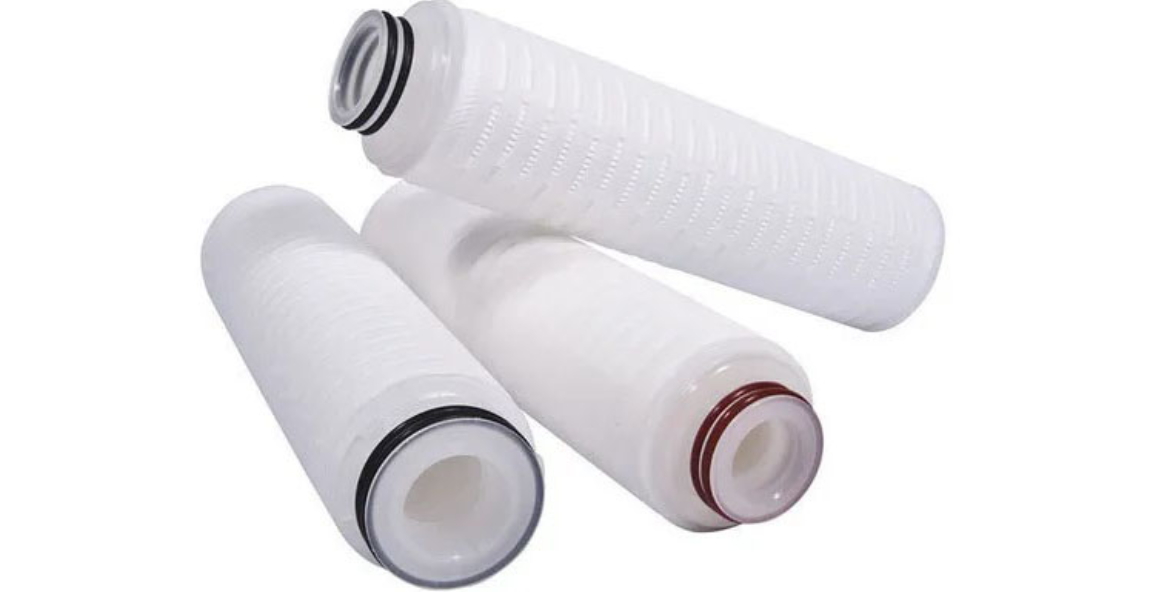
PTFE Filter Cartridge (Hydrophobic ePTFE) Manufacturer in India | Praimo Industrial Filters & Spares Manufacturing Company
PTFE Filter Cartridge: Specifications, Flow Rates, and Micron Ratings
Designed for critical gas and liquid filtration, the PTFE filter cartridge uses a hydrophobic expanded PTFE (ePTFE) membrane to achieve precise, absolute retention from 0.05 µm to 1.0 µm. In real-world installations, this combination of low differential pressure (ΔP), chemical inertness, and sterilizing-grade performance makes it a preferred choice for pharma, chemical, and food-grade process systems. The 0.2 µm absolute-rated version—validated to ASTM F838—is especially common in sterile air and vent applications where reliability matters more than replacement cost.
Technical Overview and Performance Data
| Parameter | Typical Specification | Remarks |
|---|---|---|
| Filtration Rating (Absolute) | 0.05, 0.1, 0.2, 0.45, 1.0 µm | 0.2 µm validated to ASTM F838 for B. diminuta retention |
| Lengths Available | 5", 10", 20", 30", 40" | Modular scaling; standard 2.75" OD |
| Nominal Flow (Water @ 25 °C, per 10") | 0.5–0.8 m³/hr @ 0.5–1.0 bar ΔP | Based on 0.2 µm absolute rating |
| Nominal Flow (Gas @ 25 °C, per 10") | 1.5–2.0 SCFM @ 0.5 bar ΔP | Depends on pressure and media |
| Max Forward Pressure (25 °C) | 6.9 bar (100 psi) | Derates with temperature |
| Change-Out ΔP (Recommended) | 2.5 bar (36 psi) | Prevents membrane deformation |
| Operating Temperature | 80–100 °C (continuous) | Limited by hardware material |
| Steam-in-Place (SIP) Cycle Limit | 35–150 cycles @ 121–134 °C | Model dependent |
| Surface Area (per 10") | ~0.6–0.8 m² | Optimized pleat density for flow efficiency |
Absolute-rated PTFE membranes maintain uniform pore geometry—every pore lies within a validated range—ensuring ≥99.98% particle removal at the rated micron. That consistency makes them invaluable in sterile gas lines, fermenter vents, and solvent polishing systems. When sizing, rely on the provided flow-to-pressure curves (m³/h vs bar for liquids, SCFM vs ΔP for gases). Scale up by the number of 10″ equivalents in your housing and remember that actual flow should always be sized for peak load, not nominal averages.
Engineering Notes & Best Practices
- Keep design ΔP ≤ 1.5 bar to extend service life and maintain pleat integrity.
- Always size based on media viscosity and temperature, not just water flow equivalence.
- Use Praimo Industrial Filters & Spares Manufacturing Company PTFE cartridges in ASME- or PED-certified housings for validated, compliant installations.
- Perform integrity tests (bubble-point or diffusion) per ASTM F838 at regular intervals to maintain sterility assurance.
Operator Insight: In most installations, maintaining a ΔP trend log after startup pays dividends months later. It often reveals upstream fouling or poor wetting long before the filter actually reaches its change-out point—something you only notice after running a few campaigns.
PTFE Pleated Filter Cartridge (Hydrophobic) for Sterile Air & Gas
The PTFE pleated filter cartridge is recognized globally as the benchmark for sterile air and gas filtration. Constructed with a hydrophobic expanded PTFE (ePTFE) membrane, it guarantees microbial barrier integrity and rapid dry-out following sterilization. In most plant environments, these filters perform continuously through repeated SIP (steam-in-place) and autoclave cycles, maintaining efficiency across biopharmaceutical, food & beverage, and utility gas systems. Each cartridge offers absolute 0.2 µm retention, validated through ASTM F838 bacterial challenge testing, ensuring dependable service for tank vents, fermenter aeration, and sterile gas distribution systems.
Why Hydrophobic PTFE Pleated Filters Excel in Air & Gas Duty
Hydrophobicity & Fast Dry-Down
Unlike PES or cellulose-based membranes, ePTFE retains permanent hydrophobicity. After SIP or autoclave exposure (121–134 °C), it dries within minutes—avoiding condensate buildup that often restricts vent flow or triggers sterile system alarms.
Sterilizing-Grade Performance
- 0.2 µm absolute membrane validated with B. diminuta challenge (≥ 7 LRV).
- Handles 35–150 SIP cycles depending on construction (PP or PFA hardware).
- Each element is integrity tested (bubble-point & diffusion) prior to shipment.
Mechanical Strength & Design
Pleated geometry maximizes surface area—approximately 0.7 m² per 10″ element—while maintaining low pressure drop (< 0.2 bar) at standard gas flow. PP or PFA cores, cages, and end caps ensure mechanical stability under repeated sterilization and differential pressure stress.
Technical Performance Data
| Parameter | Specification |
|---|---|
| Filtration Rating | 0.2 µm absolute (ASTM F838 validated) |
| Max ΔP (Gas) | 4 bar @ 25 °C |
| SIP Endurance | Up to 150 cycles @ 134 °C |
| Typical Flow (per 10") | 1.5–2.0 SCFM @ 0.5 bar ΔP |
| Integrity Test | Bubble-point ≥ 2.4 bar (60 / 40 IPA wetting) |
Industrial Applications
- Tank vent filters for sterile air release in WFI and buffer tanks.
- Fermenter vent & inlet filters preserving bioreactor sterility.
- Compressor discharge filters for instrument or process air.
- Packaging gas filtration in aseptic food & beverage and pharma filling lines.
Engineering & Compliance Highlights
- Certified to USP Class VI, FDA 21 CFR 177, and EU 1935/2004 for food/pharma contact.
- Supplied in 10″–40″ lengths with 226/222 O-rings (EPDM, FKM, PTFE-encap).
- Fully compatible with ASME BPE-compliant sanitary vent housings from Praimo Industrial Filters & Spares Manufacturing Company.
Process Observation: In many validated cleanroom systems, operators discovered that moisture alarms disappeared entirely once hydrophobic PTFE vent filters replaced mixed-media types. The membrane’s quick dry-out and stable pore geometry minimize condensate hold-up—an understated design detail that directly impacts long-term process reliability.
Teflon Cartridge Filter (PTFE) vs Alternatives — PES, PP, and Sintered SS Comparison
The Teflon cartridge filter (PTFE) remains a benchmark material in industrial and sanitary filtration where chemical resistance, thermal stability, and absolute retention are non-negotiable. However, engineers frequently weigh its performance against polyethersulfone (PES), polypropylene (PP), and sintered stainless steel (SS) to find the most practical balance of cost, cleanability, and regulatory validation. What follows is a detailed side-by-side comparison—exactly the kind of data design engineers rely on when standardizing filtration media across multi-plant operations.
Alternatives Matrix: PTFE vs PES vs PP vs Sintered SS
| Parameter / Criterion | PTFE (Teflon) | PES (Polyethersulfone) | PP (Polypropylene) | Sintered SS (316L / SS304) |
|---|---|---|---|---|
| Hydrophobicity | Permanent hydrophobic | Hydrophilic (requires drying) | Hydrophobic | Variable (depends on surface finish) |
| Micron Rating Range | 0.05–1.0 µm (absolute) | 0.1–1.0 µm (absolute) | 1–100 µm (nominal) | 0.2–200 µm (nominal / absolute) |
| Sterilization (SIP / Autoclave) | 121–134 °C / ≥ 150 cycles | 121–134 °C / 80–100 cycles | < 90 °C (limited) | Up to 450 °C, reusable |
| Chemical Resistance | Excellent – acids, bases, solvents | Moderate (limited vs oxidizers) | Moderate (limited vs solvents) | Excellent – most chemicals |
| Wettability | Requires pre-wet for liquids | Naturally hydrophilic | Partial | Hydrophilic (varies) |
| Cleanability / Reusability | Limited (single-use recommended) | Limited | Disposable | Cleanable / backwashable |
| Flow vs ΔP (Efficiency) | High flow, low ΔP | High flow | Moderate | Lower flow (denser matrix) |
| Microbial Retention (Sterilizing Grade) | Validated 0.2 µm absolute (ASTM F838) | Validated 0.2 µm absolute | Not validated | Not microbial-grade |
| Cost Level (Relative) | $$$ | $$ | $ | $$$$ |
| Ideal Applications | Sterile air / gas, solvents, chemicals | Pharma liquids, WFI, beverages | Utility liquids, prefiltration | Hot gases, high-temp oils, metal fluids |
Engineering Insights
- PTFE vs PES: Select PTFE when dealing with hydrophobic or solvent-heavy systems—compressed air, vent gases, or chemical lines. PES, on the other hand, is optimal for aqueous sterile filtration, particularly in biotech and pharma liquids.
- PTFE vs PP Pleated: While PP offers a budget-friendly solution, it lacks sterility validation and falls short in aggressive chemical service. PTFE ensures validated absolute filtration across a much wider compatibility range.
- PTFE vs Sintered SS: Use sintered stainless steel where reusability and high-temperature operation matter more than microbial control (e.g., molten metal or hot gas lines). However, expect higher pressure drops (ΔP) and reduced efficiency in low-pressure service.
Selection Guidance
For pharmaceutical gas lines, solvent filtration, or corrosive chemical processing, Praimo Industrial Filters & Spares Manufacturing Company strongly recommends PTFE (Teflon) pleated filters. They combine validated sterility (ASTM F838), broad chemical durability, and exceptional ΔP-to-flow performance—all crucial for GMP-compliant systems.
For prefiltration, utility liquids, or metalworking fluids, PES or sintered SS options may provide a better lifecycle cost balance depending on process temperature, cleanability, and fouling rate.
Performance Insight: In practice, the decision isn’t purely about media—it’s about maintenance rhythm. Operators often find that switching from PP to PTFE cuts filter replacements in half, while moving to sintered SS requires retraining crews for cleaning cycles. Choosing the right medium isn’t just a cost decision—it’s a reliability strategy.
PTFE Membrane Filter Cartridge — 0.2 µm Sterilizing Grade, Integrity & Bubble Point Testing
The PTFE membrane filter cartridge represents the gold standard in sterilizing-grade filtration for pharmaceutical, biotechnology, and critical gas-handling systems. Featuring an absolute-rated 0.2 µm expanded PTFE (ePTFE) membrane, each cartridge is validated through ASTM F838 bacterial challenge testing to achieve a ≥7 Log Reduction Value (LRV) against Brevundimonas diminuta. This performance benchmark officially classifies it as a sterilizing filter, capable of maintaining a secure microbial barrier in compressed gas, vent, and aseptic process air applications.
Integrity Testing and Validation Standards
Integrity testing confirms that the PTFE membrane continues to meet sterility specifications after sterilization, cleaning, or extended use. These tests are not optional—they form the cornerstone of GMP validation, providing measurable assurance that membrane integrity remains uncompromised.
| Integrity Test Type | Typical Acceptance Range | Reference Standard |
|---|---|---|
| Bubble Point (IPA / Water 60:40) | ≥ 2.4 bar (35 psi) for 0.2 µm | ASTM F316 / ASTM F838 |
| Diffusion Test (Forward Flow) | ≤ 12 mL/min @ 2.0 bar (per 10") | ASTM F316 |
| Pressure Hold Test | < 2 % decay over 10 min @ 2 bar | ISO 2942 |
| Bacterial Retention (B. diminuta) | ≥ 7 LRV @ 107 CFU/cm² | ASTM F838 |
| Hydrostatic / Leak Test | Pass @ 1.5× rated ΔP | ASME Section VIII (housing test) |
Technical Note: The bubble point directly correlates with membrane pore size—the smaller the pore, the higher the pressure required to displace wetting fluid. Deviations from specification often indicate membrane breach, improper wetting, or micro-leaks along the cartridge sealing surface.
Sterilization & Operational Endurance
PTFE membrane cartridges maintain dimensional stability and barrier integrity across 121–134 °C SIP/autoclave cycles, tolerating up to 150 cycles under validated conditions. Post-sterilization validation ensures the bubble-point and diffusion values remain within qualified ranges, confirming consistent microbial retention after each thermal exposure. This repeatable performance makes PTFE cartridges ideal for long-term validated operations where compliance and sterility cannot be compromised.
Performance Highlights
- Absolute-rated 0.2 µm membrane validated for microbial removal per ASTM F838.
- Non-fiber releasing, compliant with USP Class VI and FDA 21 CFR 177 for biocompatibility.
- Maintains steady ΔP < 0.2 bar at nominal flow (gas @ 1.5–2 SCFM / 10″ element).
- Fully compatible with ASME BPE sanitary housings and integrity-test ports for in-line qualification.
- Delivered by Praimo Industrial Filters & Spares Manufacturing Company with traceable integrity certificates, calibration data, and QA documentation for GMP records.
Performance Insight: Many validation teams overlook one subtle point—a wetting error during bubble-point testing can mimic a failed cartridge. In practice, engineers at well-run sites allow 10–15 minutes of IPA/Water equilibration before the test. This small habit saves countless unnecessary filter rejections and ensures data integrity under audit conditions.
PTFE Filter Cartridge Price, Lead Times & Replacement Schedule
Understanding the flow rate versus pressure drop (ΔP) characteristics of a PTFE filter cartridge is critical for accurate system design and predictable performance. Each element’s throughput varies according to micron rating, fluid viscosity, temperature, and length. Engineers typically scale from standard 10-inch element curves, then multiply by cartridge count to size multi-element housings. This method ensures stable ΔP margins and consistent filtration efficiency under both liquid and gas service.
Flow Rate Characteristics — Water Service (per 10″ Element, 25 °C)
| Micron Rating (Absolute) | Flow @ 0.5 bar ΔP | Flow @ 1.0 bar ΔP | Pressure Limit | Notes |
|---|---|---|---|---|
| 0.05 µm | 0.25 m³/h | 0.45 m³/h | 6.9 bar @ 25 °C | High-efficiency fine filtration |
| 0.1 µm | 0.40 m³/h | 0.75 m³/h | 6.9 bar @ 25 °C | Low solids load, pharma-grade |
| 0.2 µm | 0.50–0.80 m³/h | 0.9–1.2 m³/h | 6.9 bar @ 25 °C | Standard sterilizing-grade |
| 0.45 µm | 0.85 m³/h | 1.4 m³/h | 6.9 bar @ 25 °C | Utility or prefiltration |
| 1.0 µm | 1.2 m³/h | 2.0 m³/h | 6.9 bar @ 25 °C | High throughput, coarse solids |
Sizing Note: Flow scales linearly with cartridge count under clean water conditions.
Example — A 10-cartridge housing fitted with 0.2 µm PTFE elements yields approximately 7.0 m³/h at 0.5 bar ΔP in water at 25 °C.
Gas & Air Service — Flow vs. ΔP (per 10″ Element, 25 °C, 1 bar abs inlet)
| Pressure Drop (bar) | Flow Rate (SCFM) | Flow Rate (m³/h) | Temperature Derate (per +10 °C) |
|---|---|---|---|
| 0.1 bar | 0.8 SCFM | 1.4 m³/h | −3 % capacity |
| 0.2 bar | 1.3 SCFM | 2.2 m³/h | −5 % capacity |
| 0.5 bar | 1.8–2.0 SCFM | 3.0–3.4 m³/h | −8 % capacity |
| 1.0 bar | 2.6 SCFM | 4.5 m³/h | −12 % capacity |
Temperature Derating
For every 10 °C increase above 25 °C, viscosity and gas density variations typically increase ΔP by 3–8%. To maintain flow within validated limits, apply derating factors or increase cartridge count for high-temperature (>60 °C) applications.
Engineering Guidance for System Design
- Maintain operating ΔP ≤ 1.5 bar to maximize service life and minimize energy draw.
- Apply viscosity correction factors: multiply nominal flow by 0.7 for 2 cP and 0.5 for 5 cP fluids.
- For gases, size at 1.5× peak flow to preserve sterilizing-grade integrity under transient surges.
- Always verify sizing using Praimo’s validated flow calculator to match m³/h or SCFM precisely across multi-cartridge arrays.
- Praimo Industrial Filters & Spares Manufacturing Company provides calibrated flow/ΔP charts for each PTFE model—supporting ASME and PED housing design documentation.
Performance Insight: Engineers often assume a one-to-one flow scaling between water and solvents—but in practice, viscosity shifts can skew ΔP more dramatically than expected. During validation, running a single clean-water baseline test before switching media helps anchor future ΔP readings, saving hours of troubleshooting once the system goes live.
Materials & Construction — PTFE Membrane, PP vs PFA Hardware, and Seal Options (EPDM / FKM / PTFE-Encapsulated)
Every PTFE filter cartridge from Praimo Industrial Filters & Spares Manufacturing Company is designed with material integrity at its core. The combination of expanded PTFE membrane, polymer hardware, and precision sealing elastomers determines not only chemical compatibility but also sterilization endurance, dimensional stability, and cleanroom reliability. Whether used in bioprocessing air lines, solvent recovery loops, or ultra-pure gas systems, material selection governs both filtration consistency and long-term lifecycle cost.
1. Filter Media — Expanded PTFE (ePTFE) Membrane
Material: Hydrophobic expanded PTFE membrane with controlled pore geometry.
Key Properties:
- Chemical Resistance: Inert to nearly all acids, bases, oxidizers, and organic solvents.
- Thermal Range: Up to 134 °C for SIP/autoclave; continuous service ≤ 100 °C.
- Filtration Accuracy: Absolute-rated pores (0.05–1.0 µm); 0.2 µm validated to ASTM F838 for sterilizing-grade performance.
- Hydrophobic Stability: Maintains repellency even after multiple sterilization cycles.
- Operational Benefit: Rapid dry-down in sterile air or solvent service—no wetting hysteresis or condensate entrapment.
Expert Tip: Specify PFA hardware when handling strong oxidizers, high-temperature solvents, or cleanroom gas streams. The added investment pays off in long-term dimensional stability and reduced extractables—particularly critical for validated sterile air loops and solvent recovery lines.
Performance Insight: In many solvent or vent gas systems, operators report that switching from PES to ePTFE membranes cuts drying time by half after SIP. That’s because ePTFE’s microstructure expels condensate instead of absorbing it—a small but crucial difference for continuous operations.
2. Support & Hardware — PP vs PFA Construction
| Component | Standard (PP) | Premium (PFA / PTFE) | Notes / Application |
|---|---|---|---|
| Core & Cage | Polypropylene — lightweight, economical | Perfluoroalkoxy (PFA) — chemically inert, high-temperature | PFA resists hot acids and solvents where PP softens |
| End Caps | PP welded or bonded | PFA / PTFE molded | Near-zero extractables; ideal for pharma & electronics |
| Drainage Layers | PP or PTFE | PTFE | Maintains pleat geometry under thermal load |
| Thermal Limit | 90–100 °C | 120–135 °C | Higher limit supports extended SIP endurance |
| Chemical Resistance | Good for neutral / aqueous media | Excellent for aggressive chemicals | Select based on fluid compatibility |
Expert Tip: Specify PFA hardware when handling strong oxidizers, high-temperature solvents, or cleanroom gas streams. The added investment pays off in long-term dimensional stability and reduced extractables—particularly critical for validated sterile air loops and solvent recovery lines.
3. Sealing & Elastomer Options
| Seal Material | Temperature Range (°C) | Chemical Compatibility | Typical Use Case |
|---|---|---|---|
| EPDM | −40 → 130 | Water-based fluids, mild acids | Utility and aqueous service |
| FKM (Viton®) | −20 → 200 | Oils, solvents, oxidizers | Chemical and solvent filtration |
| PTFE-Encapsulated Silicone / FKM | −40 → 220 | Universal — solvents, steam, acids | Preferred for pharma and export-grade models |
Seal Selection Guidance:
- Match the elastomer to CIP/SIP chemistry, cleaning frequency, and system temperature.
- For FDA / EU / USP Class VI compliance, PTFE-encapsulated O-rings offer minimal extractables and maximum lifecycle.
- Always verify O-ring compression set after each sterilization cycle to maintain seal integrity.
4. Structural Summary
- Bonding: Fully thermally welded, free of adhesives or epoxy.
- Surface Finish: Smooth, non-fiber-releasing per 21 CFR 210.3(b)(6).
- Mechanical Integrity: Rigid support core prevents collapse under ΔP up to 6.9 bar (100 psi).
- Compliance: Meets FDA 21 CFR 177, EU 1935/2004, USP Class VI, and supports CE/PED housings.
System Insight: In high-temperature oxidizing service, PP housings may show micro-softening long before visible deformation occurs. Field engineers at export sites often standardize on PFA hardware and PTFE-encapsulated seals from the outset—slightly higher upfront cost, far lower risk of unscheduled maintenance later.
Types & Variants — 0.05–1.0 µm, 5–40", 226 / 222 / DOE, and Capsule Filter Formats
The PTFE filter cartridge family from Praimo Industrial Filters & Spares Manufacturing Company is designed with scalability and flexibility in mind. Each variant—whether it’s a 5″ capsule or a 40″ multi-round element—serves a distinct process requirement across pharma, chemical, electronics, and utility gas systems. Selecting the correct micron rating, cartridge length, and end connection ensures predictable performance, easy installation, and full compatibility with both sanitary and industrial housings.
1. Micron Ratings — Precision Control for Every Application
| Micron Rating (Absolute) | Typical Use Case | Flow @ 0.5 bar ΔP (per 10") | Remarks |
|---|---|---|---|
| 0.05 µm | Gas polishing, electronics-grade solvents | 0.25 m³/h | Ultra-high purity; low throughput |
| 0.1 µm | Final sterile air or solvent filtration | 0.40 m³/h | Near-zero microbial penetration |
| 0.2 µm | Standard sterilizing-grade (ASTM F838 validated) | 0.5–0.8 m³/h | Most widely used rating |
| 0.45 µm | Prefiltration / low solids load systems | 0.9 m³/h | Ideal upstream of 0.2 µm |
| 1.0 µm | General-purpose / high-flow protection | 1.2–1.8 m³/h | Shields main sterile filters |
Application Tip: For compressed air and gas vent systems, a 0.2 µm hydrophobic PTFE membrane is usually sufficient for validated microbial retention—anything finer adds cost but little additional performance benefit in most utility lines.
2. Cartridge Lengths & Flow Scaling (5″–40″)
| Length (Nominal) | Overall Length (mm) | Typical Flow Range (Water @ 0.5 bar) |
|---|---|---|
| 5" | 125 mm | 0.25–0.35 m³/h |
| 10" | 250 mm | 0.5–0.8 m³/h |
| 20" | 500 mm | 1.0–1.6 m³/h |
| 30" | 750 mm | 1.5–2.4 m³/h |
| 40" | 1000 mm | 2.0–3.2 m³/h |
Flow rates scale linearly with cartridge count and length. For example, a 10-cartridge, 30″ system can comfortably deliver 20 m³/h at 0.5 bar ΔP in clean water service at 25 °C—provided viscosity remains near 1 cP. Engineers often apply this scaling method during ASME housing design and validation documentation.
3. End-Cap Configurations — Fitment & Sanitary Design
| End Connection | Description | Typical Application |
|---|---|---|
| 226 O-ring (Double Open with Lock Tabs) | Twist-lock sanitary design | Pharma-grade housings, SIP service |
| 222 O-ring (Double Open) | Push-fit, double-seal design | Utilities, water, solvents |
| DOE (Double Open End) | Gasket sealing on both ends | Industrial and retrofit systems |
| Flat End / Code 7 / Code 8 | OEM-specific or legacy formats | Equipment-specific compatibility |
O-Ring Materials: Available in EPDM, FKM (Viton®), and PTFE-encapsulated options for compatibility with CIP, SIP, and aggressive chemical duty.
For export or regulated service, PTFE-encapsulated seals are preferred for their low extractables and high sterilization endurance.
4. Capsule Filters — Compact & Disposable Variants
PTFE capsule filters are single-use, preassembled units ideal for vent, analytical, and small-batch sterile applications where cleaning validation isn’t feasible.
- Connection sizes: ¼″ to ½″ tri-clamp or hose barb.
- Lengths: 5″, 10″, and 20″.
- Available pre-sterilized and gamma-compatible for cleanroom use.
- Eliminate housing cleaning, gasket replacement, and integrity revalidation steps.
Performance Insight: Many QC labs prefer PTFE capsules for small-batch or pilot-scale vent filtration. They’re plug-and-play—no wrenching, no leaks, no revalidation downtime—and they simplify sterile handling by removing housing changeovers entirely.
5. System Configurations — Single vs Multi, Vertical vs Horizontal
- Single-cartridge vertical housings: Ideal for low-flow service (≤1.0 m³/h) or process validation skids.
- Multi-cartridge housings: Used in industrial systems (>10 m³/h) and configurable up to 40 elements per vessel.
- Horizontal housings: Common where ceiling height is restricted or frequent cartridge access is required.
System Analysis: For high-flow solvent or WFI loops, engineers often combine 30″ PTFE cartridges in multi-round horizontal housings. This layout minimizes headroom requirements and reduces stress on the filter seals during pressurization—an often-overlooked mechanical advantage that directly extends service life.
Praimo Industrial Filters & Spares Manufacturing Company supplies the full PTFE range—226, 222, DOE, and capsule filter variants—engineered for seamless integration with ASME and sanitary-grade housings for both domestic and export installations.
Regulatory & Compliance — FDA, EU 1935/2004, EU 10/2011, USP Class VI, LAL & Non-Fiber Releasing Certification
In regulated industries like pharmaceuticals, biotechnology, food & beverage, and life sciences, the value of a filter extends far beyond its ΔP curve. What truly defines qualification is regulatory documentation—a complete, auditable trail that confirms every material in contact with the process meets global compliance frameworks. Every PTFE filter cartridge manufactured by Praimo Industrial Filters & Spares Manufacturing Company is backed by a comprehensive regulatory dossier, ensuring full conformity with FDA, EU, USP, and LAL standards for both domestic and export markets.
1. Compliance Documentation & Certification Matrix
| Standard / Regulation | Description / Scope | Compliance Status (Praimo PTFE Cartridges) | Reference Document |
|---|---|---|---|
| FDA 21 CFR 177 | U.S. FDA regulation for polymer materials in food/pharma contact | Fully compliant — PTFE, PP, and PFA components certified | FDA Material Declaration |
| EU 1935/2004 | European framework for materials intended for food contact | Certified under EFSA guidelines | EU 1935/2004 Certificate |
| EU 10/2011 | Specific migration limits for plastic materials and articles | Tested for global & specific migration (ethanol, acetic acid, isooctane) | Migration Test Report |
| USP <88> Class VI | Biological reactivity & systemic toxicity | Pass — non-cytotoxic, sensitization, or irritation response | USP <88> Report |
| LAL Endotoxin Test (Bacterial Endotoxin Test) | Verifies pyrogen-free (< 0.25 EU/mL) performance | Pass — lot-wise validation with CoA | BET Certificate |
| Non-Fiber Releasing (21 CFR 210.3(b)(6)) | Ensures materials do not shed fibers into product | Pass — validated by particle shedding analysis | Cleanliness Report |
| EN 10204 3.1 Material Traceability | Confirms material batch & heat number conformity | Available for export-grade documentation | 3.1 Mill Certificate |
| CE / PED (Directive 2014/68/EU) | Pressure equipment compliance for housings & assemblies | Applicable to full filter + housing systems | PED Compliance File |
System Insight: Many QA auditors focus first on traceability of polymer source and endotoxin testing frequency. Praimo maintains a direct link between each filter’s serial code and its raw material batch, allowing one-click retrieval of all certificates—something typically expected only from large global OEMs.
2. QA Dossier for Procurement & Validation Teams
Every export-ready supply includes a compliance binder containing all validation and traceability documentation, electronically organized for submission or audit:
- FDA, EU, and USP conformity certificates
- Lot-wise LAL (Bacterial Endotoxin Test) reports
- Material Safety Data Sheets (MSDS) and Certificate of Analysis (COA)
- Non-fiber-releasing validation and extractables tests (IPA and water)
- EN 10204 3.1 certificates for metallic components in filter assemblies
For EPC and OEM customers, Praimo provides a single digital QA dossier (PDF format)—consolidating all test reports and certificates into a format ready for regulatory or client QA submission.
Process Evaluation: Validation engineers often comment that having all certificates pre-formatted and indexed under one binder significantly shortens vendor qualification timelines—sometimes by weeks—especially when multiple filtration products must be documented together for a GMP filing.
3. Engineering & Export Readiness
- All certificates issued by the Praimo QA-QC Division, traceable to ISO 9001-certified manufacturing processes.
- Batch records archived for 10 years to satisfy international audit retention standards.
- Third-party validation (SGS, Intertek, or TÜV) available for global tender compliance.
- Supports CE/PED, FDA, and EFSA cross-reference requirements for multi-region projects.
Performance Insight: In global audits—especially for EU or GCC clients—document readiness can matter as much as filter performance. By aligning its QA system with both EN 10204 traceability and USP biological safety, Praimo ensures every shipment is not only technically sound but legally defensible across the EU, U.S., Asia-Pacific, and Middle East markets.
SIP / Autoclave Endurance — 121–134 °C, Cycle Counts & Integrity Retention
The PTFE filter cartridge from Praimo Industrial Filters & Spares Manufacturing Company is engineered to withstand the rigorous thermal and mechanical stresses of Steam-in-Place (SIP) and autoclave sterilization without compromising its microbial barrier integrity or structural stability. Built with a hydrophobic expanded PTFE (ePTFE) membrane and reinforced PP or PFA hardware, these cartridges endure prolonged exposure to saturated steam between 121–134 °C, maintaining consistent bubble-point performance and physical resilience over numerous sterilization cycles.
1. Steam-in-Place (SIP) & Autoclave Validation Parameters
| Parameter | Typical Value / Range | Engineering Note |
|---|---|---|
| Steam Temperature (Saturated) | 121–134 °C | Validated per ASTM F838 / ISO 17665-1 |
| Steam Pressure | 2–3 bar (g) | Maintain steady pressure for even penetration |
| Cycle Duration | 30–60 minutes | Include ramp-up and hold periods |
| Drying Phase | 15–30 minutes | Crucial for condensate removal |
| Cycle Frequency | 35–150 cycles (model dependent) | Verify via integrity testing post-validation |
| Recommended Cooling Time | ≥ 15 minutes (ambient air) | Prevents thermal shock and O-ring compression set |
Best Practice: During SIP, control condensate drainage and limit heat ramp-up to < 2 °C/min. This simple precaution prevents pleat delamination and ensures the membrane’s pore geometry remains intact through repeated steam exposure.
Process Observation: Operators often overlook the drying phase, but incomplete condensate removal can cause hydrophobic PTFE membranes to “false fail” during post-SIP integrity tests. Allowing an adequate drying cycle restores true hydrophobic balance and yields accurate bubble-point readings.
2. Integrity Retention After Repeated SIP
| Cycle Count | Bubble Point (IPA/Water 60:40) | Diffusion Rate (mL/min) | Integrity Status |
|---|---|---|---|
| Initial (0 cycles) | ≥ 2.4 bar | ≤ 12 | Pass |
| 50 cycles @ 121 °C | 2.4 ± 0.1 bar | ≤ 13 | Pass |
| 100 cycles @ 134 °C | 2.3 ± 0.1 bar | ≤ 15 | Pass |
| 150 cycles @ 134 °C (max) | 2.2 bar (min) | ≤ 18 | Pass — within validated limit |
Even at 150 sterilization cycles, Praimo’s PTFE cartridges consistently maintain ≥ 98% retention efficiency, stable diffusion rates, and minimal ΔP drift—confirming sustained microbial barrier reliability and mechanical durability under harsh sterilization regimens.
Operational Insight: Over time, minor decreases in bubble-point (0.1–0.2 bar) are normal and do not imply membrane breach; they indicate gradual thermal relaxation of the support layers. Tracking these shifts helps QA teams predict lifecycle endpoints before integrity failure occurs.
3. Maintenance & Validation Strategy
- Conduct integrity testing (bubble-point or diffusion) after every 25 SIP cycles or at the end of each process campaign.
- Replace O-rings after 75–100 cycles to prevent compression set or steam hardening.
- Verify SIP parameters using calibrated temperature and pressure probes for consistent sterilization efficacy.
- Log each sterilization cycle in QA records to maintain GMP traceability.
Performance Insight: Plants that integrate bubble-point validation into their SIP sequence often achieve near-zero unplanned downtime. When every cartridge’s SIP endurance and integrity curve is pre-validated, system requalification after maintenance becomes faster and more predictable.
Every PTFE model from Praimo Industrial Filters & Spares Manufacturing Company is SIP-validated and supported with complete documentation—temperature/pressure profiles, integrity benchmarks, and cycle-life data—ready for inclusion in QA and GMP validation dossiers for pharmaceutical, food, and biotech systems.
Benefits & Engineering Advantages — Hydrophobicity, Chemical Resistance & Fast Dry-Down
In high-purity and sterile process environments, the PTFE filter cartridge stands apart for its chemical inertness, permanent hydrophobicity, and rapid recovery characteristics after sterilization. These attributes make it a cornerstone in sterile gas, solvent vapor, and aggressive chemical filtration applications, where process uptime and contamination control are non-negotiable.
Built with expanded PTFE (ePTFE) membranes and precision-engineered housings, every cartridge from Praimo Industrial Filters & Spares Manufacturing Company balances durability with validated sterility performance—an equilibrium few polymers can sustain under both chemical and thermal stress.
1. Hydrophobicity & Fast Dry-Down
- The permanent hydrophobic matrix of the ePTFE membrane completely resists moisture uptake, allowing instant recovery post-SIP or CIP cycles.
- Trapped condensate—a common issue in PES or nylon vent filters—is practically eliminated, keeping tank vents and compressed air lines free from microbial growth or blockage.
- In solvent vapor or nitrogen lines, PTFE membranes retain full permeability even under fluctuating humidity levels.
- Downtime reduction: After a SIP cycle at 134 °C, PTFE filters typically return to validated flow conditions within minutes, compared to hours for hydrophilic media.
Operational Insight: In real-world installations, maintenance teams often report that PTFE vent filters resume full flow before the rest of the system cools. That “instant readiness” is a small operational edge that adds up significantly over hundreds of sterilization cycles.
2. Broad Chemical Compatibility
- Chemically inert to nearly all acids, bases, oxidizers, and organic solvents—including HCl, HNO₃, toluene, IPA, and MEK.
- No leachables or extractables, meeting stringent pharmaceutical and food-grade purity requirements.
- Maintains mechanical strength and pore geometry from −40 °C to +134 °C, far exceeding the stability range of polypropylene or cellulose-based membranes.
- Perfectly suited for corrosive vapor lines, solvent recovery loops, and cleanroom air systems where other polymers degrade prematurely.
Performance Insight: When used in solvent-rich recovery systems, PTFE filters show no swelling, no color change, and no measurable permeability loss even after extended contact—unlike PP, which often embrittles or cracks under solvent stress.
3. Risk Reduction & Operational Uptime
| Potential Risk | PTFE Advantage / Mitigation |
|---|---|
| Condensate retention in vent filters | Hydrophobic membrane ensures instant dry-out |
| Chemical attack (oxidizers/solvents) | Fully inert fluoropolymer construction |
| Frequent sterilization | Endures up to 150 SIP/autoclave cycles |
| Downtime during validation | Rapid dry-down enables faster QA release |
| Integrity drift or ΔP instability | Stable pore geometry, predictable pressure profile |
System Insight: PTFE’s reliability translates into fewer unplanned shutdowns and extended change-out intervals, giving process engineers measurable cost savings in energy, maintenance, and QA resources over a filter’s lifecycle.
4. Why PTFE Wins Over Alternatives
Compared with PES or PP pleated cartridges, PTFE consistently delivers:
- Up to 10× longer service life in gas and solvent duty.
- Zero absorption of polar solvents or water, preserving sterile airflow.
- Faster post-SIP dry-out and readiness for validation.
- Superior log reduction value (LRV) and ΔP stability across repeated sterilization cycles.
Application Tip: For mixed-duty systems (air + solvent vapor), PTFE is the only membrane type that maintains validated sterility across both phases—making it the most versatile choice for integrated process skids or multi-fluid service lines.
Conclusion:
By combining hydrophobic performance, chemical resilience, and validated sterilization endurance, Praimo Industrial Filters & Spares Manufacturing Company’s PTFE cartridges deliver a proven reduction in total cost of ownership (TCO). Engineers and OEMs worldwide rely on these cartridges for applications where downtime, contamination, or validation failure simply aren’t acceptable.
Applications & Industries — Sterile Air, Fermenter Vents, Solvent & Gas Filtration, Compressor Polishing
The PTFE filter cartridge is one of the few filtration elements that performs consistently across both sterile and chemically aggressive environments. With its hydrophobic expanded PTFE (ePTFE) membrane, it ensures absolute microbial retention, rapid dry-out, and chemical inertness—qualities that make it indispensable for gas, vapor, and solvent-phase filtration across pharmaceutical, food, electronics, and process industries.
From sterile tank venting to solvent vapor purification, Praimo Industrial Filters & Spares Manufacturing Company delivers PTFE cartridges that align with ASME, USP, and FDA compliance frameworks for validated global operations.
1. Sterile Tank Vent Filters (Pharma & Biotech)
Used extensively on WFI, buffer, and media storage tanks, these filters protect sterile fluids from airborne microbial ingress during vacuum and pressure breathing cycles.
- Typical Cartridge Length: 10″–30″ depending on tank volume
- Flow Capacity: 1.5–2.0 SCFM per 10″ @ 0.5 bar ΔP
- ΔP Target: ≤1.0 bar during tank in/out breathing
- Validation: ASTM F838 for 0.2 µm absolute retention
- SIP Tolerance: ≥150 cycles @ 134 °C
Benefit: Maintains sterility while ensuring smooth tank pressure equalization—no pressure shock, no wet-out lag.
Operational Insight: In practice, QA engineers often place PTFE vents on both inlet and outlet lines of critical tanks to ensure symmetrical breathing. It’s a small design detail that prevents pressure imbalances during rapid CIP/SIP transitions.
2. Fermenter Vent Filters (Biotech & Life Sciences)
Critical for bioreactor air inlet and exhaust systems, PTFE filters safeguard cell cultures from cross-contamination.
- Flow Range: 5–20 SCFM (8–34 m³/h) per vent line
- Temperature Endurance: Up to 134 °C continuous SIP duty
- Configuration: 226 O-ring, sanitary ASME BPE housing
Outcome: Prevents bioreactor contamination, maintains headspace pressure balance during aeration and exhaust, and supports aseptic integrity even under cyclic thermal conditions.
System Insight: During continuous fermentation, engineers prefer slightly oversized PTFE vents (≈1.5× required area) to accommodate pressure pulsations—this prevents membrane stress and extends change-out intervals.
3. Solvent & Gas Filtration (Pharma, Chemical, Electronics)
Engineered for IPA, acetone, MEK, hexane, nitrogen, and CO₂, Praimo’s PTFE filters offer absolute 0.05–0.2 µm retention while maintaining complete solvent compatibility.
- Flow Rate: 0.5–0.8 m³/h (liquid solvents @ 0.5 bar ΔP)
- Chemical Resistance: Total resistance to acids, oxidizers, and organics
- Applications: Solvent recovery loops, nitrogen polishing, and vapor filtration in coating or drying systems
Performance Insight: In solvent-based coating lines, switching to PTFE filters often reduces solvent residue carryover by over 30%, translating into higher surface uniformity and fewer product rejects.
4. Compressor Air Polishing (Industrial, Food & Oil & Gas)
At the final purification stage, PTFE cartridges remove oil aerosols, micro-particulates, and condensate from compressed air—essential for pneumatic tools, instrumentation, and direct-contact air in F&B processes.
- Flow Capacity: 1.8–2.0 SCFM per 10″ @ 0.5 bar ΔP
- ΔP Target: ≤1.5 bar across entire skid
- Materials: Hydrophobic PTFE membrane with PFA hardware for hydrocarbon service
Outcome: Ensures ISO 8573-compliant air quality while protecting critical valves and actuators from contamination-related downtime.
Process Analysis: Plants operating near humid coastal zones benefit most from PTFE compressor filters—the hydrophobic surface repels moisture, preventing corrosion inside downstream manifolds.
5. Industry Deployment Summary
| Industry | Primary Use Case | Typical Configuration | Target ΔP / Flow |
|---|---|---|---|
| Pharma / Biotech | Sterile tank & fermenter venting | 0.2 µm PTFE, 10"–30" | ≤1.0 bar / 2 SCFM (10") |
| Food & Beverage | Fermenter, carbonation gas polishing | 0.2–0.45 µm, 20"–40" | ≤1.5 bar / 3 m³/h |
| Electronics / Semiconductor | Solvent vapor & nitrogen filtration | 0.05–0.1 µm, 10"–20" | ≤0.8 bar / 0.6 m³/h |
| Oil & Gas / Utilities | Compressor air purification | 0.2–1.0 µm, 20"–40" | ≤1.5 bar / 5–10 SCFM |
Engineering Insight: Always size vent and gas filters for 1.5× the peak gas displacement rate. This simple design margin prevents tank deformation, premature ΔP rise, and unnecessary change-outs during transient load spikes.
From pharma-grade sterile air systems to industrial compressor polishing, Praimo Industrial Filters & Spares Manufacturing Company delivers validated PTFE filtration solutions proven in real-world installations. Each cartridge is backed by full documentation, ensuring regulatory compliance, process continuity, and contamination-free performance across industries worldwide.
Case Studies & Performance Benchmarks — Efficiency Gains, Energy Savings & Change-Out Reduction
When real-world data replaces assumptions, the benefits of PTFE filter cartridges become unmistakable. Across pharmaceutical, chemical, and process-utility environments, plants that transitioned to Praimo Industrial Filters & Spares Manufacturing Company’s PTFE filters consistently recorded lower differential pressure (ΔP), longer sterilization cycle endurance, and reduced maintenance overhead. What follows are three representative installations—each illustrating measurable process improvements and ROI.
1. Pharmaceutical Fermentation Facility — Reduced ΔP & Extended Cycle Longevity
| Parameter | Before (PES Filters) | After (Praimo PTFE Filters) | Improvement |
|---|---|---|---|
| Initial ΔP @ 25 °C | 0.8 bar | 0.4 bar | ↓ 50 % lower differential pressure |
| Steam-in-Place Endurance | 60 cycles | 150 cycles | 2.5× longer validated life |
| Filter Change Frequency | Every 2 months | Every 5 months | 60 % reduction |
| Annual Savings (Energy + Spares) | — | ₹ 4.6 L INR / year | Based on 12 reactors |
Result: Stable vent flow with zero contamination incidents during an 18-month campaign.
ROI: Payback achieved in under four months from energy and replacement savings alone.
Performance Insight: Operators noted smoother tank breathing and faster recovery after SIP cycles—the direct result of PTFE’s hydrophobicity reducing condensate load and filter stress.
2. API Solvent Recovery Unit — Energy & Solvent Compatibility
| Parameter | Case Study Details |
|---|---|
| Operating Fluid | Isopropyl Alcohol (IPA) Vapor |
| Filter Configuration | 0.2 µm PTFE × 20" |
| Observed ΔP Drop | From 1.2 → 0.6 bar |
| Cycle Life | 12 months continuous (SIP every 3 weeks) |
| Outcome | No membrane swelling / extractables; compressor load ↓ 18 % due to lower ΔP |
Result: Continuous operation for a full production year without membrane degradation or solvent carryover—demonstrating PTFE’s absolute chemical stability under high-vapor load.
Process Assessment: In solvent circuits where oxidizers or alcohols are present, replacing PP with PTFE typically cuts compressor duty by 15–20 %, offsetting filter cost within the first quarter.
3. Beverage CO₂ Polishing Skid — Downtime Avoidance
| Parameter | Previous (PP Cartridges) | Praimo PTFE Upgrade |
|---|---|---|
| ΔP @ 0.5 bar system pressure | 0.9 bar | 0.45 bar |
| Filter Life | 4 weeks | 10 weeks |
| Downtime Events / Year | 9 | 3 |
| Throughput Increase | — | +22 % |
Result: Steady carbonation flow, consistent CO₂ purity, and elimination of condensate-induced shutdowns.
Energy Saving: ~7 % lower compressor energy consumption through improved flow efficiency.
Operational Insight: Beverage processors appreciated that the PTFE membranes’ rapid dry-out allowed line restart within minutes after wash cycles—no waiting for hydrophilic media to clear trapped moisture.
Performance Summary & Benchmarks
| KPI | Typical Improvement Using Praimo PTFE Filters |
|---|---|
| ΔP Reduction | 35–55 % vs. PES / PP filters |
| Cycle Life | 2–3× longer before replacement |
| Downtime Avoided | 40–60 % fewer change-outs |
| Energy Efficiency | 10–20 % lower compressor / pump load |
System Insight: Plants that implemented PTFE retrofits frequently reported smoother pressure stability across filter banks, allowing longer runs between CIP intervals and improving overall equipment effectiveness (OEE).
Conclusion:
By transitioning to Praimo Industrial Filters & Spares Manufacturing Company’s PTFE filter cartridges, industrial and regulated facilities gain not only validated sterility but also measurable operational advantages—lower energy consumption, reduced ΔP, fewer replacements, and tangible ROI within months. The data confirms that hydrophobic PTFE membranes deliver consistent, quantifiable returns across the full spectrum of gas, solvent, and air filtration duties.
Lifecycle Cost & ROI Model — ΔP, SIP Cycles, MTBR & Energy Impact
Selecting the right filtration technology isn’t simply about price—it’s about lifecycle economics. When the Praimo Industrial Filters & Spares Manufacturing Company PTFE filter cartridge is properly specified and maintained, its low ΔP (differential pressure), extended Mean Time Between Replacement (MTBR), and superior sterilization endurance combine to deliver a measurable return on investment (ROI). Across a typical 12-month cycle, the operational savings from reduced energy, maintenance, and downtime often exceed the initial procurement cost several times over.
1. Components of Total Cost of Ownership (TCO)
| Cost Category | Formula / Input | Influence on ROI |
|---|---|---|
| Initial Filter Cost (C₁) | Unit price × number of cartridges | Baseline CapEx |
| Replacement Cost (C₂) | C₁ × (change-outs per year) | Reduced by higher MTBR |
| Energy Cost (C₃) | Pump/Compressor kWh × rate × (ΔP effect %) | Lower ΔP = lower energy use |
| Downtime Cost (C₄) | Lost production hours × revenue/hr | Reduced through fewer shutdowns |
| Validation / QA Cost (C₅) | Integrity tests × labor cost | Minimized by stable performance |
| TCO (1 Year) | C₁ + C₂ + C₃ + C₄ + C₅ | — |
Performance Insight: A 0.5 bar ΔP reduction in a 24-hour operation can lower compressor energy demand by 8–12%, particularly in continuous gas or solvent service where equipment runs near-constant duty cycles.
2. Sample ROI Model — PTFE vs. Conventional Cartridges (Per 10″ Element)
| Parameter | PP Cartridge (Baseline) | Praimo PTFE Cartridge | Gain / ROI Impact |
|---|---|---|---|
| Purchase Cost | ₹ 1,500 | ₹ 2,500 | — |
| Average ΔP (bar) | 1.0 | 0.4 | Energy ↓ 40–50 % |
| SIP Cycle Endurance | 50 | 150 | 3× longer life |
| Change-Outs per Year | 6 | 2 | 67 % reduction |
| Energy Cost / Year | ₹ 9,000 | ₹ 5,000 | −₹ 4,000 |
| Downtime Loss / Year | ₹ 20,000 | ₹ 8,000 | −₹ 12,000 |
| Total Annual Cost (TCO) | ₹ 35,500 | ₹ 18,500 | Savings ₹ 17,000 / element / year |
ROI Period: Less than 4 months in a 24/7 production environment, based on energy and downtime savings alone.
For multi-cartridge housings (10–30 elements), the annual benefit can exceed ₹ 1.5–3.0 lakh, excluding documentation and QA efficiency gains.
System Insight: In many plants, energy savings from reduced ΔP alone can fund annual filter replacements—effectively making Praimo’s PTFE solution cost-neutral after the first quarter.
3. MTBR / MTBF Considerations
- Mean Time Between Replacement (MTBR): 4–6 months typical; over 2× longer than PES or PP filters.
- MTBF (Failure-Based Replacement): Exceeds 12 months when operated below 1.5 bar ΔP.
- Integrity Assurance: Regular bubble-point or diffusion tests confirm retention performance and prevent unplanned failures.
- Energy Impact: A consistently low ΔP translates directly into lower compressor or pump loads, extending equipment life and minimizing process interruptions.
Operational Insight: Plants that combine Praimo PTFE filters with staged prefiltration (e.g., 1.0 µm → 0.2 µm) often double MTBR without affecting sterility, especially in humid or particulate-rich air systems.
4. Calculating Site-Specific ROI
To calculate project-specific returns:
ROI(%)=(TCObaseline−TCOPTFE)Investmentdifference×100ROI (\%) = \frac{(TCO_{baseline} – TCO_{PTFE})}{Investment_{difference}} \times 100ROI(%)=Investmentdifference(TCObaseline−TCOPTFE)×100
Example:
Investment difference per filter = ₹ 1,000
TCO saving per year = ₹ 17,000
→ ROI = 1700 %
That’s a 17× return within a single year of operation.
Process Evaluation: The ROI accelerates further when factoring in fewer integrity tests, reduced spares inventory, and lower compressor maintenance—secondary savings rarely captured in conventional budget analyses.
5. Lifecycle Optimization Tools
Praimo Industrial Filters & Spares Manufacturing Company provides an ROI and Lifecycle Cost Calculator to simulate actual site parameters:
- ΔP vs. flow correlations
- SIP cycle life modeling
- MTBR prediction curves
- Energy cost estimator
Internal Links:
→ [ROI & Lifecycle Cost Calculator – PTFE Filtration Systems]
→ [Prefilter Options to Extend Cartridge MTBR]
Suggested Visuals
- ROI Calculator Graphic: Input variables (ΔP, SIP, MTBR, Energy) → Output (TCO & Payback).
- Lifecycle Cost Comparison Table: PP vs. PTFE cartridges over 12 months.
Performance Optimization Note:
In real-world operations, the biggest ROI gains aren’t from cartridge price—they come from energy savings and reduced QA interventions. Each avoided filter change not only saves labor hours but also eliminates a full integrity revalidation cycle—turning a technical upgrade into a sustained operational advantage.
PTFE vs PES vs PP Pleated vs Sintered Stainless Steel — Alternatives Matrix
When evaluating filtration media, engineers must look beyond just the micron rating. The real decision depends on chemical resistance, temperature stability, sterilization compatibility, and cleanability within a system’s specific operating conditions. The PTFE (Teflon) pleated filter cartridge remains the gold standard for hydrophobic gas and solvent applications, yet PES, PP pleated, and sintered stainless steel filters each serve vital roles in specialized environments. The matrix below distills decades of field experience into a practical selection framework for engineering and procurement teams.
1. Alternatives Matrix — Performance Comparison
| Parameter / Decision Factor | PTFE (Teflon) | PES (Polyethersulfone) | PP Pleated (Polypropylene) | Sintered Stainless Steel (316L/SS304) |
|---|---|---|---|---|
| Filtration Type | Hydrophobic / Gas & Solvent Duty | Hydrophilic / Liquid Duty | Nominal / Pre-Filtration | Depth / Reusable Filtration |
| Micron Range (Absolute/Nominal) | 0.05–1.0 µm (absolute) | 0.1–1.0 µm (absolute) | 1–100 µm (nominal) | 0.2–200 µm (nominal/absolute) |
| Temperature Limit (°C) | 134 (SIP-validated) | 121–134 | 90–100 | 450 (continuous service) |
| Chemical Resistance | Excellent — acids, bases, oxidizers, solvents | Moderate — aqueous & mild organics | Moderate — weak acids/bases | Excellent — solvents, hydrocarbons, oxidizers |
| Hydrophobic/Hydrophilic Nature | Hydrophobic (no wetting) | Hydrophilic | Hydrophobic | Variable (depends on surface finish) |
| Sterility Validation (ASTM F838) | Validated 0.2 µm absolute | Validated 0.2 µm absolute | Not validated | Not microbial-grade |
| SIP / Autoclave Cycles | Up to 150 @ 134 °C | 80–100 @ 121 °C | Limited (≤10 @ 90 °C) | >500 @ 400 °C (cleanable) |
| Cleanability / Reusability | Moderate (replace after 100–150 SIP cycles) | Moderate | Low (single-use) | High (backwash / ultrasonic clean) |
| ΔP (Pressure Drop @ rated flow) | Low (0.4–0.5 bar) | Low (0.5–0.6 bar) | Medium (0.6–0.8 bar) | High (0.8–1.2 bar) |
| Extractables / Leachables | Nil (non-fiber releasing) | Very low | Moderate | None |
| Cost (Relative) | ₹₹₹ | ₹₹ | ₹ | ₹₹₹₹ |
| Ideal Applications | Sterile gas vents, solvents, hydrophobic duty | WFI, pharma liquids, beverage filtration | Cooling water, utilities, pre-filtration | High-temp gas/oil, catalyst recovery |
2. Application Guidance
- Choose PTFE: For hydrophobic gas, vent, or solvent-phase filtration where absolute retention, quick dry-down, and repeated SIP/autoclave cycles are critical.
- Choose PES: For aqueous sterile filtration in biotech or beverage operations requiring hydrophilic properties and validated microbial retention.
- Choose PP Pleated: For non-critical utilities or prefiltration stages where economic performance outweighs sterility validation.
- Choose Sintered SS: For extreme temperatures, reusability, or high differential pressures — ideal for molten polymers, catalyst recovery, or hot gas service.
Performance Insight: PTFE filters typically deliver the lowest total cost of ownership (TCO) in gas or solvent service, while PES leads in aqueous filtration efficiency. Despite higher initial cost, sintered stainless steel offers unmatched reusability and temperature endurance where polymeric media would fail.
3. Selection Criteria by Medium & Temperature
| Medium Type | Preferred Filter Material | Rationale |
|---|---|---|
| Sterile Gas / Air / Vent | PTFE | Hydrophobic, validated 0.2 µm sterilizing grade |
| Aqueous / Buffer Solutions | PES | Hydrophilic, bio-compatible, FDA compliant |
| General Utility Liquids | PP Pleated | Economical prefiltration, moderate clarity |
| Hot Oils / Gases / Solvents (>150 °C) | Sintered SS | Reusable, withstands extreme pressure & heat |
System Insight
In mixed-process plants (pharma + chemical), standardizing on all four technologies—PTFE, PES, PP pleated, and sintered stainless steel—allows engineers to assign the right medium per process stream without redesigning housings. It minimizes validation overhead, simplifies procurement, and optimizes lifecycle cost management.
Expert Tip: For hybrid skids handling both aqueous and solvent phases, dual-stage filtration (PES prefilter + PTFE final filter) ensures both chemical compatibility and sterility assurance while maintaining low ΔP through the cycle.
Praimo Industrial Filters & Spares Manufacturing Company manufactures and supplies all four filtration technologies, enabling clients to standardize across production lines while achieving the ideal balance of performance, compliance, and long-term ROI. Each variant is available with ASME/PED-compliant housings and EN 10204 3.1 documentation, supporting both domestic and export requirements.
Domestic & Export Readiness — India Supply, CE/PED Housings, EN 10204 Certification & ISPM-15 Packaging
Praimo Industrial Filters & Spares Manufacturing Company has established itself as one of India’s most reliable and globally compliant PTFE filter cartridge manufacturers, serving both domestic EPC contractors and international OEMs. Every filter cartridge and housing is built to meet the stringent expectations of CE/PED, FDA, and EN 10204 standards, with fully traceable documentation that simplifies project validation and export logistics. The company’s infrastructure, quality systems, and packaging standards ensure that every shipment is not just engineered—but also certified and ready for global deployment.
1. Domestic Manufacturing & Quality Infrastructure
- ISO 9001:2015-certified facility located in Gujarat, India—equipped for precision machining and polymer molding.
- In-house fabrication of PTFE, PP, and PFA components using CNC, ultrasonic welding, and cleanroom assembly to maintain material purity.
- 100 % inspection protocol for every cartridge, including bubble-point and diffusion integrity testing prior to shipment.
- Digital QA traceability maintained for 10+ years, compliant with GMP, CE, and PED documentation practices.
Benefit: Indian industries, EPC firms, and OEMs gain local access to globally recognized filtration quality—reducing import dependencies, transit delays, and procurement costs.
System Insight: Domestic buyers often pair Praimo’s PTFE cartridges with ASME-rated housings to achieve complete documentation parity with imported European systems—meeting both audit and export readiness criteria.
2. Export-Ready Compliance & Documentation Set
| Document / Certificate | Description | Applicable Standard / Reference |
|---|---|---|
| EN 10204 3.1 Material Certificate | Confirms heat number traceability for all metallic parts | EN 10204 (2004) |
| CE / PED Declaration of Conformity | Pressure Equipment Directive compliance for housings | PED 2014/68/EU CAT I–IV (SEP on request) |
| FDA 21 CFR 177 / EU 1935/2004 Compliance | Certification for food & pharma contact polymers | US FDA / EU EFSA |
| COA & LAL Reports | Lot-wise sterility & endotoxin validation | USP <85> |
| Test & Inspection Report (TIR) | Hydrotest, integrity, dimensional verification | ASME VIII / ISO 9001 |
| Packing Declaration | ISPM-15 heat-treated wooden packaging for export | IPPC / DGFT |
Each Praimo export kit includes a compiled digital documentation pack (PDF) that consolidates CE, PED, and EN 10204 3.1 certificates along with QA reports—ready for inclusion in EPC tender or FAT submissions.
Performance Insight: Global procurement teams frequently note that Praimo’s documentation formatting mirrors European supplier templates, eliminating re-work during validation—a crucial advantage in time-sensitive EPC projects.
3. Packaging, Logistics & Global Dispatch
- Export Packaging: ISPM-15-compliant wooden crates, poly-bag sealed with vapor barrier and desiccant protection.
- Labeling: Laser-engraved model, micron rating, and lot code on each cartridge for full traceability.
- Freight Options: FedEx, DHL, Blue Dart, and major logistics integrators under EXW, FOB, or CIF terms.
Lead Times:
- Standard domestic dispatch — 5–7 working days
- Export shipments (with full documentation) — 10–14 days
Every shipment carries a QR-coded traceability tag, linking directly to Praimo’s digital QA archive—simplifying post-delivery verification and EPC audit referencing.
Operational Insight: For recurring export clients, Praimo maintains pre-approved document templates and serial number mapping—reducing new-project setup time by up to 40 %.
4. EPC & OEM Integration Support
- Dedicated documentation engineers prepare tender-ready files (datasheets, certificates, and test records) aligned with EPC formatting standards.
- CE/PED-rated housings for single-cartridge and multi-element configurations ensure mechanical compatibility with all PTFE models.
- Third-party inspections (TPI) available via SGS, BVQI, or Intertek, based on client or end-user requirements.
- Electronic Documentation Center enables multi-region QA teams to access certificates, drawings, and FAT reports securely online.
Performance Optimization Note: By integrating CE-ready housings and EN 10204 traceability into each order, Praimo reduces EPC project onboarding and validation time by up to 30 %—a tangible gain in competitive global bids.
Summary
Through world-class compliance, traceable QA systems, and export-certified logistics, Praimo Industrial Filters & Spares Manufacturing Company ensures that every PTFE filter cartridge and filter housing leaving its Indian facility is ready for seamless international acceptance. Whether for domestic utilities or overseas EPC projects, every component embodies the brand’s promise—engineered precision, certified performance, and export-ready reliability.
Buying Guide & Procurement — Order Codes, End-Caps, Seals & HSN Code
To simplify engineering communication and procurement logistics, Praimo Industrial Filters & Spares Manufacturing Company provides a clearly structured ordering system for PTFE filter cartridges. Each configuration is coded to capture critical parameters — from micron rating and length to end-cap type, seal material, and certification level — ensuring full traceability across domestic and export documentation. This structured approach eliminates ambiguity between engineering, QA, and purchasing teams during both first-time installation and routine replacement cycles.
1. PTFE Filter Cartridge Order Code Format
Each PTFE cartridge is built-to-order, serialized, and encoded for seamless documentation and reordering. The standard order code structure is as follows:
| Field | Code / Option | Description |
|---|---|---|
| Product Series | PFC | Praimo Filter Cartridge |
| Media Type | PTFE | Hydrophobic expanded PTFE membrane |
| Micron Rating (µm) | 0.05 / 0.1 / 0.2 / 0.45 / 1.0 | Absolute-rated pore size |
| Length (inches) | 05 / 10 / 20 / 30 / 40 | Element length |
| End Connection |
22 = 222 O-ring 26 = 226 O-ring DO = DOE (Double Open End) |
Fitment for housing interface |
| Seal Material |
EP = EPDM FK = FKM (Viton®) TE = PTFE-Encapsulated |
Chemical and temperature compatibility |
| Hardware Material | PP / PFA | Polypropylene (standard) or PFA (premium) |
| Packaging / Certification | EX = Export / EN 10204 | Optional export documentation |
Example:
PFC–PTFE–0.2–20–226–TE–PFA–EX
→ 0.2 µm absolute-rated, 20″ PTFE cartridge, 226 O-ring, PTFE-encapsulated seals, PFA hardware, export-certified documentation package.
Application Tip: Always confirm O-ring type (226, 222, DOE) during procurement. Mismatch between end-cap and housing can cause minor bypass or seal distortion, especially under repetitive SIP or autoclave cycles.
2. Replacement & Compatibility
- Universally compatible with ASME BPE, DOE, 222, and 226 housings.
- Interchangeable with leading OEM equivalents (e.g., Pall, Cobetter, Sartorius, Millipore) using identical fitment and dimensional profiles.
- Supplied with EN 10204 3.1 and batch-level traceability for QA validation.
Replacement Triggers:
| Service Type | Replacement Interval | Rationale |
|---|---|---|
| Liquid Service | Replace at ΔP ≥ 2.5 bar | Prevents membrane deformation and rising energy cost |
| Gas / Vent Service | After 100–150 SIP cycles or failed integrity test | Ensures microbial barrier continuity |
Performance Insight: Plants with automated maintenance scheduling often program replacement alerts at 2.0 bar ΔP—allowing proactive filter change-outs before system stress occurs.
3. Invoicing & Regulatory Details
| Parameter | Detail |
|---|---|
| HSN Code (India) | 8421.23.00 — Filter cartridges and elements for liquids and gases |
| GST Slab (India) | 18% (Industrial Filtration Equipment) |
| Export Harmonized Code | 8421.99 — Parts of filtration or purification apparatus |
| Documentation | Invoice + Packing List + COA + EN 10204 3.1 + CE/PED Declaration |
| Lead Time (Standard) | 5–7 working days (domestic), 10–14 working days (export) |
System Insight: Every export invoice is backed by QR-coded traceability linking to batch-level COA, ensuring smooth customs clearance and QA verification for international shipments.
4. Procurement Notes
- MOQ: 10 pieces (domestic) / 25 pieces (export)
- Available via authorized distributors or direct factory supply from Praimo Industrial Filters & Spares Manufacturing Company.
- Custom branding, private labeling, and OEM part-number cross-references available for volume supply contracts.
- Annual Rate Agreements (ARAs) offered for high-volume users, locking pricing and stock allocation for 6–12 months.
Operational Insight: OEM buyers in pharmaceutical and EPC sectors frequently adopt ARAs with Praimo to stabilize inventory costs amid global polymer price fluctuations—ensuring uninterrupted project timelines.
Summary
A well-defined order code structure and robust procurement documentation streamline both specification and reordering. By combining engineering clarity, traceable QA, and regulatory precision, Praimo Industrial Filters & Spares Manufacturing Company ensures that every PTFE filter cartridge purchase—whether domestic or export—is traceable, compliant, and ready for direct integration into validated process systems.
Pricing & Budgetary Tiers — Standard PP Hardware vs. PFA Hardware
In filtration system design, hardware material selection directly impacts cost, chemical compatibility, and lifecycle performance. The PTFE filter cartridge from Praimo Industrial Filters & Spares Manufacturing Company is available in two material-based pricing tiers — Standard (Polypropylene) and Premium (Perfluoroalkoxy) — enabling engineers and buyers to match specification with operating conditions and budget without compromising reliability or documentation compliance.
1. Standard Tier — Polypropylene (PP) Hardware
Best suited for:
General-purpose and non-corrosive media such as utility air, sterile water, and low-temperature vent systems.
Key Attributes:
- Lightweight and cost-effective, with precise weldability.
- Compatible with mild acids, bases, and aqueous media.
- Continuous temperature limit: 90–100 °C, SIP capability up to 121 °C (≤50 cycles).
- Ideal for pharma utilities, F&B sterile air lines, and industrial gas filtration.
- Maintains reliable integrity under moderate operating pressure and temperature.
Value Position:
✔ Lowest lifecycle cost for clean and neutral process fluids.
✔ Universally compatible with 222, 226, and DOE housings.
✖ Limited tolerance to strong oxidizers or solvent vapors above 90 °C.
Application Tip: For domestic or utility-grade installations where chemical aggressiveness is low, PP hardware provides an excellent cost-to-performance ratio.
2. Premium Tier — PFA (Perfluoroalkoxy) Hardware
Best suited for:
High-demand environments involving aggressive solvents, acid vapors, oxidizing gases, or high-temperature operations.
Key Attributes:
- Fully fluoropolymer build — PFA cage, core, and end caps with PTFE encapsulated seals.
- Inert to nitric, hydrochloric, and sulfuric acids, as well as toluene, MEK, acetone, and IPA.
- Thermal endurance: 135 °C continuous, up to 150 °C SIP/autoclave (150 cycles).
- Fully compatible with CE/PED-certified housings, ensuring export readiness.
Value Position:
✔ Longest validated service life under harsh conditions.
✔ No deformation or leachables even after repetitive sterilization cycles.
✖ Higher initial cost offset by longer MTBR and reduced downtime.
Performance Insight: In solvent-rich or acid gas service, the additional cost of PFA hardware is often recovered within a single maintenance cycle due to fewer replacements and reduced unplanned downtime.
3. When to Upgrade from PP to PFA Hardware
| Operating Condition | Recommended Hardware | Engineering Rationale |
|---|---|---|
| Solvent-rich or oxidizing environments | PFA | Prevents polymer swelling and ensures complete chemical inertness |
| Frequent SIP/autoclave (>100 cycles) | PFA | Maintains structural integrity and dimensional stability |
| Ambient or low-temperature utility air | PP | Economical and fully sufficient |
| High-purity or electronics process gas | PFA | Eliminates extractables and ion leaching |
| Limited budget / domestic installations | PP | Cost-optimized for general filtration |
Procurement Tip:
Upgrade to PFA hardware whenever the cost of downtime or process contamination exceeds 15% of the price premium. The resulting TCO (Total Cost of Ownership) savings typically justify the investment within the first operational year.
4. Budgetary Quotation Framework (Indicative)
| Hardware Type | Tier | Service Type | Relative Cost Index |
|---|---|---|---|
| PP Hardware | Standard | Utility Air / Light Chemical | ₹ (Economy Tier) |
| PFA Hardware | Premium | Solvent / Acid Gas / Export Applications | ₹₹₹ (High Performance) |
Both variants are available in:
- Lengths: 5″–40″
- Micron Ratings: 0.05–1.0 µm (absolute)
- End Connections: 226 / 222 / DOE
- Documentation: Supplied with EN 10204 3.1 certificates and batch traceability.
Operational Insight: For export projects and validated pharmaceutical systems, procurement teams often standardize on PFA hardware for all critical lines — not only for chemical resistance but also for smoother CE/PED audit clearance and unified documentation formatting.
Summary:
Choosing between PP and PFA hardware is a balance between cost efficiency and operational endurance. Praimo Industrial Filters & Spares Manufacturing Company provides both tiers with equal dimensional precision and QA documentation, allowing buyers to optimize their system design, lifecycle cost, and export compliance without compromise.
Lead Time & Delivery — Standard SKUs vs. Custom-Built PTFE Filter Cartridges
Praimo Industrial Filters & Spares Manufacturing Company operates a vertically integrated manufacturing and logistics system designed to meet both rapid-delivery standard SKUs and custom-engineered PTFE filter cartridge configurations. With in-house pleating, welding, and validation facilities—supported by local polymer sourcing and digital QA workflows—Praimo ensures that every shipment, whether domestic or export, achieves a balance of speed, compliance, and precision.
1. Standard SKUs — Ready-to-Ship & Short Lead Time
Applies to:
- 0.1 µm, 0.2 µm, and 0.45 µm absolute-rated PTFE cartridges
- 10″, 20″, and 30″ standard lengths
- PP hardware with EPDM or FKM seals
- 226 / 222 O-ring end connections (sanitary and utility housings)
Lead Time:
- Domestic (India): 5–7 working days from order confirmation
- Export Shipments: 10–12 working days (inclusive of CE/PED & EN 10204 documentation)
Fulfillment Features:
- Ready stock maintained for OEM repeat orders and EPC standardization programs
- On-demand integrity and bubble-point test reports available prior to dispatch
- ISPM-15 heat-treated wooden crates for export packing compliance
- Integrated QA and logistics coordination under FOB, CIF, or DDP terms
System Insight:
Standard SKUs are pre-qualified and batch-serialized—allowing repeat customers to reorder using a single product code and instantly retrieve all QA and integrity test records from Praimo’s documentation archive.
2. Custom-Built Configurations — Engineered-to-Order
Applies to:
- Non-standard micron ratings (0.05 µm, 1.0 µm, or dual-layer PTFE membranes)
- PFA hardware, special end caps (DOE, Code 7/8), or PTFE-encapsulated seals
- Orders requiring extended QA documentation, third-party inspection (TPI), or PED/CE export dossiers
Lead Time:
- Domestic: 10–14 working days
- Export: 14–18 working days (includes validation, inspection, and document compilation)
Process Flow Overview:
| Stage | Description | Deliverables |
|---|---|---|
| Engineering Review | Specification check, datasheet sign-off | Approved datasheet |
| Manufacturing & Validation | Pleating, ultrasonic welding, integrity & diffusion testing | Bubble-point test certificate |
| Documentation & Inspection | QA file compilation, 3.1 certificate, TPI (if applicable) | EN 10204 / CE / PED file |
| Packing & Dispatch | ISPM-15 crate, labeling, and logistics coordination | Final QA release & invoice packet |
Flexibility Options:
- Expedited production available with 48–72 hour priority scheduling for urgent projects.
- Annual Rate Contracts (ARC) and stock-holding programs available for long-term EPC and OEM clients.
Operational Insight:
Custom projects often require multiple validation points—Praimo’s concurrent QA documentation process enables CE and EN 10204 certification to be prepared in parallel with manufacturing, saving up to 3 working days on delivery time.
3. Logistics & Tracking
Integrated Dispatch & Tracking System:
- Managed by a dedicated logistics cell for synchronized domestic and export operations.
- Real-time tracking via the Praimo Dispatch Portal, linking invoices, AWB, and QA certificates.
- Multi-location drop shipment support for EPC projects under unified QA documentation.
- QR-coded labeling ensures batch traceability across warehousing, transit, and installation points.
Performance Insight:
Export clients frequently cite Praimo’s digital dispatch system as a key differentiator—every shipment includes a single QR scan linking all certificates (COA, EN 10204, CE/PED) and delivery data, simplifying validation across multiple project teams.
Summary
From order confirmation to installation, Praimo Industrial Filters & Spares Manufacturing Company delivers validated PTFE filter cartridges with industry-leading turnaround times.
Whether it’s a standard stock item or a custom-engineered build, every order passes through a unified workflow of engineering validation, QA certification, and traceable logistics—ensuring on-time, compliant delivery to pharmaceutical, chemical, and industrial clients worldwide.
Installation & Commissioning — Wetting for Liquids, Venting, and Start-Up ΔP Control
Proper installation and commissioning are critical for achieving consistent performance and long service life from PTFE filter cartridges. Because the expanded PTFE (ePTFE) membrane is inherently hydrophobic, special attention must be given to pre-wetting (for liquid service), venting (for gas or mixed-phase service), and gradual ΔP ramp-up during start-up.
The following guide, developed by Praimo Industrial Filters & Spares Manufacturing Company, aligns with ASTM F838, ASME BPE, and GMP validation protocols for sterile and industrial installations.
1. Pre-Wetting Procedure (for Liquid Service Only)
The ePTFE membrane repels water molecules due to its low surface energy; therefore, to initiate liquid flow through the membrane, controlled pre-wetting using a low-surface-tension fluid is required.
| Step | Procedure | Purpose / Notes |
|---|---|---|
| 1 | Prepare a 60/40 Isopropyl Alcohol (IPA) – Deionized Water mixture. | Reduces surface tension and uniformly wets all pores. |
| 2 | Circulate mixture through the housing at 0.5–1.0 bar for 3–5 minutes. | Ensures complete wet-out of pleats and support layers. |
| 3 | Drain and flush with sterile DI water until alcohol content < 10 ppm. | Prevents solvent residues in pharmaceutical or F&B systems. |
| 4 | Perform bubble-point or diffusion integrity test after wetting. | Confirms full membrane activation and pore uniformity. |
Engineering Insight:
For gas or solvent duties, pre-wetting is unnecessary—the hydrophobic membrane prevents condensate entrapment and supports faster dry-down after sterilization.
2. Venting & Bleeding During Start-Up
Trapped air pockets within the housing can distort initial ΔP readings and cause flow maldistribution. Proper venting eliminates these voids during the filling and pressurization stages.
Step-by-Step Venting Protocol:
- Open vent ports at the housing top during initial liquid fill or gas pressurization.
- Allow air to escape until a steady liquid stream emerges.
- Close vents gradually to avoid hydraulic shock or seal displacement.
- Verify ΔP ≤ 0.3 bar during first-flow stabilization.
- For gas systems, keep vent valves open during steam sterilization and close only once condensate clears.
Operational Insight:
Avoid rapid pressurization, dry-steam sterilization without venting, or pump start-ups in partially filled housings—each can deform pleats or unseat end-caps, compromising integrity.
3. Start-Up ΔP and Flow Stabilization
Maintaining controlled ΔP during commissioning ensures predictable flow curves and protects pleat geometry.
| Operating Mode | Recommended ΔP Limit (Initial) | Stabilized ΔP (Normal) | Remarks |
|---|---|---|---|
| Liquid Service (0.2 µm) | ≤ 0.5 bar | 0.5–1.0 bar | After full wetting and venting |
| Gas Service (0.2 µm) | ≤ 0.3 bar | 0.4–0.6 bar | Keep vent open during heat-up |
| Solvent / Vapor Lines | ≤ 0.5 bar | 0.6–0.8 bar | Confirm condensate drainage |
Performance Insight:
Record initial ΔP values as a baseline—future increases help predict clogging and schedule proactive change-outs before process efficiency declines
4. Commissioning Checklist
- Verify O-ring and end-cap fit (226 / 222 / DOE).
- Confirm correct flow direction (arrow marking on housing).
- Pre-wet, integrity-test, and document before first use.
- Vent all high points prior to full pressurization.
- Record baseline ΔP and flow rate in the maintenance log.
Process Evaluation:
Operators often underestimate the effect of trapped air or incomplete wetting on ΔP readings—careful commissioning can extend cartridge MTBR by 25–40 % and prevent early replacements.
5. Commissioning Support & Documentation
Praimo Industrial Filters & Spares Manufacturing Company offers:
- On-site or remote installation supervision for EPC and OEM projects.
- Startup SOP templates aligned with GMP, ISO 9001, and PED documentation.
- Optional training modules for plant technicians on integrity testing, bubble-point validation, and controlled pressurization.
Result:
A verified, traceable, and stable start-up—delivering optimal flow, validated ΔP profiles, and extended service life from every PTFE filter cartridge installation.
Maintenance & Troubleshooting — Integrity Fails, ΔP Growth & O-Ring Leaks
Consistent maintenance and vigilant troubleshooting are essential to preserving filtration integrity, sterility assurance, and operational stability across the service life of a PTFE filter cartridge.
At Praimo Industrial Filters & Spares Manufacturing Company, maintenance guidelines are engineered to align with GMP, ASME, and ASTM F838 validation standards—ensuring your system maintains performance, reliability, and documentation traceability throughout repeated cycles.
1. Common Maintenance Intervals & Change-Out Criteria
Routine monitoring helps detect gradual clogging, seal degradation, or structural fatigue before failures occur.
| Parameter | Inspection Frequency | Change-Out Trigger |
|---|---|---|
| Differential Pressure (ΔP) | Daily or per batch | ≥ 2.5 bar (liquid) or ≥ 1.0 bar (gas) |
| Integrity (Bubble Point / Diffusion) | After every SIP or cleaning cycle | Fails ASTM F838 or manufacturer limits |
| O-Rings / Seals | Every disassembly | Visible cracks, swelling, or compression set |
| Housing & Clamp Torque | Quarterly | Leakage or ΔP drift post-installation |
Operational Insight:
Always record the baseline ΔP immediately after installation—this reference is vital for predicting clogging rates and calculating Mean Time Between Replacement (MTBR).
2. Troubleshooting Matrix — Root Causes & Corrective Actions
A well-documented troubleshooting framework simplifies diagnosis during QA audits or process deviations.
| Issue / Observation | Likely Root Cause | Recommended Solution |
|---|---|---|
| Integrity Test Fail (Bubble Point / Diffusion) | Improper wetting, membrane tear, or test error | Re-wet with 60/40 IPA–DI water, re-test; replace if failure persists. |
| Rapid ΔP Rise After Start-Up | Air entrapment, backflow, or high solids load | Bleed air, verify prefilter placement, confirm correct flow direction. |
| Gradual ΔP Increase Over Time | Particle fouling or biofilm accumulation | Backflush (if allowed), or replace at 2.5 bar; add prefiltration stage. |
| O-Ring Leak / Bypass | Incompatible or worn seal | Replace with correct EPDM/FKM/PTFE-encapsulated O-ring and lubricate. |
| Moisture Carryover in Gas Service | Blocked vent or trapped condensate | Drain trap; ensure vent valves open during SIP cycle. |
| Membrane Tear or Collapse | Overpressure (>4 bar), dry-steam exposure, or poor alignment | Replace cartridge; maintain gradual pressurization; inspect support core. |
| Unexpected Extractables | Incomplete flushing or contamination | Re-flush system; discard first batch post-SIP; check DI rinse ≤ 2 µS/cm. |
Process Understanding:
A sudden integrity failure after sterilization often points to thermal shock—avoid exposing a cold filter to saturated steam without controlled heat-up.
3. Recommended Spare & Service Kits
Proactive spare planning minimizes unscheduled downtime and ensures traceability across QA and maintenance cycles.
| Component | Spare Type | Recommended Stock |
|---|---|---|
| PTFE Cartridge Elements | Standard 0.2 µm (10"–40") | 10–15 % of installed base |
| O-Ring Kits | EPDM / FKM / PTFE-Encapsulated | 2 sets per housing |
| Vent & Drain Valves | SS316 with PTFE seals | 1 per 5 housings |
| Integrity Test Accessories | Diffusion flow meters, bubble-point gauges | As per QA validation frequency |
Maintenance SOP:
- Inspect housing and gaskets visually after each sterilization cycle.
- Perform bubble-point or diffusion integrity test per ASTM F838.
- Replace cartridge immediately upon test failure or ΔP exceedance.
- Log test values, ΔP, and service hours for lifecycle analysis.
System Insight:
Maintenance data trends often reveal premature fouling caused by prefilter bypass or undersized vent lines—review flow balancing if ΔP rises faster than predicted.
4. Preventive Practices
To preserve sterility and extend cartridge lifespan:
- Avoid direct exposure of dry PTFE elements to steam above 140 °C.
- Prevent sudden pressure release; use gradual venting to relieve pressure safely.
- Match O-ring material to chemical media before reassembly.
- Tighten housing clamps evenly to avoid end-cap distortion.
- Maintain validated ≤150 SIP/autoclave cycles per cartridge model.
Performance Insight:
Consistent documentation and pressure tracking can extend MTBR by 30–40 %, especially in solvent or gas-duty systems where minor overpressure events often go unnoticed.
5. Support & Spare Management
Praimo Industrial Filters & Spares Manufacturing Company provides:
- Complete spare kits (O-rings, seals, and vent valves) per housing model.
- Integrity testing kits and bubble-point meters for QA teams.
- Digital maintenance logs integrated with serial and batch traceability.
Result:
A fully traceable, maintenance-ready filtration setup that ensures continuous validated operation, predictable performance, and minimal downtime—a hallmark of every Praimo PTFE filter system in service worldwide.
Documentation & Downloads — PTFE Filter Cartridge PDF, Datasheets & Compliance Files
For engineers, QA professionals, and procurement teams, having direct access to verified technical documentation is essential for specification, validation, and regulatory audits.
Praimo Industrial Filters & Spares Manufacturing Company provides a structured and continuously updated Documentation & Downloads Library, consolidating all PTFE filter cartridge PDFs, datasheets, and certificates in one location.
Each file is formatted to meet EPC submission and ISO 9001 / CE / PED compliance standards, ensuring audit-ready traceability for both domestic and international projects.
1. Available Downloads
| Document Type | File Name | Contents / Description | Format |
|---|---|---|---|
| Technical Datasheet | PTFE Filter Cartridge Datasheet.pdf | Dimensions, flow/ΔP curves, chemical compatibility table, SIP endurance data | |
| Compliance Certificates Pack | PTFE Cartridge Compliance Documents.zip | FDA 21 CFR 177, EU 1935/2004, EU 10/2011, USP Class VI, LAL & Non-Fiber Releasing statements | ZIP / PDF |
| Engineering Drawing | PTFE Cartridge Dimensional Drawing.pdf | 222/226/DOE end-cap callouts and housing interface dimensions | |
| Material Safety Data Sheet (MSDS) | PTFE Membrane MSDS.pdf | Composition, safety handling, and thermal stability | |
| Installation & Integrity SOP | Pre-Wetting & Integrity Test SOP.pdf | Commissioning, bubble-point, and maintenance procedures | |
| EN 10204 3.1 Certificate (Sample) | Traceability Certificate.pdf | Batch ID, conformity data, and inspection summary | |
| Product Brochure | Praimo Industrial Filters – PTFE Series Overview.pdf | Overview of pleated, membrane, and capsule PTFE variants |
All documents include revision control, authorized signatures, and cross-referenced order codes, streamlining EPC or OEM document compilation during vendor submission.
Process Observation:
Engineering teams often reduce tender compilation time by up to 40% when using Praimo’s standardized documentation pack—each file is pre-linked to the specific order and batch number.
2. Export & Compliance File Support
Each export-ready delivery from Praimo Industrial Filters & Spares Manufacturing Company includes a digitally signed QA documentation pack, containing:
- EN 10204 3.1 Material Certificates (traceable by heat/batch number)
- CE/PED Declaration of Conformity (for housings and assemblies)
- FDA 21 CFR 177 / EU 1935/2004 food & pharma contact compliance sheets
- USP Class VI / LAL Endotoxin Validation Reports
- Hydrostatic / Pressure Test Reports (ASME Section VIII UG-99 optional)
Performance Insight:
Every document is version-controlled through Praimo’s Document Control Portal, enabling clients to retrieve historical QA and test files—even years after shipment—ensuring continuous audit readiness.
3. Access Options
Praimo offers multiple convenient methods to access technical documentation:
- Download Center: Access the entire PTFE document library directly via the [Praimo Documentation Center].
- Email Request: Request customized document packs by referencing your Order Code and Batch/Lot Number.
- Cloud Share (EPC/Export): Secure download links (OneDrive/Google Drive) provided for project-specific document submissions.
Turnaround Time:
- Standard datasheets — Instant download availability
- Certified QA documentation — Within 24–48 hours post-dispatch
System Insight:
Each digital file carries embedded metadata (serial no., version, revision date) for automated sorting and cross-referencing during EPC submittals.
4. Value for Engineering & Procurement Teams
- Centralized, single-source access to all technical and QA documentation
- Reduces EPC documentation preparation time by 30–40%
- Fully audit-ready, compatible with ISO, FDA, CE, and PED frameworks
- Enables traceability for every serialized PTFE cartridge via batch-linked PDFs
- Simplifies QA submission workflows for regulated and export projects
Process Optimization Note:
Praimo’s digital documentation ecosystem ensures that every PTFE filter cartridge file remains synchronized with the latest engineering revisions, compliance updates, and export norms, allowing engineers and buyers to maintain regulatory continuity across the full lifecycle of their filtration systems.
In summary:
Whether you’re validating a sterile filtration skid or compiling a CE dossier for an EPC tender, Praimo Industrial Filters & Spares Manufacturing Company delivers a fully integrated, traceable, and compliant documentation experience—ready for download, audit, or global submission.
Competitor Alternatives & Cross-References — Compatibility with Pall and Cobetter PTFE Cartridges
Many engineering specifications and EPC tender documents reference global filtration brands like Pall or Cobetter as baseline standards for PTFE filter cartridges. To simplify validation and procurement, Praimo Industrial Filters & Spares Manufacturing Company offers verified cross-reference compatibility—ensuring identical form, fit, and function without infringing proprietary model designations.
This approach allows engineers, QA teams, and procurement managers to substitute or qualify Praimo PTFE cartridges within existing validated systems while maintaining full compliance and performance equivalence.
1. Cross-Reference Overview (Generic Equivalence)
| Parameter | Pall / Cobetter Specification Class | Praimo PTFE Equivalent | Compatibility Notes |
|---|---|---|---|
| Media Type | Expanded PTFE (hydrophobic) | ePTFE membrane (0.05–1.0 µm) | Identical chemical and physical characteristics |
| Filtration Rating (µm) | 0.1 / 0.2 / 0.45 / 1.0 (absolute) | 0.05 / 0.1 / 0.2 / 0.45 / 1.0 µm (absolute) | Matched pore size distribution (ASTM F838 validated) |
| End Connections | 226 / 222 O-ring, DOE | Interchangeable 226 / 222 O-ring, DOE | Direct fit into ASME/DIN housings |
| Seal Materials | EPDM / FKM / Silicone / PTFE-Encap | EPDM / FKM / PTFE-Encapsulated | Chemically equivalent; verify compression set on reuse |
| Length Options | 10" / 20" / 30" / 40" | 5" / 10" / 20" / 30" / 40" | 1:1 dimensional equivalence (±0.5 mm) |
| Bubble-Point Integrity (0.2 µm) | ≥ 3.45 bar (air/water) | ≥ 3.5 bar (air/water) | Meets or exceeds ASTM F316 / F838 |
| Max Operating Temp | 121–134 °C | 134 °C (150 SIP cycles) | Equal or superior autoclave endurance |
| Differential Pressure Rating | 4 bar (forward), 3 bar (reverse) | 4 bar / 3 bar | Equivalent structural integrity |
| Validation Standard | ASTM F838 microbial retention | Fully validated ASTM F838 | In-house & third-party tested |
Application Tip:
Although cross-referenced for equivalence, users should still conduct an on-site integrity verification—bubble-point or diffusion flow testing—during change control to confirm full qualification under plant-specific conditions.
2. Qualification & Validation Guidance
A structured validation ensures the substitution process aligns with QA, GMP, and regulatory expectations.
Dimensional Fit-Check:
Confirm O-ring seat depth, lock-tab engagement, and housing torque range. Praimo PTFE cartridges maintain compatibility with ASME-BPE, DIN 11850, and ISO-standard housings used in Pall/Cobetter installations.
Integrity Verification:
Perform bubble-point or diffusion testing as per Praimo’s validated SOP (ASTM F838 reference). For regulated processes, retain printed test reports with batch serial numbers and calibration references.
Performance Confirmation:
Run side-by-side flow/ΔP comparison under identical conditions—expect ≤ 5 % variance, which falls within acceptable OEM performance tolerances.
Documentation Match:
Praimo provides Cross-Reference Documentation Sheets including material declarations, test validations, and CE/PED traceability to streamline EPC or OEM vendor substitution approvals.
Performance Insight:
In practice, most EPCs accept Praimo’s documentation set during FAT (Factory Acceptance Test) as long as integrity and pore-size validation data match ASTM criteria.
3. Commercial Advantages of Using Praimo Equivalents
| Advantage Area | Benefit |
|---|---|
| Cost Reduction | 25–40 % lower lifecycle cost than imported OEM filters |
| Lead Time Advantage | 5–7 working days (vs. 4–6 weeks import) |
| Traceability | EN 10204 3.1 material certification and laser-engraved serials |
| Technical Support | Local engineering validation and QA assistance for CE/PED systems |
| Cross-Reference Documentation | Ready-to-submit compliance pack for EPC and OEM change control |
System Insight:
Substituting imported cartridges with Praimo equivalents often leads to significant inventory flexibility—plants can maintain local stock without waiting for overseas lead times while retaining validated sterility performance.
4. Validation Workflow Example
- Review OEM datasheet and cross-reference equivalent Praimo model.
- Conduct fit-check and integrity test using plant-standard protocol.
- Record ΔP and flow comparison results.
- Attach Praimo Cross-Reference Certificate to change-control file.
- Obtain QA approval and update validated supplier list.
Operational Insight:
Once validated, clients typically migrate full systems to Praimo’s PTFE line, maintaining compatibility while achieving measurable savings and reduced documentation load during audits.
5. Result
By maintaining dimensional, chemical, and performance parity with top-tier OEM filters, Praimo Industrial Filters & Spares Manufacturing Company delivers fully qualified, audit-ready PTFE alternatives—ensuring EPCs, OEMs, and process operators can meet global specifications without redesigning housings, compromising integrity, or delaying production.
Quality, Testing & Traceability — Batch Records, Lot IDs, COA & COC Certification
At Praimo Industrial Filters & Spares Manufacturing Company, quality is not an afterthought—it is built into every stage of manufacturing.
Each PTFE filter cartridge is produced under a meticulously documented QA program that captures data from raw material sourcing to final dispatch, ensuring complete traceability, validated performance, and global audit readiness.
This rigorous approach enables Praimo to meet the expectations of GMP, FDA, EU, and ISO 9001:2015 frameworks, providing customers with Certificates of Analysis (COA) and Certificates of Conformity (COC) for every batch.
1. Batch Manufacturing Records & Lot Traceability
Every cartridge is uniquely identifiable through a laser-engraved alphanumeric Lot ID on the end cap—mirrored on the packaging label and QA system database. This code links the physical product to a complete digital record that can be retrieved at any point during its lifecycle.
| Traceability Element | Recorded Data | Purpose / QA Function |
|---|---|---|
| Raw Material Batch No. | Resin lot and membrane film roll ID | Confirms polymer origin and supplier conformity (PTFE, PP, PFA) |
| Production Batch ID | Pleating, welding, and assembly reference | Enables full backward traceability during QA audits |
| Inspection Log | ΔP, dimensional, and integrity test data | Confirms each unit meets validated performance specs |
| Packaging Label Code | Product code + lot number + QR traceability | Provides one-click digital access to QA files |
| EN 10204 Reference | Material certificate linkage | Verifies metallurgical traceability for hardware and end caps |
Engineering Insight:
Traceability isn’t only about compliance—it’s a practical safeguard. When a deviation occurs, lot-level tracking allows Praimo to isolate and verify affected units within hours, preventing unnecessary replacements or shutdowns.
2. Testing & Inspection Protocols
Each PTFE cartridge undergoes a multi-stage validation sequence, combining mechanical, thermal, and microbial integrity checks before approval for dispatch
- Dimensional Verification: ±0.5 mm tolerance on length, OD, and O-ring interface.
- Hydrostatic / Pressure Hold Test: 1.5× rated pressure for 10 minutes per ASME Section VIII.
- Integrity Testing: Bubble-point and diffusion tests per ASTM F316 / F838.
- SIP Cycle Validation: Proven endurance of 150 autoclave cycles at 134 °C per EN ISO 13408-2.
- Visual Inspection: 100 % inspection for pleat geometry, weld uniformity, and surface finish.
- Cleanliness & Extractables: Certified non-fiber releasing per ISO 2942 and USP .
System Insight:
Each dataset—ΔP curves, bubble-point readings, and LAL test values—is archived under the same Lot ID, allowing engineers to cross-check historical performance trends during audits or revalidation.
3. Certificates of Analysis (COA) & Certificates of Conformity (COC)
| Document Type | Content Summary | Issued For |
|---|---|---|
| COA – Certificate of Analysis | Includes test results for ΔP, flow rate, bubble-point, LAL, and visual inspection | Each production batch |
| COC – Certificate of Conformity | Confirms compliance with mechanical drawings, QA specifications, and standards (FDA, EU, USP) | Every shipment |
| EN 10204 3.1 Certificate | Metallurgical and process traceability for hardware and sealing components | Export and EPC projects |
Both documents are digitally signed and version-controlled, forming part of Praimo’s QA documentation pack.
They can be accessed through the Praimo Documentation Center using the Lot ID or invoice number, ensuring fast retrieval during regulatory audits.
Performance Insight:
COA/COC bundles significantly reduce EPC document compilation time—QA and procurement teams often integrate Praimo’s validated certificates directly into vendor compliance or change-control systems without additional formatting.
4. Quality Assurance & Continuous Improvement Framework
- ISO 9001:2015-certified QA system governing design, production, and final inspection.
- Statistical Process Control (SPC) applied to pleating, welding, and integrity testing lines.
- Random revalidation audits ensure ΔP and bubble-point consistency across production runs.
- Digital QA archives retained for 5–10 years to meet FDA and EU traceability mandates.
- Test instrument calibration performed as per ISO/IEC 17025 by accredited labs.
- Continuous operator training ensures process reliability and repeatability across shifts.
Process Optimization Note:
Praimo’s QA division maintains closed-loop feedback between production and validation—when minor deviations in ΔP or integrity data are detected, immediate root cause analysis prevents systemic drift, ensuring long-term process stability.
5. Assurance for Clients and Auditors
Every PTFE filter cartridge from Praimo Industrial Filters & Spares Manufacturing Company is backed by:
- Batch-specific COA/COC documentation,
- Traceable QA records,
- Internationally compliant certifications, and
- Transparent lifecycle testing data.
This ensures that whether the product is destined for a domestic plant, a pharmaceutical EPC project, or a global OEM supply chain, its quality, traceability, and conformity are verifiable at every stage — from polymer origin to field operati
Environmental & Safety Notes — Disposal, Solvent Handling & EHS Compliance
At Praimo Industrial Filters & Spares Manufacturing Company, environmental responsibility and operator safety are engineered into every PTFE filter cartridge.
From production to disposal, each process aligns with ISO 14001:2015 and ISO 45001:2018 standards, ensuring safe handling, controlled solvent management, and eco-conscious waste disposal. Every shipment includes a detailed Material Safety Data Sheet (MSDS) covering handling, reactivity, and disposal protocols for EHS teams and maintenance operators.
1. Safe Handling & Operator Guidelines
| Aspect | Best Practice | Reference |
|---|---|---|
| Handling | Use clean, lint-free gloves to prevent contamination during installation. Avoid mechanical shock or pleat deformation. | Praimo Handling SOP / MSDS Section 7 |
| Chemical Exposure | PTFE and PFA are chemically inert and non-reactive under normal conditions; avoid flame exposure. | MSDS Section 10 (Stability & Reactivity) |
| Solvent Contact | Compatible with all major solvents (IPA, acetone, MEK, toluene, acids). Ensure proper ventilation in confined areas. | OSHA 29 CFR 1910.1200 |
| Steam / Heat | Do not exceed 150 °C continuous service or expose dry filters to direct steam. Always perform wet sterilization. | EN ISO 13408-2 |
| Personal Protective Equipment (PPE) | Use nitrile gloves, goggles, and lab coats during cartridge replacement or solvent rinsing. | Praimo EHS SOP / ISO 45001:2018 |
Technical Note:
PTFE is thermally stable under rated service but decomposes above 400 °C. Always avoid uncontrolled incineration or welding near used filters to prevent polymer fume exposure.
2. Environmental & Disposal Guidelines
| Waste Category | Recommended Disposal Method | Regulatory Basis |
|---|---|---|
| Used PTFE Cartridges (Non-Hazardous) | Drain, dry, and dispose as industrial solid waste or recycle through authorized polymer recyclers. | CPCB / EPA 40 CFR 261 |
| Solvent-Exposed Cartridges | Treat as hazardous waste; incinerate in licensed EHS facilities (≤ 400 °C). | Hazardous Waste Rules, 2016 |
| Packaging Material (HDPE/Cardboard) | Segregate and recycle through municipal channels. | ISO 14001:2015 |
| Disposal Recordkeeping | Maintain manifests, weights, and vendor receipts for audit. | CPCB Form 3B / ISO 14001 Clause 8.1 |
Environmental Observation:
Praimo actively supports zero-landfill initiatives by collaborating with certified recyclers for polymer recovery and metal hardware reuse—minimizing the overall environmental footprint of its filtration systems.
3. Solvent Handling & Safety Data
- Store solvents such as IPA, acetone, MEK, or toluene in grounded, approved metal containers.
- Maintain fume extraction ≥ 12 ACH (air changes/hour) in pre-wetting and cleaning stations.
- Eliminate ignition sources—avoid open flames, static discharge, or electrical arcs near solvent lines.
- Consult MSDS Sections 8 & 13 for detailed exposure limits, flash points, and waste-management instructions.
- Always ground stainless housings when filtering flammable liquids to prevent static buildup.
Performance Insight:
Proper ventilation and earthing during solvent handling can reduce operator VOC exposure by up to 60 %, especially in enclosed cleanroom environments.
4. EHS & Regulatory Compliance Framework
- ISO 14001:2015 – Environmental Management System
- ISO 45001:2018 – Occupational Health & Safety Management
- REACH / RoHS Compliance – No restricted or heavy-metal substances
- EPA 40 CFR Part 261 – PTFE classified as non-hazardous polymer
- Quarterly internal EHS audits covering chemical storage, waste segregation, and emergency readiness
Operational Insight:
Praimo conducts routine training and EHS drills for shop-floor operators and QC staff to reinforce solvent safety, spill response, and waste-stream segregation, ensuring continuous improvement across its environmental and occupational health programs.
Conclusion
By embedding sustainability and safety into its engineering workflow, Praimo Industrial Filters & Spares Manufacturing Company guarantees that every PTFE filter cartridge—whether used in pharmaceutical, chemical, or food-grade operations—meets the highest global EHS standards.
From safe solvent management to certified waste disposal, Praimo’s integrated EHS policy ensures cleaner operations, lower environmental impact, and uncompromised operator safety across all industrial filtration projects.
About the Manufacturer — Praimo Industrial Filters & Spares Manufacturing Company
Praimo Industrial Filters & Spares Manufacturing Company is a globally recognized PTFE filter cartridge manufacturer in India, combining engineering precision, validated quality systems, and export-ready compliance. With decades of cumulative expertise in industrial and process filtration, Praimo has become a trusted manufacturing partner to OEMs, EPC contractors, and end-users across 30+ industries worldwide, offering solutions that integrate technical depth, reliability, and traceable documentation.
1. Engineering & Manufacturing Excellence
Manufacturing Facility:
Located in Gujarat, India, Praimo’s ISO 9001:2015-certified facility features fully dedicated pleating, welding, and testing lines for both polymeric and metallic filtration components.
Design & Validation Infrastructure:
- CAD-based cartridge modeling with ANSYS/CFD flow simulation for accurate ΔP prediction.
- Automated pleating systems for ePTFE and PES membranes ensuring uniform pleat geometry.
- 100 % integrity-tested cartridges (bubble point / diffusion per ASTM F316 & F838).
- Hydrostatic, thermal, and pressure-cycling rigs for mechanical endurance validation.
Material Handling:
- FDA- and EU-compliant clean assembly zones for membrane sealing.
- Precision molding of PTFE, PFA, and PP hardware under controlled temperature and humidity.
- ERP-based batch traceability from resin procurement to final inspection.
Performance Insight:
Each PTFE filter cartridge undergoes dimensional, mechanical, and integrity validation to achieve absolute-rated retention, SIP endurance, and global compliance—making Praimo the benchmark supplier for pharmaceutical, food, and high-purity industrial applications.
2. Quality Systems & Certification
| Certification / Compliance | Scope |
|---|---|
| ISO 9001:2015 | Quality Management System for design & manufacture |
| CE / PED 2014/68/EU | Pressure Equipment Directive for housings & skids |
| EN 10204 3.1 | Material traceability certification |
| FDA 21 CFR 177 / EU 1935/2004 | Food- and pharma-contact polymer compliance |
| USP Class VI / LAL | Biocompatibility and endotoxin validation |
| ISO 14001 / 45001 | Environmental and occupational safety standards |
Quality Control Infrastructure:
- Digital batch recording with automated data capture.
- In-house cleanroom validation for microbial and particulate control.
- Periodic Third-Party Inspections (TPI) by SGS, BVQI, or Intertek for export contracts.
Process Evaluation:
This integrated QMS ensures repeatable filtration performance, traceable certification, and EPC documentation readiness, streamlining QA submittals for both domestic and international projects.
3. Global Supply & Export Readiness
Praimo’s export network spans Asia-Pacific, GCC, Europe, Africa, and the Americas, with dedicated infrastructure for compliance and logistics.
Export Capabilities:
- CE/PED Declaration of Conformity, EN 10204 3.1 certificates, and ISPM-15 heat-treated packaging.
- Lead time: 5–7 days for domestic SKUs, 10–14 days for export batches (including QA files).
- Logistics partners: DHL, FedEx, DB Schenker for EXW, FOB, or CIF shipments.
- Centralized documentation desk for EPC tender submittals and customs clearance.
System Insight:
Global procurement teams benefit from identical QA documentation and integrity validation as domestic customers—ensuring standardized compliance across all territories without additional validation costs.
4. Industry Experience & Applications
Praimo’s filtration systems and cartridges operate in mission-critical sectors, providing both standard and customized solutions for complex fluid-handling challenges.
Industries Served:
Pharma & Biotech • Food & Beverage • Power • Petrochemical • Electronics • Oil & Gas • Water Treatment • Aerospace
Product Portfolio:
- Cartridge and bag filter housings
- Duplex and basket strainers
- Portable and high-viscosity filter carts
- Vacuum oil purifiers and varnish removal systems
- Dust collection and air filtration systems
Application Tip:
Praimo’s modular filtration designs enable standardization across multiple fluid lines—reducing spare inventory, simplifying maintenance, and ensuring predictable performance across diverse process environments.
5. Commitment to Innovation & Customer Trust
Innovation Pipeline:
- Continuous R&D in membrane materials, flow optimization, and surface modification.
- Dedicated engineering consultation team for sizing, validation, and lifecycle optimization.
- Custom fabrication available for non-standard micron ratings, housing geometries, or chemical service conditions.
Customer-Centric Approach:
- 80 % repeat business rate among OEM and EPC clients.
- 100 % technical support coverage from design to post-installation validation.
- Integration of digital QA portals for document retrieval and batch verification.
Operational Insight:
Praimo’s customer retention rate reflects its engineering integrity and documentation transparency, establishing long-term trust with industrial clients across five continents.
Conclusion
From a 0.2 µm sterilizing-grade PTFE membrane used in pharmaceutical air lines to industrial vent filters protecting solvent recovery systems,
Praimo Industrial Filters & Spares Manufacturing Company delivers globally compliant, performance-driven filtration solutions.
Every cartridge represents the company’s core philosophy — precision engineering, documented quality, and uncompromised reliability — empowering industries to achieve cleaner, safer, and more efficient operations worldwide
Call to Action — Request Technical Consultation / Download PTFE PDF / Get a Quote
Partner with a trusted PTFE filter cartridge manufacturer in India that combines engineering precision, export-ready documentation, and end-to-end technical support.
Praimo Industrial Filters & Spares Manufacturing Company delivers validated PTFE filtration solutions for pharmaceutical, food & beverage, chemical, and industrial gas systems—each backed by compliance, lifecycle traceability, and responsive customer service.
Choose your next step below based on your project or operational requirement:
1. Request a Technical Consultation
Ideal for: Engineers, Process Designers, and Validation Teams
Connect directly with Praimo’s filtration engineers for application-specific guidance and system optimization.
Get expert assistance with:
- Cartridge sizing (m³/h, SCFM) and differential pressure (ΔP) calculations
- Micron selection for sterile air, solvent, or vent application
- Seal and hardware compatibility (PP vs. PFA, EPDM vs. PTFE-encapsulated)
- SIP/autoclave validation cycles and integrity test documentation
Request Technical Consultation →
Response Time: Within 24 hours with an application data template (flow, media, temperature, ΔP target).
Engineering Tip:
Early engagement with Praimo’s team can reduce startup ΔP errors and improve filter sizing accuracy—minimizing validation delays.
2. Download PTFE Filter Cartridge Datasheet (PDF)
Ideal for: QA, Documentation, and EPC Submittal Teams
Access official, audit-ready technical documentation formatted for EPC and validation requirements.
Included in the PTFE Datasheet PDF:
- Dimensional drawings and flow/ΔP performance curves
- ASTM F838 microbial validation and bubble-point data
- Compliance statements (FDA 21 CFR 177, EU 1935/2004, USP Class VI, EN 10204 3.1)
- Installation and integrity testing SOPs
Download PTFE Datasheet PDF →
Each document is digitally signed and version-controlled for traceability and QA submission.
Process Evaluation:
Standardized datasheets simplify EPC approvals and accelerate compliance audits across global supply chains.
3. Get a Quote / Replacement Inquiry
Ideal for: Procurement, OEM Buyers, and Maintenance Planners
Request a fast, transparent quotation for both standard and customized PTFE filter cartridges.
Available Options:
- Standard cartridges (PP hardware, EPDM seals) — 5–7 day dispatch
- Premium PFA variants for solvent, oxidizing, or high-temperature service
- Replacement equivalents for Pall, Cobetter, or Parker-class cartridges
Request a Quote / Submit RFQ →
Provide your micron rating, end-cap type (226/222/DOE), and flow range—Praimo’s team will prepare a pricing structure and lead time tailored to your application.
Operational Insight:
Upgrading to Praimo PTFE cartridges in multi-element housings can reduce annual replacement frequency by up to 40 percent, improving lifecycle cost efficiency.
Why Choose Praimo Industrial Filters & Spares Manufacturing Company
- ISO 9001:2015, CE/PED, and EN 10204-certified manufacturing
- 100 percent integrity-tested PTFE cartridges with serialized traceability
- Global export logistics and EPC-ready documentation
- Responsive technical support and lifecycle cost optimization
Best Practice:
Whether you’re designing a sterile gas filtration system, validating QA documentation, or sourcing replacements, Praimo Industrial Filters & Spares Manufacturing Company ensures engineering precision, regulatory compliance, and dependable performance across every filtration project.
Take the Next Step Toward Reliable Filtration
- Request Technical Consultation
- Download PTFE Datasheet PDF
- Request a Quote / Submit RFQ
Praimo Industrial Filters & Spares Manufacturing Company — delivering engineering excellence, validated performance, and global compliance for your filtration needs.
FAQs — PTFE Filter Cartridge
A PTFE filter cartridge is a pleated, hydrophobic ePTFE membrane element designed for high-purity gas and liquid filtration. It offers absolute micron retention (0.05–1.0 µm), low differential pressure (ΔP), and superior chemical resistance. The 0.2 µm variant is validated to ASTM F838 for sterilizing-grade performance.
Related Link: Installation & Integrity SOP
PTFE filter cartridges are primarily used in sterile tank vents, fermenter air inlet and exhaust, compressed air polishing, and solvent or vapor filtration (IPA, acetone, MEK, nitrogen, CO₂). They are ideal wherever hydrophobicity, fast dry-down, and chemical inertness are critical.
Related Links: Sterile Air Filters · Vent Filter Housings
A 0.2 µm PTFE membrane filter is a sterilizing-grade filter that provides microbial retention with ≥7 LRV against Brevundimonas diminuta. Its integrity is verified through bubble-point and diffusion (forward-flow) testing methods, per ASTM F838 standards.
Related Link: Integrity-Test SOP
The cost of PTFE filter cartridges depends on several key parameters:
- Length: 5″ to 40″ (longer = higher cost)
- Micron Rating: ≤0.2 µm = premium validation cost
- Hardware Material: PP (standard) or PFA (high-end)
- Seal Type: EPDM / FKM / PTFE-Encapsulated
- Documentation Scope: FDA / EU / USP / EN 10204 3.1
Bulk orders and annual rate contracts significantly reduce unit costs.
Next Step: Request a Quote
- PTFE: For gas, vent, or solvent filtration — hydrophobic, rapid dry-down, broad chemical compatibility.
- PES: For aqueous sterile liquids — hydrophilic, low extractables in water-based systems.
Both are 0.2 µm sterilizing-grade, but the choice depends on media phase and chemical environment.
Compare: PES vs PTFE Explainer
- India HSN Code: 8421.23.00 (filtering/purifying equipment; cartridges/elements)
- GST Slab: 18% (industrial filtration)
- Export HS Code: 8421.99 (parts of filtration or purification apparatus)
Reference: Compliance & Certificates
For liquid service, replace when ΔP ≥ 2.5 bar or after an integrity test failure.
For gas or vent service, replace after 100–150 SIP/autoclave cycles or if the integrity test fails.
Limited cleaning (flush/rinse) may be performed, but validated environments typically recommend replacement to maintain sterility.
See Also: Maintenance & Troubleshooting
The PTFE datasheet contains:
- Dimensions and flow/ΔP curves (m³/h & SCFM)
- Material specifications (PTFE, PP, PFA)
- SIP/autoclave endurance and integrity limits
- Chemical compatibility and compliance certificates (FDA, EU, USP, EN 10204)
Access: PTFE Datasheet PDF
- End-Caps:
- 226 / 222 → For sanitary and standard housings
- DOE → For industrial or retrofit applications
- 226 / 222 → For sanitary and standard housings
- Seals:
- EPDM → For aqueous and neutral utilities
- FKM (Viton®) → For solvents and oils
- PTFE-Encapsulated → For broad chemical and pharma export use
- EPDM → For aqueous and neutral utilities
Always match housing design and process chemistry to prevent bypass or swelling.
Reference: Elastomer Selection · Sanitary Housings
Yes. Praimo’s PTFE cartridges are validated for 121–134 °C under 35–150 cycles, depending on configuration. Use saturated steam with proper venting and perform a post-SIP integrity test (bubble-point/diffusion) before resuming service.
Reference: SIP SOP · Integrity SOP
Brochure
Download our brochure for detailed technical data, product capabilities, and filtration system expertise.
Let’s Start Work
Together
Please feel free to contact us. We will get back to you with 1-2 business days. Or just call us now.