


Introduction — Panel Air Filters for HVAC & AHU (ISO 16890, MERV, G3/G4)
In nearly every HVAC or AHU system, the panel air filter is the unsung first barrier against dust and debris — the part that quietly keeps the rest of the filtration chain breathing freely. Before the finer filters come into play — the bag filters, rigid filters, or HEPA stages — the panel prefilter does the essential job of intercepting coarse particulates, often invisible to the eye but detrimental to equipment and airflow stability.
In a typical staged setup — Panel → ePM1 Bag/Rigid → HEPA — this first layer is what prevents premature fouling of cooling coils and downstream filters. In real-world HVAC systems, engineers often observe that maintaining the right initial pressure drop (ΔP) at this stage can extend the life of higher-grade filters by 40–60 %, while also keeping fan energy consumption in check.
Now, from a technical standpoint, panel filters are manufactured to conform with ISO 16890 performance classifications — ePM10, ePM2.5, and ePM1 — and equivalent ASHRAE MERV 5 to 12 ratings. In practice, this means they can remove airborne contaminants in the 1–10 µm range, aligning with global Indoor Air Quality (IAQ) standards for commercial and industrial ventilation. In sectors like pharmaceuticals, food & beverage, power generation, and electronics, a steady ΔP across the AHU isn’t just a number—it’s an operational benchmark. Lower resistance equals reduced power draw, and over a year, that translates to measurable OPEX savings.
Most G3–G4-grade panel air filters (as per EN 779) handle rated flows between 3,000 – 3,400 m³/h per 592 × 592 × 48 mm module, with an initial ΔP typically around 50–80 Pa, rising to a final ΔP of 200–250 Pa. They trap roughly 80–95 % of coarse dust before it reaches sensitive components or HEPA H13/H14 stages (per EN 1822). That’s the point where the economics of good filtration really show—less downtime, cleaner coils, and longer service intervals downstream.
At Praimo Industrial Filters & Spares Manufacturing Company, each panel air filter for HVAC and AHU duty is engineered with precision—optimized pleat geometry, rigid frame construction, and tight gasket sealing to eliminate bypass. Whether it’s a standard retrofit module or a custom-dimensioned filter for export systems, Praimo’s design approach prioritizes ΔP stability, media utilization efficiency, and verified IAQ performance. In short, a well-built panel filter from Praimo isn’t just another component in the duct; it’s the foundation of a clean, efficient, and compliant air-handling system.
What Is a Panel Air Filter? (Panel Air Filter vs Other HVAC Filters)
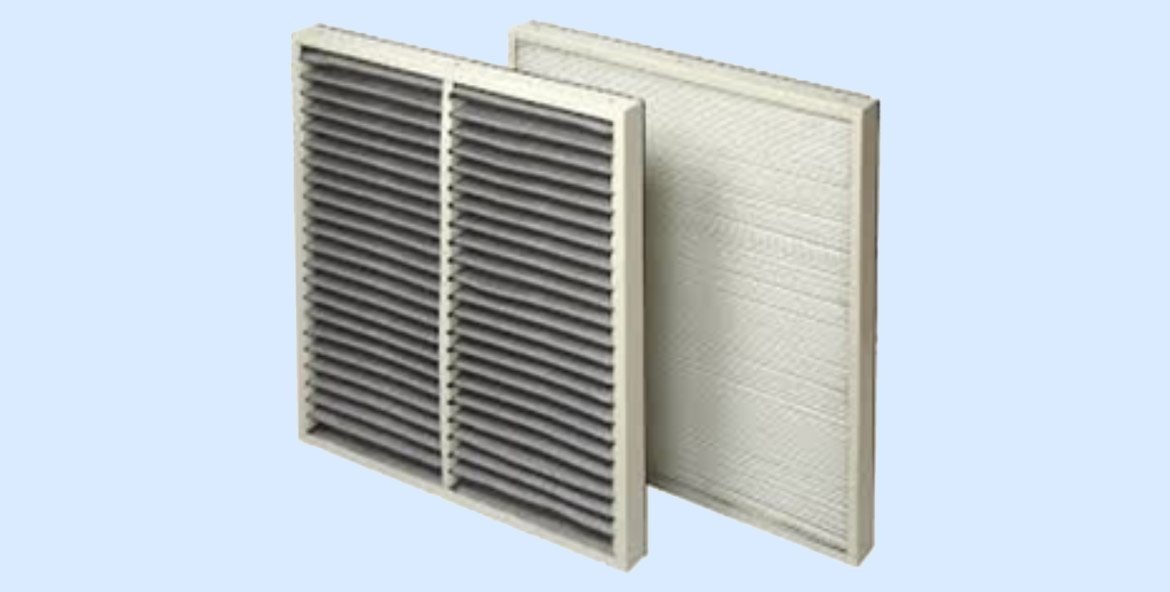
A panel air filter is the first working barrier in any HVAC or AHU air filtration system—a flat or pleated media element designed to catch coarse particles, lint, and dust before the air moves downstream into the finer stages of filtration. Think of it as the “roughing” filter in a multi-layer defense line: it stops what you can see (and plenty that you can’t) so that the bag filters, rigid filters, and HEPA units can focus on precision removal without being overloaded.
In practice, these filters are constructed with pleated synthetic, glass fiber, or metal mesh media, supported by a rigid frame of galvanized steel, aluminum, or high-impact polymer. The pleating is not just aesthetic—it increases surface area, improves dust-holding capacity, and maintains low initial pressure drop (ΔP) even at higher face velocities. Most industrial AHUs run their panel filters at around 2.0–2.5 m/s, a sweet spot where airflow remains uniform, and downstream filters avoid early clogging.
One small but important detail engineers often notice: the frame rigidity and media uniformity directly affect airflow distribution. Poorly designed panels can flex under suction load, creating bypass paths. Praimo Industrial Filters & Spares Manufacturing Company addresses this by reinforcing each frame and ensuring pleat geometry stays stable under varying ΔP conditions—especially critical in multi-stage HVAC configurations.
Panel Air Filter vs. Bag & Rigid Filters
| Parameter | Panel Air Filter | Bag Filter | Rigid/HEPA Filter |
|---|---|---|---|
| Function | Coarse prefiltration | Fine filtration | Absolute filtration |
| Efficiency (ISO 16890) | ePM₁₀ / Coarse | ePM₁–ePM₂.₅ | ≥ 99.95 % @ MPPS |
| Typical Rating | G3–G4 / MERV 5–8 | F7–F9 / MERV 11–13 | H13–H14 (EN 1822) |
| Pressure Drop (Initial) | 50–80 Pa | 100–180 Pa | 200–300 Pa |
| Maintenance | Replace or wash | Replace | Replace |
| Placement | First stage | Intermediate | Final stage |
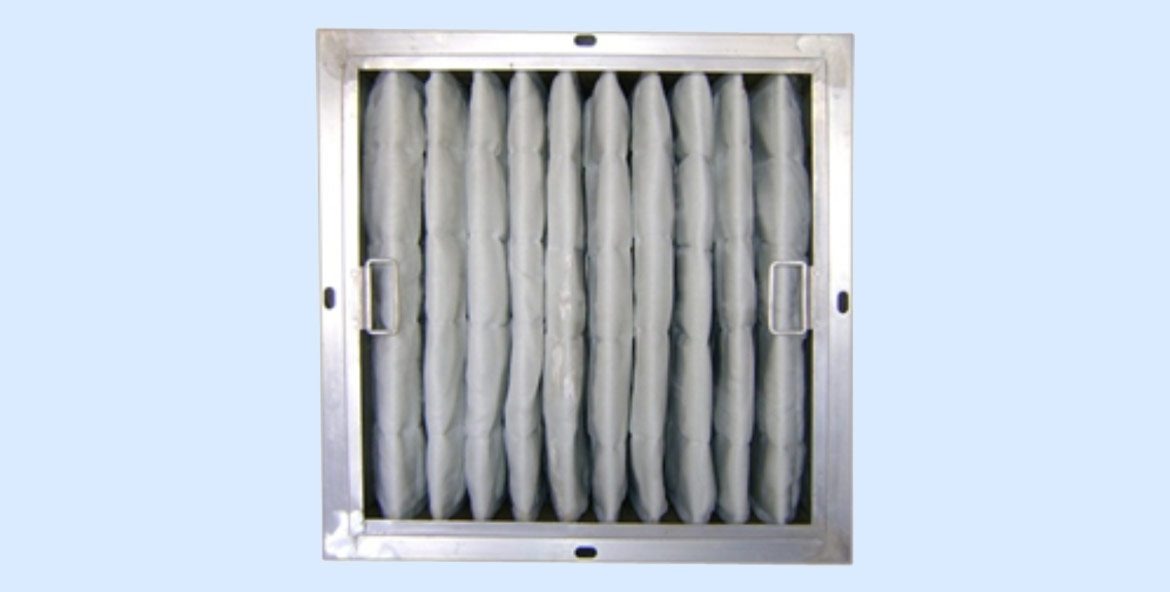
While bag and rigid filters focus on finer particulates and microbial control, the panel filter is the workhorse that protects them. By capturing the bulk of airborne dust, it prevents the costly premature loading of high-efficiency filters. In actual operation, this translates into:
- Extended HEPA life (often doubled under stable ΔP conditions)
- Reduced energy draw by minimizing system resistance
- Lower overall OPEX, thanks to fewer replacements and cleaning cycles
At Praimo Industrial Filters & Spares Manufacturing Company, every panel filter is engineered for precise modular integration—dimensionally compatible with ISO 16890 and ASHRAE MERV-rated bag and rigid filter housings. Whether part of a new system or a retrofit upgrade, Praimo ensures a mechanically secure fit, consistent performance, and a seamless interface between filtration stages.
Panel Air Filter Technical Specifications (Size, Flow, ΔP, Temperature)
In industrial HVAC design, panel air filters follow standardized dimensions and airflow profiles to simplify installation, replacement, and multi-stage integration within AHU filter banks. The most common full module size you’ll see is 592 × 592 mm, a global convention based on European EN standards. For compact or variable-airflow systems, half (287 × 592 mm) and quarter (287 × 287 mm) modules are used, offering flexibility in both surface area and flow balancing.
Depth options typically include 48 mm for standard pleated models and 96 mm for extended surface or high dust-holding capacity (DHC) configurations. Engineers often select deeper modules where longer service intervals or high airborne particulate loads are expected — especially in heavy-duty industrial AHUs or offshore HVAC systems.
In actual operation, maintaining a face velocity between 2.0 and 2.5 m/s ensures a stable pressure drop (ΔP) and optimized energy consumption per EN 13053 guidance. It’s a balance — higher velocity boosts throughput but can reduce media loading efficiency, while lower velocity conserves energy but may underutilize filter surface area. Finding the sweet spot depends on fan curve design and system ΔP budget.
Standard Technical Parameters — Panel Air Filters
| Parameter | Specification / Range | Reference |
|---|---|---|
| Nominal Size (WxHxD) | 592×592×48 mm (Standard), 592×592×96 mm (High-DHC), Half / Quarter Modules | ISO 16890 / EN 779 |
| Rated Airflow | 3,000–3,400 m³/h per full module | AHU standard velocity (2–2.5 m/s) |
| Initial Pressure Drop (ΔP) | 50–80 Pa | ISO 16890 test conditions |
| Recommended Final ΔP | 200–250 Pa (Initial ×3 or +50 Pa rule) | EN 13053 |
| Efficiency Class | G3–G4 / ISO Coarse–ePM₁₀ | ISO 16890 / MERV 5–8 |
| Operating Temperature | up to 70–80 °C (synthetic/glass media), higher for metal mesh | Manufacturer test |
| Frame Material | GI / Aluminum / Plastic / Cardboard | UL 900 compliant |
| Gasket Options | PU Foam / EPDM / Neoprene, 5–10 mm thick | Airtight sealing, reusable |
| Mounting Orientation | Vertical or horizontal; front-loading or side-access frames | AHU modular design |
ΔP vs Flow Curve (Indicative)
- At 2.0 m/s: ~55 Pa
- At 2.5 m/s: ~70–80 Pa
- At 3.0 m/s: ~95–110 Pa
(Performance variation: ±10% depending on pleat depth and media type)
Engineers often use the “initial ×3 or +50 Pa” rule to determine filter changeout intervals — a practical balance between dust-holding capacity, fan efficiency, and system stability. Pushing a panel filter beyond its rated final ΔP can increase blower load by up to 15–20 %, so periodic ΔP monitoring remains essential. In most AHUs, a simple Magnehelic gauge or digital ΔP sensor tied to the BMS (Building Management System) helps automate timely maintenance alerts.
At Praimo Industrial Filters & Spares Manufacturing Company, each panel air filter undergoes flow-rate and ΔP calibration tests before dispatch. QA data is logged under a traceable batch number and supplied with ISO 16890 labeling for global compliance. For critical or export projects, optional documentation such as EN 10204 3.1 material certificates and UL 900 fire-resistance ratings can be provided upon request — ensuring every filter meets both domestic and international engineering expectations.
ISO 16890 & MERV Classes (ISO ePM₁₀ / ePM₂.₅ / ePM₁, MERV 5–12)
When specifying panel air filters for industrial HVAC or AHU systems, two efficiency frameworks dominate global practice — ISO 16890 and ASHRAE’s MERV (Minimum Efficiency Reporting Value). Both measure how well a filter captures airborne particles of varying diameters, but they use different test philosophies. Knowing how the two align helps engineers, QA specialists, and procurement teams specify filters correctly for projects across India, the Middle East, Europe, and North America.
Understanding ISO 16890
The ISO 16890:2016 classification method evaluates filter efficiency based on real-world particulate fractions — PM₁₀ (≤10 µm), PM₂.₅ (≤2.5 µm), and PM₁ (≤1 µm) — aligning directly with the same particulate categories used in ambient air quality monitoring by the WHO and global environmental agencies.
To simplify the classification:
- ISO Coarse – For particles >10 µm (typical of G3–G4 prefilters)
- ISO ePM₁₀ 50–90 % – Transition between coarse and fine stages
- ISO ePM₂.₅ 50–80 % – Fine filtration class
- ISO ePM₁ ≥ 50 % – High-efficiency or pre-HEPA stage
Any filter achieving ≥ 50 % efficiency in one of these particle bands qualifies under that class. In actual operation, G4 pleated panel filters usually fall in the ISO ePM₁₀ 60–70 % bracket — a perfect fit for AHU prefiltration where energy cost and particle load are both moderate.
ISO 16890 ↔ MERV Equivalence Chart
| ISO 16890 Class | Approx. MERV Rating | Particle Size Efficiency (µm) | Typical Filter Type |
|---|---|---|---|
| ISO Coarse (≥ 70 %) | MERV 4–5 | >10 µm | Panel prefilters (G3–G4) |
| ISO ePM₁₀ 50–70 % | MERV 6–8 | 10–3 µm | Pleated panel air filters |
| ISO ePM₂.₅ 50–80 % | MERV 9–11 | 3–1 µm | Fine bag filters |
| ISO ePM₁ ≥ 50 % | MERV 12–13 | <1 µm | Rigid or compact filters |
| ISO ePM₁ ≥ 80 % | MERV 14–16 | <1 µm | HEPA-grade prefilters |
In practice, this chart lets you translate specifications between regions. For example:
- A MERV 8 filter in a U.S. commercial AHU roughly equals an ISO ePM₁₀ 60 % panel filter — ideal for first-stage coarse dust removal.
- A MERV 12 (ISO ePM₂.₅ 70–80 %) filter is often used as a final or secondary stage in clean manufacturing, pharmaceutical, or electronics applications before HEPA filtration.
As a rule of thumb, engineers cross-check both values to ensure compliance in multinational projects or when retrofitting imported AHU systems.
At Praimo Industrial Filters & Spares Manufacturing Company, every panel air filter undergoes independent ISO 16890 testing, complete with certified lab reports. For export-ready documentation, optional UL 900 fire-rating certificates, EN 10204 3.1 MTCs, and CE/PED SEP Declarations are available on request. This ensures full traceability and cross-standard compliance — whether you’re supplying a pharmaceutical AHU in India or integrating a CE-marked HVAC system in Europe.
Materials & Construction — Pleated PET/PP, Glass Fiber, Metal Mesh
The materials and construction of a panel air filter dictate not only its filtration efficiency but also how it stands up to real-world challenges — humidity, corrosion, mechanical vibration, and temperature fluctuations. In any HVAC or AHU application, these factors directly influence pressure drop (ΔP) stability, media integrity, and maintenance frequency. At Praimo Industrial Filters & Spares Manufacturing Company, each panel filter is fabricated from carefully selected, traceable materials and validated for compliance with ISO 16890 and UL 900 standards, ensuring safety and performance consistency for both industrial and commercial environments.
Construction Components & Material Options
| Component | Material Options | Key Features / Benefits | Typical Use |
|---|---|---|---|
| Filter Media | Pleated PET / PP (synthetic), Micro-glass fiber, Metal mesh (Al / SS304 / SS316L), Activated carbon (charcoal) |
- PET/PP: strong, washable, moisture-tolerant - Glass fiber: excellent fine dust capture (≤1 µm) - Metal mesh: reusable, ideal for oily or humid systems - Charcoal: removes odor & VOCs |
HVAC & AHU prefilters, chemical, paint, and exhaust booths |
| Frame / Enclosure | Cardboard, Plastic, GI, Aluminum, Stainless Steel |
- Cardboard/plastic: cost-efficient, disposable - GI/Al: corrosion-resistant and rigid - SS304/316L: hygienic, durable, long-life |
Industrial HVAC, pharma, food, marine & offshore |
| Faceguard / Retainer Mesh | Electro-galvanized or SS wire mesh | Prevents media damage, stabilizes pleat form | All pleated panel types |
| Gasket / Seal | PU Foam, EPDM, Neoprene (5–10 mm) | Leak-free sealing under 400–600 Pa pressure | AHU and duct mounting frames |
| Adhesive / Bonding | Polyurethane or Epoxy | High-strength bonding, vibration resistant | High-temp or heavy-duty units |
Design Insights
- Pleated synthetic media (PET/PP) remains the standard for modern AHU filters—offering high dust-holding capacity with low ΔP, even after thousands of operating hours.
- Fiberglass media achieves ≥ 90 % ePM₁₀ efficiency, ideal for facilities targeting high IAQ, though it’s non-washable and suited for disposable configurations.
- Metal panel filters (stainless or aluminum) shine in oily or humid environments — compressor intakes, paint booths, and marine systems — where washability and corrosion resistance are key.
- Foam and reticulated media filters are lightweight and consistent under low-pressure ventilation systems, often found in electronics cabinets and HVAC control panels.
- Charcoal or activated carbon HVAC filters integrate adsorptive media to remove odors and volatile organic compounds (VOCs), essential for paint shops, laboratories, and clean manufacturing environments.
Every Praimo panel filter undergoes hydro-mechanical integrity testing and visual QA inspection before dispatch. Engineers verify pleat uniformity, frame bonding integrity, and gasket compression tolerance, ensuring no bypass leakage and predictable ΔP behavior. In real installations, this attention to construction detail can easily extend filter service life by 25–30 %, reducing both downtime and energy cost across the system’s lifecycle.
Types of Panel Filters (G3/G4 Pleated, Washable Metal Mesh, Carbon-Loaded)
Panel air filters aren’t one-size-fits-all. Different environments demand different media, frames, and service cycles. At Praimo Industrial Filters & Spares Manufacturing Company, the range covers everything from G3/G4 pleated prefilters for general HVAC duty, to washable metal mesh filters for oily or humid air streams, and carbon-loaded odor control panels for VOC-sensitive applications. Each type is tested to meet ISO 16890, EN 779, and UL 900 performance and safety standards.
G3 / G4 Pleated Panel Filters
These are the workhorses of industrial AHU systems — lightweight, high-area prefilters designed to trap coarse dust and lint before the air reaches the finer F7–F9 or HEPA stages.
- Efficiency Class: G3–G4 (ISO Coarse 70–90 % / ePM₁₀ 50–70 %)
- Media: Pleated synthetic (PET/PP) or glass-fiber media for high DHC
- Initial ΔP: 50–80 Pa @ 2.5 m/s face velocity
- Available Depths: 48 mm (standard) / 96 mm (extended)
- Applications: AHUs, cleanroom prefiltration, compressor inlets, paint booths
In practice, operators appreciate these filters for their low pressure loss and predictable loading curve — two factors that directly impact fan energy consumption. Once the ΔP triples (usually around 200–250 Pa), replacement is recommended to maintain system efficiency.
Washable Metal Mesh Panel Filters
When humidity, oil mist, or heat would quickly destroy a paper or glass-fiber element, a metal mesh panel filter is the logical choice. Constructed from multiple crimped layers of expanded aluminum or stainless steel (SS304 / SS316L), these filters combine rigidity with reusability.
- Efficiency Class: G2–G3 (ISO Coarse 60–70 %)
- Operating Temperature: Up to 250–300 °C (depending on alloy)
- Frame Material: Al / SS304 / SS316L — welded or riveted construction
- Maintenance: Washable (25–30 cycles) using compressed air or detergent
- Applications: Compressor air intakes, turbine ventilation, marine HVAC, kitchen exhausts
Metal filters deliver long-term cost advantages — no consumables, minimal disposal, and steady ΔP even after cleaning. In oily air or coastal installations, a stainless version often pays for itself within a year through reduced replacement frequency.
Carbon-Loaded Panel Filters (Activated Charcoal Layer)
These filters go beyond dust — they adsorb odors and volatile organic compounds (VOCs) while still removing coarse particulates. A layer of activated carbon granules or impregnated non-woven media is placed between two retaining meshes to stabilize flow.
- Efficiency Class: G3–G4 (for dust) + VOC adsorption
- Media: Non-woven synthetic + activated carbon layer
- ΔP: ≈ 90–120 Pa @ rated flow
- Applications: Paint spray booths, laboratories, chemical processing, HVAC exhaust systems
- Key Benefit: Reduces odors, hydrocarbons, and chemical vapors while maintaining moderate airflow resistance
In paint or solvent-handling facilities, carbon-loaded panels help maintain workplace IAQ and extend the life of downstream molecular filters or carbon canisters.
Filter Type Comparison
| Filter Type | Efficiency (ISO / MERV) | Washable | Best For |
|---|---|---|---|
| G3 Pleated | ISO Coarse 70 %, MERV 5 | ✕ | General HVAC prefiltration |
| G4 Pleated | ISO Coarse 90 %, MERV 8 | ✕ | AHU fine prefiltration |
| Metal Mesh | G2–G3 | ✓ | Oily / humid / high-temperature zones |
| Carbon-Loaded | G3–G4 + VOC control | ✕ | Odor / VOC removal applications |
Each variant can be custom-fitted for front-loading or side-access housings, complete with EPDM or PU gaskets to ensure airtight sealing under 400–600 Pa operating pressure.
In every case, Praimo Industrial Filters & Spares Manufacturing Company maintains strict manufacturing controls — from pleat uniformity to bonding integrity — guaranteeing long-term performance and compliance with ISO 16890, EN 779, and UL 900 standards.
Standard Sizes & Panel Air Filter Size Chart (HVAC Dimensions)
In industrial and commercial HVAC design, dimensional standardization is what keeps maintenance simple and system performance consistent. Panel air filters, whether pleated or flat, follow globally recognized ISO, ASHRAE, and EN modular grid dimensions, ensuring they fit seamlessly into filter banks, AHUs, and duct-mounted housings.
At Praimo Industrial Filters & Spares Manufacturing Company, every panel filter is fabricated in full (592×592 mm), half (287×592 mm), and quarter (287×287 mm) modules, offering perfect interchangeability for both front-loading and side-access housings. The result is reduced installation downtime and a guaranteed fit—without costly frame adjustments on site.
Dimensional accuracy is maintained within ±2 mm tolerances on width and depth. Optional EPDM or PU foam gaskets (5–10 mm) are applied to the air-exit or frame perimeter to create an airtight seal under system pressures up to 600 Pa, preventing bypass and ensuring rated ΔP stability.
Standard Panel Air Filter Size Chart (mm ↔ inch equivalents)
| Nominal Size (W×H×D) | Equivalent (Inches) | Airflow Capacity (m³/h) | Remarks |
|---|---|---|---|
| 592 × 592 × 48 mm | 24 × 24 × 2 in | 3,000–3,400 | Standard pleated panel |
| 592 × 592 × 96 mm | 24 × 24 × 4 in | 3,500–3,800 | High dust-holding, extended life |
| 287 × 592 × 48 mm | 12 × 24 × 2 in | 1,500–1,800 | Half module for compact AHUs |
| 287 × 287 × 48 mm | 12 × 12 × 2 in | 800–1,000 | Quarter module |
| 495 × 495 × 48 mm | 20 × 20 × 2 in | 2,400–2,800 | Common retrofit size |
| 495 × 620 × 25 mm | 20 × 25 × 1 in | 2,800–3,200 | Standard commercial AHU model |
| 406 × 635 × 127 mm | 16 × 25 × 5 in | 3,200–3,600 | Deep-pleat high-capacity filter |
| 610 × 610 × 292 mm | 24 × 24 × 12 in | 4,000–4,500 | Rigid-panel compact filter |
Note: Non-standard sizes (thickness 20–300 mm) and frame materials (GI, Aluminum, SS304/316L) can be manufactured on request for OEM or export specifications.
Engineering Notes
- Face Velocity: Rated between 2.0–2.5 m/s for optimum airflow and pressure balance.
- Tolerance: Maintained at ±2 mm, allowing smooth insertion into AHU frames or modular filter banks.
- Sealing: Gaskets may be placed on the air-exit side or perimeter, depending on the housing configuration.
- Retrofit Compatibility: Direct replacement for legacy 20×20×1, 20×25×1, and 16×25×5 inch models used in commercial or industrial systems.
- Identification: Each Praimo filter carries a size label, airflow rating, ISO 16890 class, and a directional arrow, simplifying service and ensuring correct installation orientation.
In actual operation, engineers often note that improper gasket compression or mismatched frame thickness can cause micro-bypass, raising dust counts even in systems with otherwise high-efficiency downstream filters. That’s why Praimo’s QA protocol includes gasket compression tests and pleat geometry checks on every production batch. The combination of dimensional uniformity and mechanical precision guarantees stable airflow, easy maintenance, and reliable performance across all installations — from industrial AHUs to export-bound HVAC skids.
Performance Curves — ΔP vs Flow, Dust-Loading, Final ΔP (EN 13053)
The performance of a panel air filter is best understood by observing how its pressure drop (ΔP) changes with airflow and dust loading over time. This relationship isn’t just academic—it directly defines energy consumption, filter life, and maintenance intervals in both HVAC and AHU systems. At Praimo Industrial Filters & Spares Manufacturing Company, each filter model is tested and validated under ISO 16890 and EN 13053 standards, providing engineers with accurate ΔP–Q behavior curves for real-world system modeling.
Pressure Drop vs Airflow (ΔP–Q Curve)
At a constant filter area and media type, ΔP rises non-linearly as airflow increases. This happens because higher velocities create additional turbulence within the pleat channels and media fibers, reducing laminar flow efficiency. It’s one of those classic design trade-offs—push more air, pay more in fan energy.
| Face Velocity (m/s) | Airflow (m³/h) | Initial ΔP (Pa) | Energy Class (EN 13053) |
|---|---|---|---|
| 1.5 | 2,100–2,300 | 35–45 Pa | A+ (Low-energy) |
| 2.0 | 3,000–3,200 | 50–60 Pa | A |
| 2.5 | 3,300–3,500 | 70–80 Pa | B |
| 3.0 | 3,800–4,000 | 90–110 Pa | C |
Design Note: For most AHU systems, filters are sized so that initial ΔP ≤ 75 Pa at nominal face velocity. This ensures stable fan operation, balanced airflow across filter banks, and prevents overloading of return ducts.
Dust-Loading Curve (Lifecycle Behavior)
In operation, ΔP doesn’t jump suddenly—it climbs gradually as dust accumulates within the pleats. Once it crosses the threshold where airflow restriction outweighs efficiency benefits, it’s time for replacement. According to EN 13053, the recommended final pressure drop (ΔPₓ) is defined as:
Final ΔP = Initial ΔP × 3 or Initial ΔP + 50 Pa, whichever occurs first.
Example: A filter that starts at 70 Pa should be replaced when it reaches 200–220 Pa, depending on operating conditions and dust type.
Typical dust-holding capacity (DHC) for a pleated synthetic panel (48 mm depth) is around 350–450 g/m². Maintaining a ΔP/Q ratio < 40 Pa per 1,000 m³/h helps extend filter service intervals by 20–25 %, cutting fan energy usage by up to 10 % annually.
Energy Impact & Optimization
- Every 10 Pa rise in ΔP increases fan energy consumption by approximately 1 %.
- Using low-resistance pleated PET or glass-fiber media yields measurable long-term savings.
- Proper gasket sealing and frame rigidity prevent bypass leakage, which can cause localized clogging and uneven loading.
- Installing differential pressure gauges across pre- and fine-filter stages enables predictive maintenance and protects downstream HEPA filters from overload.
In actual field use, technicians often note that a stable ΔP curve isn’t just about the filter—it’s about installation integrity and consistent airflow. Poor seating or uneven gasket compression can add 10–15 Pa artificially, skewing energy data.
At Praimo Industrial Filters & Spares Manufacturing Company, every filter batch undergoes ΔP vs Flow performance testing on calibrated EN 779 / ISO 16890 flow benches, ensuring reliable, reproducible data. The resulting performance curves are included in the QA dossier for each product, allowing designers and energy managers to perform precise HVAC air-filter sizing calculations and lifecycle cost analysis before deployment.
AHU Pre Filter Selection (MERV / ISO Class, Face Velocity 2.0–2.5 m/s)
Selecting the correct AHU pre-filter is one of those decisions that quietly determines whether an air-handling system performs efficiently or becomes a maintenance burden. In an AHU’s filtration hierarchy, the pre-filter acts as the first line of defense—capturing coarse dust and particulates ≥10 µm before air reaches fine or absolute stages. A well-designed setup typically follows the staged pattern:
Panel (G3–G4) → Bag (F7–F9) → HEPA (H13/H14).
This structure keeps differential pressure (ΔP) balanced throughout the system and protects expensive downstream filters from premature loading. At Praimo Industrial Filters & Spares Manufacturing Company, pre-filter sizing and specification strictly follow ISO 16890 and EN 13053 guidelines, ensuring stable performance across a range of operating conditions — from general HVAC to validated cleanroom environments.
Selection Parameters
| Parameter | Recommended Range / Class | Reference Standard | Remarks |
|---|---|---|---|
| Face Velocity | 2.0 – 2.5 m/s | EN 13053 / ISO 16890 | Maintains ΔP ≤ 80 Pa at clean condition |
| Filter Class | G3–G4 (MERV 5–8) / ISO Coarse – ePM₁₀ 60 % | ISO 16890 / ASHRAE 52.2 | Coarse pre-filtration |
| Final Filter Stage | ePM₁ / HEPA (H13–H14) | EN 1822 | Downstream protection |
| Mounting Options | Side-access or front-loading cassette | ISO 29463 | For modular AHU frames |
| ΔP Limit | 200–250 Pa (max) | EN 13053 | Replacement threshold |
Rule of Thumb:
At nominal velocity (2.0–2.5 m/s), a G4-class panel filter removes approximately 90 % of particles ≥10 µm, extending the life of fine filters (F7–F9) by up to 30 %.
Engineering Insights
- Under-sizing a pre-filter raises face velocity, accelerating clogging and elevating ΔP—effectively wasting fan energy.
- Over-sizing, on the other hand, inflates capital cost without proportional improvement in airflow resistance.
- In most installations, a G4 panel filter at 2.3 m/s handles around 3,200 m³/h per 592×592×48 mm module, maintaining an initial ΔP near 60 Pa.
- Dual-stage prefiltration (G4 + F7) is recommended for ISO Class 7–8 clean zones in pharmaceutical AHUs to ensure compliance and extended HEPA life.
- Maintaining ΔP below the 200–250 Pa final threshold can reduce fan energy consumption by 8–12 % annually, a saving often overlooked in lifecycle cost models.
At Praimo Industrial Filters & Spares Manufacturing Company, every AHU pre-filter is flow-bench tested to validate its ΔP vs. Q curve. Each unit undergoes pleat-uniformity inspection, gasket compression verification, and frame sealing checks to eliminate bypass risk in modular housings. Whether for new installations or retrofit projects, Praimo’s filters combine precision manufacturing, verifiable test data, and ISO-compliant design — ensuring that every AHU operates with predictable efficiency and stability.
Electrical & Control Panel Fan Filters (Washable Mesh, IP Considerations)
In modern automation systems, electrical and control panel fan filters play a small but critical role: they prevent dust, lint, and oil mist from entering control enclosures while keeping sufficient airflow for cooling. Even a thin layer of dust inside a VFD cabinet, MCC, or PLC enclosure can restrict heat dissipation and lead to thermal derating or premature component failure. That’s why washable metal mesh and non-woven synthetic filters have become a standard safeguard for maintaining clean, stable airflow through control panel ventilation grilles.
At Praimo Industrial Filters & Spares Manufacturing Company, every control panel air filter is engineered to achieve IP54–IP65 protection levels, ensuring a balance between dust exclusion and cooling efficiency. Whether installed in a robotic cell, a CNC control cabinet, or a power distribution panel, Praimo’s fan filters are built to withstand the real-world demands of industrial environments.
Construction & Design Parameters
| Parameter | Specification / Range | Notes |
|---|---|---|
| Media Type | Multi-layer expanded aluminum mesh, stainless steel wire mesh, or synthetic non-woven fabric | Washable and reusable |
| Frame Material | Aluminum / SS304 / ABS (flame-retardant) | Corrosion-resistant and lightweight |
| Micron Rating | 50–200 µm (nominal) | Suitable for dust-laden environments |
| Airflow Capacity | 300–1,200 m³/h (per fan assembly) | Depends on fan diameter (80–400 mm) |
| Pressure Drop (ΔP) | < 40 Pa at rated velocity | Ensures low-resistance airflow |
| Operating Temperature | Up to 120 °C (metal mesh) | Stable under continuous duty |
| Mounting Style | Snap-fit, magnetic frame, or bolted guard | For front- or rear-mounted fan housings |
| Protection Level | IP54–IP65 | Dust-proof and splash-resistant configuration |
Application & Selection Insights
In electrical control panels and automation enclosures, filtration is about airflow management—not sterile filtration. The goal is to stop large contaminants without strangling ventilation flow. Washable metal mesh filters are particularly suited for rugged environments such as automotive assembly lines, foundries, and heavy machining plants, where ambient dust and oil aerosols are common.
- Synthetic or foam fan filters perform best in controlled indoor facilities (e.g., PLC or IT cabinets).
- Metal mesh filters excel in areas with high particulate or oil mist exposure, maintaining consistent ΔP and cooling efficiency.
- Oversizing can cause bypass leakage, while undersizing leads to rapid ΔP buildup. A rise beyond 70 Pa can drop fan output by 10–15 %, resulting in localized hot spots inside the cabinet.
- Regular cleaning every 4–6 weeks using compressed air or mild detergent restores free flow and prevents motor overheating.
For OEM compatibility, Praimo Industrial Filters & Spares Manufacturing Company manufactures custom-fit control panel fan filters for major brands such as Rittal, Schneider, Siemens, and ABB. Units are available with optional hydrophobic or oleophobic coatings for oil-mist resistance and long-term corrosion protection — essential in CNC shops, process lines, and marine electrical enclosures.
Spray Booth Panel Filters (Overspray Capture, G-Grade Choice)
In paint spray booths and powder-coating enclosures, panel air filters form the first and most critical defense against airborne paint mist, pigment overspray, and fine dust. Without them, coatings can suffer from uneven deposition, surface defects, or unwanted color contamination. These filters maintain smooth, laminar airflow inside the booth while preventing particulate buildup in exhaust ducts and downstream fine-filtration stages.
At Praimo Industrial Filters & Spares Manufacturing Company, each spray booth panel filter is engineered for uniform velocity distribution, low turbulence, and high overspray-holding capacity, ensuring a cleaner working environment and consistent coating finish. Every unit is tested to meet EN 13053 airflow standards and DIN 53438-F1 flame-retardant classifications—key factors for industrial safety and compliance.
Technical Characteristics
| Parameter | Typical Specification | Notes |
|---|---|---|
| Filter Class | G3–G4 (ISO Coarse 70–90 %) | Captures paint overspray and coarse dust |
| Media Type | Synthetic non-woven polyester or glass-fiber mat (progressive density) | Flame-retardant as per DIN 53438-F1 |
| Frame Options | GI / Aluminum / Cardboard | Available in rigid or disposable types |
| Nominal Size | 592 × 592 × 48 mm (custom sizes on request) | Fits modular exhaust grids |
| Initial ΔP | 60–90 Pa @ 2.0 m/s | Tested under EN 13053 conditions |
| Recommended Final ΔP | 200–250 Pa | Replacement threshold |
| Dust / Overspray Holding Capacity | 350–500 g/m² | High-density pleated or mat media |
| Temperature Resistance | Up to 100 °C | Suitable for bake or flash-off zones |
Operational Insights
- Air velocity balance: Maintain 0.3–0.5 m/s across the booth face area for consistent paint deposition and controlled overspray flow.
- Filter changeout: Typically every 150–200 operating hours, or when ΔP exceeds 220 Pa, depending on coating type and particle load.
- Staged filtration setup:
- Inlet side: G4 pleated prefilters protect surfaces and operators.
- Exhaust side: F5–F7 pocket filters capture fine pigment and resin aerosols.
- VOC & odor management: Solvent-based systems benefit from carbon-loaded modules downstream to remove volatile compounds and fumes.
- System optimization: Stable ΔP and clean booth airflow reduce fan wear, extend ductwork life, and help maintain ISO 14644-1 air cleanliness classifications in high-precision coating environments.
In practice, operators often notice that consistent air velocity at the floor and side walls yields the most uniform paint finish. A small imbalance—even 0.1 m/s deviation—can shift the spray pattern or cause paint drift onto critical surfaces.
That’s why Praimo Industrial Filters & Spares Manufacturing Company builds each filter using progressive-density media, ensuring steady particle capture without sudden ΔP rise. Combined with optional carbon modules and pocket filters, Praimo’s multi-stage booth ventilation systems deliver cleaner exhaust, reduced maintenance intervals, and safer working conditions for industrial painters and surface-finishing operators.
Residential & Commercial HVAC Queries (Map & Qualify)
Search terms like “aircon air filters,” “central air filters,” and “HVAC filters near me” may sound purely residential, but in practice, many of these inquiries relate to light-commercial HVAC systems — such as those used in office complexes, hospitals, schools, or mixed-use residential towers. These setups often operate under higher air volumes and continuous duty cycles, making them unsuitable for retail-grade filters.
At Praimo Industrial Filters & Spares Manufacturing Company, such queries are carefully qualified and mapped to the right industrial-grade panel air filter solutions, ensuring that commercial and institutional clients receive durable, compliant products tailored for their air-handling systems rather than short-life consumer filters.
Application Differentiation
| Segment | Typical Filter Used | MERV / ISO Rating | Replacement Cycle | Remarks |
|---|---|---|---|---|
| Residential HVAC | Disposable pleated panel (20×25×1 / 16×25×5) | MERV 6–8 / ISO ePM₁₀ 60 % | 60–90 days | Cost-efficient coarse filtration |
| Commercial Buildings | Rigid panel or G4 pleated prefilter | MERV 8–11 / ISO ePM₂.₅ 65–70 % | 90–120 days | Improves IAQ and coil hygiene |
| Industrial AHUs | Deep-pleat panel + bag filter stages | MERV 9–13 / ISO ePM₁ 70–80 % | 120–180 days | Maintains process air purity |
| Healthcare & Pharma | Multi-stage prefilter (G4 + F7 + H13) | MERV 13+ / ISO ePM₁ 90 % | As per ΔP | Critical cleanroom applications |
Practical Insights for Buyers
- Panel filters with G3–G4 (MERV 5–8) ratings are a cost-effective step up from consumer “aircon filters,” offering better dust capture and longer service life.
- Commercial HVAC systems (offices, shopping malls, hotels) typically operate at ISO ePM₁₀ 70 % for balanced IAQ and energy savings.
- Upgrading to MERV 11 or ISO ePM₂.₅ filters improves indoor air quality without major modifications to fan capacity or duct design.
- Replacement intervals should depend on actual ΔP readings — for example, replace once ΔP exceeds 200 Pa or at 90-day intervals in dusty environments.
- Residential filters may appear cheaper, but their lower DHC (dust-holding capacity) and weaker frame integrity cause frequent changeouts and airflow losses.
Many facility managers are unaware that industrial-grade filters used in AHUs offer 3–4× the service life and maintain lower ΔP even under continuous operation. By helping customers “graduate” from household-style filters to ISO 16890-compliant industrial panels, Praimo enables better IAQ compliance, reduced maintenance, and longer fan lifespan — all with measurable energy savings.
At Praimo Industrial Filters & Spares Manufacturing Company, we regularly assist maintenance teams and HVAC integrators in selecting the correct MERV/ISO-rated filters compatible with systems from Voltas, Daikin, Blue Star, Trane, and Carrier — bridging the gap between consumer perception and true industrial performance.
Carbon & Specialty Media (Odor / VOC, Charcoal)
Not every air quality challenge is about dust. In many process environments, gaseous contaminants and odors become the limiting factor for air purity. This is where carbon-loaded panel air filters come into play. Unlike particulate-only filters that rely on mechanical interception, these specialty filters incorporate activated carbon, a material with an enormous internal surface area capable of adsorbing volatile organic compounds (VOCs), hydrocarbons, and chemical vapors at the molecular level.
At Praimo Industrial Filters & Spares Manufacturing Company, our charcoal HVAC filters and VOC control filters are engineered for dual-function performance—capturing both particulates and gas-phase pollutants. Each unit is tested to meet ISO 10121 gas-phase filtration standards, ensuring reliability in food & beverage processing plants, laboratories, paint booths, kitchens, and hospitality ventilation systems where air cleanliness and odor management are paramount.
Technical Construction & Performance
| Cost Element | Baseline (Unfiltered / Coarse Filtration) | With Filter Paper Roll System | % Reduction / Improvement |
|---|---|---|---|
| Tool Wear & Replacement | ₹100,000 / month (avg.) | ₹60,000 / month | ↓ 40% tool wear cost |
| Coolant Consumption | 500 L / month (replacement) | 150–200 L / month | ↓ 60–70% coolant cost |
| Downtime (Maintenance / Clogging) | 8–10 hrs / month | 3–4 hrs / month | ↓ 50–60% downtime |
| Media Consumption (Rolls) | — | 1 roll per 15–20 days (avg.) | Predictable consumption rate |
| Waste Disposal / Sludge Handling | ₹15,000 / month | ₹8,000 / month | ↓ 45% waste handling cost |
Practical Insights
- Installation sequence matters: Always position carbon panels after G3–G4 prefilters to prevent dust clogging and prolong carbon service life.
- Replacement frequency: In recirculating HVAC systems, change carbon media every 3–6 months or at the first sign of odor breakthrough—this often precedes visible saturation.
- System integration: VOC panels can be combined with ePM1 or HEPA stages for total particulate + gas-phase purification, particularly in cleanrooms, R&D facilities, and controlled laboratories.
- Design customization: For fume hoods or solvent-handling exhausts, Praimo offers modular carbon filter cassettes compatible with side-access housings and retrofit grids.
- Performance balance: The slight ΔP increase (typically 90–120 Pa) is a fair trade-off for 60–90 % odor removal efficiency and improved workplace air comfort.
In real-world installations, engineers often observe that a correctly staged carbon + prefilter system can reduce VOC concentration by up to 80 % within a single air exchange cycle, particularly in paint spray and F&B ventilation systems.
Every Praimo carbon-loaded panel is manufactured under controlled impregnation and bonding conditions, ensuring uniform adsorption, consistent pressure drop, and stable airflow throughout its lifecycle. Filters can be supplied with galvanized, aluminum, or ABS frames, with optional EN 10204 3.1 certification for export and regulatory compliance.
Washable Metal Mesh Panel Filters (Al/SS) — Oily / Humid Intakes
Washable metal mesh panel filters are purpose-built for air systems that operate in humid, oily, or particulate-heavy environments where disposable pleated filters clog too quickly or degrade under moisture. These robust filters—constructed with multi-layer expanded aluminum or stainless steel wire mesh—are designed to withstand frequent cleaning and extended service cycles, making them ideal for compressor intakes, marine HVAC systems, gas turbines, food-processing air intakes, and industrial utility ventilation.
At Praimo Industrial Filters & Spares Manufacturing Company, every reusable HVAC filter is engineered to deliver low pressure drop (ΔP), consistent airflow, and mechanical durability even under continuous-duty operations. By maintaining stable ΔP over years of use, these filters significantly lower maintenance frequency and consumable waste, offering a long-term, eco-efficient alternative to disposable media.
Technical Specifications — Washable Metal Mesh Filters
| Parameter | Specification / Range | Notes |
|---|---|---|
| Filter Media | Multi-layer expanded Aluminum / SS304 / SS316L wire mesh | Crimped layers for rigidity and laminar airflow |
| Efficiency Class | G2–G3 (ISO Coarse 50–70 %) | Captures coarse dust, lint, and oil mist |
| Nominal Sizes | 592×592×25 mm / 48 mm (custom on request) | Fits modular AHU and intake housings |
| Rated Velocity | 2.0–3.0 m/s | Stable ΔP across variable loads |
| Initial Pressure Drop (ΔP) | 35–55 Pa @ 2.5 m/s | Clean condition |
| Dust-Holding Capacity | 250–350 g/m² | Depends on mesh density and depth |
| Wash Cycles | 25–30 cycles (average) | Reusable after cleaning and drying |
| Operating Temperature | Up to 250–300 °C | Suitable for hot, oily, or exhaust systems |
| Frame Material | Aluminum / SS304 / SS316L | Corrosion-resistant for marine or humid zones |
Cleaning & Maintenance
- Cleaning methods: Use compressed air, hot water, or mild alkaline detergent. Always dry completely before reinstallation.
- ΔP recovery: After washing, pressure drop typically returns within 5–10 % of original levels, preserving airflow stability.
- Intervals: Clean monthly for oily mist intakes and quarterly for ambient air applications.
- Lifecycle savings: Properly maintained filters can last 5 years or longer, reducing filter waste by up to 80 % compared to disposable pleated media.
Engineering Insights
- Aluminum mesh filters are lightweight, making them ideal for AHU and HVAC retrofits where frequent access or weight constraints exist.
- Stainless steel (SS304/SS316L) mesh filters are chosen for humid, saline, or corrosive atmospheres—common in offshore, marine, and food-grade plants.
- For enhanced particle capture or moisture removal, these filters can be combined with synthetic prefilter pads or drainage layers to form hybrid filtration assemblies.
- Proper installation and periodic washing prevent airflow obstruction, while maintaining stable ΔP helps reduce fan energy draw and extend component life.
Each Praimo washable mesh panel filter undergoes hydrostatic cleaning validation, corrosion-resistance testing, and QA inspection before dispatch. Whether used in coastal HVAC systems, compressor rooms, or process exhausts, these filters provide durable, reusable, and sustainable air filtration solutions that meet ISO 16890 performance requirements and UL 900 fire-safety compliance.
Regulatory & Safety — UL 900, ISO 16890 Labeling, EN 1822 Interface
In industrial HVAC and air-handling applications, regulatory compliance and traceability are non-negotiable. Buyers need to know that every filter installed in a system is certified, fire-safe, and performance-verified. That’s why at Praimo Industrial Filters & Spares Manufacturing Company, each panel air filter is tested, certified, and labeled in accordance with internationally recognized standards — UL 900, ISO 16890, and when relevant, EN 1822 for HEPA interface compatibility. These certifications form the backbone of domestic QA, OEM acceptance, and global export readiness, assuring both safety and filtration consistency throughout a filter’s lifecycle.
Core Standards & Certification Overview
| Standard | Scope / Requirement | Relevance to Panel Air Filters |
|---|---|---|
| ISO 16890:2016 | Defines classification based on particulate fractions — ePM₁, ePM₂.₅, ePM₁₀ | Mandatory global labeling framework for HVAC filters |
| UL 900 (Underwriters Laboratories) | Evaluates flame spread and smoke generation | Essential for North American exports; confirms fire-safety compliance |
| EN 779 (Historical Reference) | Legacy classification (G1–F9) prior to ISO 16890 | Retained for backward compatibility in legacy AHU systems |
| EN 1822 (HEPA & ULPA) | Specifies efficiency and leakage tests for H13–U17 filters | Defines performance interface between prefilters and HEPA stages |
| CE / PED SEP | Pressure equipment safety conformity | Applies to housings and assemblies incorporating filters |
| DIN 53438-F1 | Flame-resistance for non-metallic filter media | Critical for paint booths and HVAC units handling flammable particulates |
Labeling & Traceability Requirements
Each Praimo panel air filter is factory-labeled with durable laser or ink-stamped identifiers that include:
- Product Code and Dimensions (mm)
- Airflow Direction Arrow
- ISO 16890 Efficiency Class (e.g., ISO ePM₁₀ 70 %)
- UL 900 Fire Classification (if applicable)
- Batch / QA Trace Number for full production tracking
- Material Grade (GI, Aluminum, SS304, SS316L)
This labeling ensures smooth acceptance during QA audits, EPC documentation, and export inspections, while maintaining traceability under EN 10204 3.1 certification. Optional documentation such as RoHS / REACH declarations, MSDS for filter media, and PED SEP statements are also available upon request.
Compliance Integration for Buyers
- For EU and Middle East projects, ISO 16890 certification is a minimum specification for all HVAC filters.
- UL 900 compliance is required for North American exports, especially in OEM HVAC systems, data centers, and medical facilities.
- EN 1822 cross-references ensure proper coordination between panel prefilters and terminal HEPA filters, allowing smooth validation in multi-stage air-handling systems.
- All Praimo filters are tested under ISO 16890 laboratory conditions (23 °C ± 2 °C, 45 % ± 5 % RH) using sodium chloride / DEHS aerosols for reproducible results across global test centers.
At Praimo Industrial Filters & Spares Manufacturing Company, compliance is built into the manufacturing DNA — from raw-material certification to final test reports. Each batch is validated on calibrated ISO 16890 / EN 1822 test benches, ensuring fire safety, mechanical integrity, and consistent performance for EPC, OEM, and international HVAC projects.
Industries & Applications (Pharma, F&B, Power, Data Centers, Oil & Gas)
Panel air filters form the foundation of clean air management across nearly every industrial and commercial sector. Whether used to protect pharmaceutical cleanrooms, maintain food hygiene, ensure turbine reliability, or stabilize data center cooling, their role is both preventive and performance-critical. A well-engineered panel filter directly influences IAQ compliance, ΔP stability, energy efficiency, and equipment longevity — all measurable parameters tied to process reliability and regulatory performance.
At Praimo Industrial Filters & Spares Manufacturing Company, our industrial HVAC filters are precision-designed and validated for diverse applications — from biotech production zones to offshore HVAC skids — ensuring predictable results under every operating condition.
Key Industry Applications & Performance Benchmarks
| Industry | Filtration Objective | Typical Filter Class | ΔP Limit (Pa) | Performance KPIs |
|---|---|---|---|---|
| Pharmaceutical & Biotech | Maintain ISO Class 7–8 cleanroom IAQ | G4 + F7 + H13 (multi-stage) | ≤ 220 Pa | Sub-micron particle control, microbial barrier integrity |
| Food & Beverage Processing | Prevent product contamination, ensure hygiene | G3–G4 (washable / disposable) | ≤ 200 Pa | ≥ 99 % removal of coarse particulates; odor-free airflow |
| Power Plants & Turbine Intakes | Protect compressors and turbines from dust erosion | G2–G3 (metal mesh / pleated synthetic) | ≤ 180 Pa | Stable ΔP under pulsation; reduced wear on rotating parts |
| Data Centers & Server Rooms | Maintain particulate-free, low-resistance cooling air | G4 / MERV 8 | ≤ 150 Pa | Constant CFM; reduced fan energy load; PUE optimization |
| Oil & Gas (Onshore / Offshore) | Resist saline, hydrocarbon, and fine dust ingress | SS304 / SS316L washable mesh | ≤ 250 Pa | Corrosion resistance; high dust-holding capacity |
Application Insights
- Pharma & Clean Manufacturing: Panel prefilters form the first stage before HEPA H13/H14 (EN 1822) filtration, extending HEPA lifespan by 25–30 % and reducing pressure-drop escalation.
- Food & Beverage Plants: Synthetic pleated media — often PET/PP or glass-fiber blends — prevent mold spores and micro-particulates from entering process air. FDA-compliant adhesives and frames ensure hygienic integrity.
- Power & Energy Sectors: Metal mesh prefilters protect compressor blades and turbine fins from dust erosion, maintaining turbine efficiency during long-hour operations in harsh environments.
- Data Centers: Low-ΔP G4 filters reduce fan energy demand by 8–12 %, directly improving Power Usage Effectiveness (PUE) and enhancing uptime reliability for cooling systems.
- Oil & Gas Installations: Stainless steel SS304/SS316L washable panels perform reliably in saline coastal or offshore air — resisting corrosion, hydrocarbons, and high humidity where polymer media would fail.
Each sector imposes distinct demands — particle size targets, pressure-drop tolerances, and filter life-cycle metrics — yet all rely on the same principle: consistent, certified filtration performance.
At Praimo Industrial Filters & Spares Manufacturing Company, we deliver custom-engineered filtration packages tailored to each industry’s KPIs. All models comply with ISO 16890, ASHRAE 52.2, and UL 900 standards, ensuring globally recognized performance, fire safety, and traceability.
Lifecycle Cost & ROI (Energy vs. ΔP, Changeout Strategy)
When evaluating HVAC filtration systems, it’s easy to focus on the purchase price of the filter. Yet, engineers know the real cost lies in energy consumption and airflow resistance (ΔP) over time. In fact, over 60 % of total filtration cost typically comes from fan power used to overcome pressure drop. Extending the filter’s operational life without exceeding its ΔP limit directly translates to measurable energy and cost savings.
At Praimo Industrial Filters & Spares Manufacturing Company, every panel air filter is optimized for low resistance, high dust-holding capacity, and predictable ΔP performance — balancing upfront investment with long-term operational ROI. These filters are not just components; they’re energy assets within your air-handling system.
Lifecycle Cost Components
| Cost Category | Share of Total Cost | Description / Example |
|---|---|---|
| Energy Cost (Fan Load) | 60–70 % | Electricity used to overcome ΔP during operation |
| Filter Replacement | 15–20 % | Filter media and labor costs per changeout cycle |
| Maintenance & Downtime | 10–15 % | Inspection frequency, shutdown periods |
| Disposal & Logistics | 5 % | Handling and safe disposal of used filters |
In continuous-duty AHUs, even a minor ΔP optimization—say, 10 Pa—can yield double-digit percentage savings in energy costs.
Performance & Payback Insights
- ΔP Management: Operating filters near their rated final ΔP (200–250 Pa) per EN 13053 extends service life by 30–40 %, provided fan margins allow it.
- Energy Impact: A 10 Pa reduction in ΔP across a 10,000 m³/h AHU can save up to 250–300 kWh/year, depending on system efficiency and duty hours.
- Replacement Strategy: Replace G4 filters every 3–6 months and metal mesh filters every 6–12 months (cleaning cycles included). This minimizes downtime and stabilizes ΔP trends.
- Total Cost of Ownership (TCO): Premium low-ΔP filters may cost 15–20 % more upfront, but can reduce lifecycle costs by 25–35 % through reduced fan load and longer service intervals.
Example ROI Case — Commercial HVAC Unit
| Parameter | Standard G4 Filter | Praimo Low-ΔP G4 Filter |
|---|---|---|
| System Airflow | 20,000 m³/h | 20,000 m³/h |
| Operating Hours | 4,000 h/year | 4,000 h/year |
| Energy Cost | ₹8.5 / kWh | ₹8.5 / kWh |
| Initial ΔP (Pa) | 90 | 65 |
| Final ΔP (Pa) | 250 | 200 |
| Annual Energy Use (kWh) | 7,200 | 6,100 |
| Total Annual Cost (₹) | 61,200 | 52,000 |
| Annual Savings | — | ₹9,200 (~15 %) |
Based on standard fan efficiency and EN 13053 operating parameters.
Engineering Takeaway
In real-world installations, energy-efficient, low-ΔP panel filters often pay for themselves within 6–9 months. When paired with proper pressure monitoring and predictive maintenance, total ROI can reach 20–25 % annually, especially in 24×7 HVAC operations such as pharma, data centers, or process cooling systems.
At Praimo Industrial Filters & Spares Manufacturing Company, we help clients calculate lifecycle cost and plan changeout intervals using ΔP sensors, filter performance curves, and custom-built ROI calculators — ensuring every unit of airflow delivers measurable value.
Alternatives Matrix — Panel vs Bag vs Rigid vs HEPA (Decision Criteria)
Choosing the right air filtration system isn’t about picking a single filter type — it’s about designing a multi-stage system that balances air purity, ΔP stability, and lifecycle cost. Each filter category — panel, bag, rigid, and HEPA — plays a distinct role within the HVAC or AHU chain. The challenge for engineers is to match ISO/MERV efficiency, dust-holding capacity, and energy profile to the operational environment.
At Praimo Industrial Filters & Spares Manufacturing Company, we assist OEMs, EPC firms, and plant engineers in making evidence-based selection decisions. The following alternatives matrix outlines key performance, cost, and compliance differences, ensuring your choice is both technically and economically optimized.
Filtration Alternatives Comparison Matrix
| Filter Type | Typical Class (ISO / MERV) | Efficiency Range | Initial ΔP (Pa) | Dust Holding Capacity (g/m²) | Typical Use | Replacement Cycle |
|---|---|---|---|---|---|---|
| Panel Filter | G3–G4 / MERV 5–8 | 80–95 % (coarse) | 50–80 | 300–400 | AHU prefilters, coil protection, general HVAC | 3–6 months |
| Bag Filter | F5–F9 / MERV 9–14 | 90–98 % (fine) | 120–180 | 600–800 | Secondary stage, air polishing | 6–12 months |
| Rigid / Box Filter | ePM₁ 80–95 / MERV 13–15 | 95–99 % (fine–micro) | 150–220 | 900–1200 | High-velocity AHUs, cleanrooms | 9–12 months |
| HEPA Filter | H13–H14 / MERV 17+ | ≥ 99.97 % @ 0.3 µm | 250–400 | 50–150 | Final filtration in sterile environments | 12–18 months |
Decision Criteria (Weighted for Industrial Applications)
| Criterion | Weight (%) | Panel | Bag | Rigid | HEPA |
|---|---|---|---|---|---|
| Initial Cost | 20 | ★★★★★ | ★★★★ | ★★★ | ★ |
| Energy Efficiency (ΔP) | 25 | ★★★★★ | ★★★★ | ★★★ | ★★ |
| Filtration Efficiency | 25 | ★★ | ★★★★ | ★★★★★ | ★★★★★ |
| Dust-Holding Capacity (DHC) | 15 | ★★★ | ★★★★ | ★★★★★ | ★★ |
| Regulatory / IAQ Compliance | 15 | ★★★ | ★★★★ | ★★★★★ | ★★★★★ |
5 = Excellent, 1 = Poor (relative performance scale)
Practical Insights
- Panel Filters remain the most cost-effective first line of defense, intercepting coarse particles and stabilizing ΔP for downstream filters.
- Bag Filters balance efficiency and pressure stability, ideal for medium- to high-dust environments and continuous-duty AHUs.
- Rigid / Box Filters excel in space-limited systems or high face velocity conditions (2.5–3.0 m/s) where deep bags cannot fit.
- HEPA Filters, rated H13–H14 per EN 1822, deliver absolute particulate control down to 0.3 µm and are indispensable in pharma, biotech, healthcare, and aerospace applications.
Engineering Recommendation
When determining the best HVAC filter configuration for your plant:
- Base selection on ISO 16890 efficiency class, rated velocity, and ambient particulate profile.
- Opt for modular housings from Praimo that support interchangeable panel, bag, and rigid filter modules — allowing performance upgrades without redesigning the AHU.
- Always validate ΔP vs DHC curves and energy models during specification to predict real-world ROI.
A properly engineered multi-stage sequence — Panel → Bag → Rigid → HEPA — delivers the optimal balance of filtration efficiency, energy performance, and regulatory compliance across diverse industries.
At Praimo Industrial Filters & Spares Manufacturing Company, we integrate technical data, compliance documentation, and lifecycle performance curves into every project. Our engineered filtration architectures empower clients to standardize across facilities, ensuring consistent IAQ, lower OPEX, and global certification readiness.
Export Readiness (Docs, Packing, Marking, HS/HSN, CE / PED SEP for Housings)
For global EPC contractors, OEMs, and industrial procurement teams, performance alone isn’t enough — export compliance, documentation, and packing standards are equally critical. Every shipment must satisfy customs, QA, and regulatory benchmarks before installation.
At Praimo Industrial Filters & Spares Manufacturing Company, export readiness is engineered into every stage — from documentation and labeling to material certification and CE/PED conformity. Each panel air filter or housing system leaves the factory as a fully traceable, audit-ready export unit.
Export Documentation & Compliance Package
| Document Type | Standard / Reference | Purpose & Applicability |
|---|---|---|
| Product Data Sheet | ISO 16890 / MERV / EN 13053 | Technical performance record (dimensions, airflow, ΔP, efficiency) |
| Quality Certificate | ISO 9001:2015 | Confirms manufacturing process control |
| Material Test Certificate (MTC) | EN 10204 3.1 (on request) | Verifies alloy grade and mechanical conformity |
| UL 900 Fire Rating Statement | UL Labs | Required for U.S. / North American markets |
| CE / PED SEP Declaration | 2014/68/EU | Certifies housings as safe pressure equipment |
| RoHS / REACH Declaration | EU Directives 2011/65/EU & EC 1907/2006 | Confirms non-toxic, environmentally safe materials |
| Packing List & Invoice | IEC / INCOTERMS | Ensures logistics and traceability compliance |
| ISPM-15 Wooden Packing Certificate | FAO IPPC | Validates treated timber for global shipment |
| Country-of-Origin & HS/HSN Code | HSN: 8421.39.20 (Panel Air Filter) | Customs classification for India and international ports |
Packing & Marking Standards
- Primary Protection: Each unit is sealed in anti-static or moisture-barrier film to prevent contamination during transit.
- Secondary Protection: Corrugated cartons with desiccant sachets and foam separators to absorb shock and vibration.
- Export Crating: Heavy-duty ISPM-15 heat-treated wooden boxes, reinforced with corner guards and strapping for marine or air freight.
- Labeling & Marking: Each package displays the Praimo logo, model number, ISO efficiency class, flow direction arrow, batch number, and handling instructions (“Handle with Care,” “Keep Dry”).
- Container Optimization: Pallets pre-configured for 20-ft / 40-ft containers with barcoded identification and ERP traceability.
Export Market Relevance
- Regions Served: Middle East (UAE, Saudi Arabia, Oman), Southeast Asia, Africa, and Europe.
- Preferred by EPCs/OEMs: Due to comprehensive, plug-and-play documentation, pre-audited QA files, and zero-delay customs processing.
- Cross-Compliance: ISO 16890 + UL 900 + CE PED SEP standards ensure global acceptability across QA inspectors and project consultants.
Engineering & Logistics Assurance
- Every export batch undergoes final QA inspection, visual verification, and photographic documentation before shipment.
- CE-marked housings (for cartridge, bag, or duplex systems) include Declaration of Conformity and PED SEP marking, when applicable.
- Each filter bears a unique batch trace code linked to internal QA and performance records for post-delivery audits.
- Export packages are designed for stacking, moisture protection, and handling stability, meeting both marine and air freight durability standards.
Conclusion
Exporting filtration systems isn’t just about manufacturing — it’s about traceability, documentation integrity, and transit safety.
At Praimo Industrial Filters & Spares Manufacturing Company, our end-to-end export readiness ensures that every filter, housing, and assembly reaches international clients fully compliant and inspection-ready, reducing administrative delays and protecting your project timelines.
Sizing & Selection Guide (Calculator Inputs, Face Velocity, ΔP Targets)
Selecting the right panel air filter for an HVAC or AHU system is an engineering balance — airflow, velocity, filter class, and environmental conditions all determine final performance. The goal is simple: achieve the desired IAQ (Indoor Air Quality) while maintaining ΔP stability and energy efficiency.
At Praimo Industrial Filters & Spares Manufacturing Company, every panel filter is engineered and tested with predictable ΔP vs flow behavior, allowing accurate sizing and lifecycle cost forecasting.
Engineer’s Quick Method — Inputs → Output
- Given Parameters:
- System Flow QQQ (m³/h)
- Target Face Velocity vvv = 2.0–2.5 m/s
- Initial ΔP ≤ 50–80 Pa
- Final ΔP = 200–250 Pa (EN 13053 recommended limit)
- Calculate Required Filter Area:
A=Qv×3600 (m²)A = \frac{Q}{v \times 3600} \text{ (m²)}A=v×3600Q (m²)
where QQQ = airflow (m³/h) and vvv = face velocity (m/s) - Determine Module Count:
N=AAmoduleN = \frac{A}{A_\text{module}}N=AmoduleA
where AmoduleA_\text{module}Amodule (e.g., 592 × 592 mm) ≈ 0.35 m² net face area - Select Filter Class:
- G3–G4 (ISO Coarse / ePM10 50–70 %) for prefiltration
- F7–F9 (ePM2.5–ePM1) for secondary polishing
- H13–H14 (HEPA) for final stages
Typical Targets & Selection Decisions
| Input / Constraint | Target / Rule of Thumb | Selection Impact |
|---|---|---|
| Face Velocity | 2.0–2.5 m/s | Keeps initial ΔP ≤ 80 Pa |
| Initial ΔP | 50–80 Pa | Select pleat depth (48 mm vs 96 mm) |
| Final ΔP | 200–250 Pa | Determines service interval |
| Environment | Humid / oily zones | Choose washable metal mesh filters |
| Odor / VOC Presence | Add carbon-loaded panels | Enables gas-phase + particulate filtration |
| Regulatory | ISO 16890 + UL 900 | Required for export or audit compliance |
Practical Engineering Picks
- High Dust Load / Compact AHUs: Use 96 mm high-DHC pleated filters to extend service life and minimize ΔP rise.
- Coastal / Offshore Installations: Opt for SS304 or SS316L metal mesh filters — corrosion-resistant, washable, and suitable for high-humidity zones.
- Commercial IAQ Upgrade: Combine a G4 (MERV 8) prefilter with a downstream ePM2.5 bag or rigid filter to achieve IAQ improvement without significant fan modification.
- ΔP Monitoring: Install differential pressure gauges across the filter bank; replace at 3× initial ΔP or +50 Pa, per EN 13053.
Selection Support by Praimo
Praimo provides calculator-ready spec sheets, helping engineers determine module count, pressure budget, and airflow distribution for each installation.
Each filter comes with verified ΔP vs flow curves and ISO 16890 labeling, ensuring predictable sizing and global export readiness.
Installation & Sealing (Gaskets, Frames, Bypass Control)
Even the most advanced panel air filter can lose up to 20 % of its rated efficiency if installed incorrectly. A small bypass gap or under-compressed gasket can allow unfiltered air to escape, compromising IAQ, increasing ΔP, and overloading downstream filters.
At Praimo Industrial Filters & Spares Manufacturing Company, installation precision is engineered into every product — from gasket formulation to frame geometry — ensuring leak-free performance and predictable ΔP across HVAC and AHU systems.
Key Installation Guidelines
| Parameter | Best Practice | Engineering Rationale |
|---|---|---|
| Filter Orientation | Install with airflow arrow aligned toward fan discharge. | Ensures even particle loading and prevents pleat distortion. |
| Gasket Material | Use EPDM, Neoprene, or PU foam (10–15 mm thick). | Provides tight sealing with high compression recovery; resists ozone, heat, and humidity. |
| Compression Ratio | Maintain 25–35 % gasket compression. | Prevents leakage while avoiding permanent compression set. |
| Mounting Frame Type | Galvanized steel or stainless-steel filter banks with knife-edge or clamping strips. | Ensures stable alignment under vibration and pressure fluctuations. |
| Bypass Gap Tolerance | ≤ 1 mm around entire periphery. | Even a 2 mm bypass can reduce filtration efficiency by more than 10 %. |
| Fastening System | Use front-loading clips, swing bolts, or hinged access doors. | Allows quick replacement, uniform compression, and tool-free service. |
Maintenance & Replacement Tips
- Inspect gasket elasticity during every changeout (3–6 months typical). Replace any hardened or deformed gaskets.
- Clean frame sealing surfaces before installing a new filter to remove dust, oil, or adhesive residues.
- Verify flat seating — warped housings or uneven clamping pressure create bypass paths.
- For return-air ducts, ensure plenums are fully sealed and vibration-isolated to avoid negative-pressure leaks.
- Base filter replacement on ΔP readings, not fixed intervals; this ensures optimum lifecycle cost and airflow balance.
Engineering Insights
- A correctly sealed filter can improve overall system efficiency by 15–20 %, lowering fan power and enhancing IAQ.
- Poor sealing leads to dust deposition on coils, sensors, and HEPA filters — raising energy costs and shortening service life.
- Praimo filters feature integrated gasket seats and double-lip profiles for consistent sealing and minimal human error.
- Knife-edge compatible frames are available for HEPA interface housings, ensuring smooth transition between G4 prefilters and H13/H14 final stages.
Conclusion
At Praimo Industrial Filters & Spares Manufacturing Company, every panel filter and housing system is designed for repeatable, leak-free installation.
By standardizing frame geometry, gasket quality, and compression parameters, we help facility engineers and OEMs maintain consistent filtration efficiency, reduce downtime, and protect downstream components across HVAC, AHU, and clean-air systems.
Maintenance Schedule & Troubleshooting (Clogging, Wet Filters, Scented Filters)
Consistent maintenance of panel air filters is critical for stable airflow, low energy consumption, and long HVAC system life. Filters left unchecked can become clogged, saturated, or biologically contaminated, leading to erratic ΔP behavior and degraded IAQ.
At Praimo Industrial Filters & Spares Manufacturing Company, we advocate ΔP-based maintenance scheduling rather than fixed calendar intervals—ensuring filters are changed only when performance warrants it, maximizing efficiency and service life.
Recommended Maintenance Schedule
| Condition / Environment | Inspection Frequency | Changeout / Cleaning Cycle | Notes |
|---|---|---|---|
| Normal Ambient (Office / Utility HVAC) | Every 2 months | Replace every 4–6 months | ΔP > 200 Pa threshold |
| Dusty / Manufacturing Zones | Monthly | Every 2–3 months | Clean prefilter screens regularly |
| Oily / Humid Intakes | Every 3–4 weeks | Washable mesh preferred | Prevent microbial or corrosion damage |
| Paint / Chemical Fumes | Monthly | 1–2 months | Use carbon-loaded VOC filters |
| Cleanroom / Pharma HVAC | Weekly | Every 3–6 months | Maintain ΔP and IAQ logs for audit |
Tip: Replace filters when ΔP ≥ (initial × 3) or +150 Pa above baseline—whichever comes first. This ensures consistent energy performance and downstream filter protection.
Common Issues & Engineering Solutions
| Problem | Likely Cause | Recommended Action |
|---|---|---|
| Clogged HVAC Filter | Extended use beyond rated ΔP, high dust load | Replace at 200–250 Pa; add prefilter stage |
| Wet or Soggy Media | Humidity, condensate carryover, AHU coil splash | Switch to hydrophobic PET or metal mesh filters |
| Filter Collapse / Deformation | Reverse airflow or poor frame sealing | Check airflow direction and gasket compression |
| Odor / VOC Smell | Chemical vapor recirculation | Install carbon-loaded VOC panels downstream |
| Use of Scented Filters | Consumer-grade or home-use media | Avoid — may emit VOCs and mask critical air warnings |
| Mold or Biofilm Growth | High humidity, stagnant air, or organic media | Sanitize housing; use synthetic non-organic media |
Maintenance Best Practices
- Monitor ΔP gauges continuously and log readings to identify early clogging or coil fouling.
- Do not reuse filters that are wet, collapsed, or biologically contaminated.
- Store spare filters in a clean, dry area — away from chemical vapors and sunlight.
- Avoid scented or perfumed filters — these are unsuitable for industrial HVAC and can interfere with IAQ sensors.
- For oily or humid environments, use Praimo’s washable aluminum or stainless-steel mesh filters for long service intervals and easy cleaning.
Conclusion
By implementing a ΔP-driven maintenance schedule, operators can extend filter life, stabilize fan load, and protect downstream filtration stages from overload.
At Praimo Industrial Filters & Spares Manufacturing Company, we provide spare filter programs, differential pressure monitoring kits, and preventive maintenance support, ensuring your HVAC systems maintain compliance, uptime, and consistent indoor air quality year-round.
Case Studies — AHU Energy Optimization, Oily Intake Mesh, Pharma Filtration Stack
Practical performance data is the ultimate proof of filtration design quality. At Praimo Industrial Filters & Spares Manufacturing Company, we don’t just supply filters — we engineer measurable results. The following case studies highlight how correct media selection, ΔP management, and filter staging translate into lower energy costs, extended service life, and cleaner air across three distinct industrial environments.
Case 1: AHU Energy Optimization in a Commercial Building
Objective: Reduce fan energy load while maintaining IAQ and ISO 16890 compliance.
Setup: 40,000 m³/h AHU system with 24 modules of 592×592×48 mm G4 pleated panel filters, replacing older G3 models.
| Metric | Before (Legacy Filter) | After (Praimo G4 Panel) | Improvement |
|---|---|---|---|
| Initial ΔP | 95 Pa | 65 Pa | ↓ 31 % |
| Final ΔP | 260 Pa | 210 Pa | ↓ 19 % |
| Fan Power Consumption | 18.6 kW | 16.2 kW | ↓ 13 % |
| HEPA Stage ΔP Stability | ±40 Pa | ±25 Pa | +20 % HEPA life |
Outcome: ROI achieved within 7 months due to lower energy draw and longer replacement intervals.
Takeaway: Optimized pleat geometry and synthetic media selection directly reduce lifecycle cost without modifying AHU housings.
Case 2: Oily Intake Mesh Filter — Power Plant Utility
Objective: Eliminate frequent clogging and wetting of disposable filters in compressor air intakes.
Setup: 15 m³/s intake airflow; replaced disposable G3 filters with washable stainless-steel mesh panels (SS316L).
| Parameter | Old Disposable G3 | Praimo SS Mesh Filter |
|---|---|---|
| Cleaning Interval | Not applicable | Every 30 days |
| Filter Life | 1 month | 5 years + (30 wash cycles) |
| ΔP Recovery After Cleaning | — | 90–95 % |
| Annual Consumable Cost | ₹ 3.6 L | ₹ 0.6 L |
| OPEX Reduction | — | ≈ 83 % |
Outcome: Monthly consumable purchase eliminated. Compressor efficiency improved under humid, oil-mist intake conditions.
Takeaway: Washable metal mesh filters deliver outstanding cost savings and operational resilience in heavy-duty applications.
Case 3: Pharma Cleanroom Filtration Stack Optimization
Objective: Extend HEPA life and maintain ISO 14644 particle-count compliance.
Setup: Multi-stage AHU stack — G4 panel + F7 bag + H13 HEPA (EN 1822).
| Parameter | Before Optimization | After Praimo G4/F7 Stack |
|---|---|---|
| HEPA ΔP Increase (6 months) | +90 Pa | +55 Pa |
| Particle Count (≥ 0.5 µm) | 3,200 /m³ | 1,850 /m³ |
| Filter Change Frequency | Every 6 months | Every 9 months |
| HEPA Life Extension | — | +50 % |
Outcome: Improved IAQ validation, fewer maintenance stoppages, and extended cleanroom uptime by one full maintenance cycle per year.
Takeaway: Correct multi-stage filtration design (panel → bag → HEPA) balances ΔP progression and particulate capture efficiency for pharmaceutical environments.
Strategic Takeaways
- Energy Optimization: Every 10 Pa ΔP reduction saves approximately 250 kWh/year per 10,000 m³/h airflow.
- Durability: Reusable aluminum or stainless-steel mesh filters dramatically reduce consumable waste in oily or humid zones.
- Filtration Stack Efficiency: Proper stage sequencing can extend fine filter life by 30–50 %, minimizing HEPA load and downtime.
At Praimo Industrial Filters & Spares Manufacturing Company, these field-proven results demonstrate how engineering-led design, material selection, and lifecycle monitoring turn filtration systems into measurable ROI assets—delivering clean air, consistent ΔP stability, and long-term energy efficiency across industries.
Compliance Matrix (ISO 16890, MERV, UL 900, EN 1822 Interface)
To streamline specification, validation, and audit workflows,
Praimo Industrial Filters & Spares Manufacturing Company provides a unified Air Filter Compliance Matrix that bridges four global standards — ISO 16890, MERV (ASHRAE 52.2), UL 900, and EN 1822.
This single-view reference allows QA, validation, and procurement teams to cross-check efficiency grades, testing requirements, and regional compliance with precision.
Air Filter Grade & Compliance Reference Chart
| Filter Class | ISO 16890 Classification | Approx. MERV Rating | Typical Efficiency (% @ Particle Size) | Application Zone | UL 900 / EN 1822 Context |
|---|---|---|---|---|---|
| G1–G4 (Coarse) | ISO Coarse ≥ 60 % | MERV 4–8 | 60–95 % @ 10 µm | Pre-filters, HVAC coils, coarse dust removal | UL 900 Class 2 / Flame-retardant media |
| M5–M6 (Fine) | ePM₁₀ 50–70 % | MERV 9–11 | 70–85 % @ 5 µm | General ventilation, comfort HVAC | UL 900 Class 2 |
| F7–F9 (Fine / High Efficiency) | ePM₂.₅ 65–95 % | MERV 12–15 | 85–95 % @ 2.5 µm | Pharma, hospitals, data centers | UL 900 Class 1 (optional) |
| E10–E12 (EPA) | ePM₁ > 95 % | MERV 16 | ≥ 95 % @ 1 µm | Micro-filtration, clean zones | Transition to EN 1822 scope |
| H13–H14 (HEPA) | — | MERV 17–18 | ≥ 99.97 % @ 0.3 µm | Cleanrooms, sterile production | EN 1822 mandatory testing |
| U15–U17 (ULPA) | — | MERV 19+ | ≥ 99.9995 % @ 0.12 µm | Semiconductor, biotech labs | EN 1822-5/-7 compliance |
Key Compliance Notes
- ISO 16890 has replaced EN 779 and now serves as the global benchmark for HVAC filter performance, classifying media by particle fractions — ePM₁, ePM₂.₅, ePM₁₀.
- MERV (ASHRAE 52.2) remains standard in North America; the table provides cross-reference values for global coordination between OEMs and EPCs.
- UL 900 certifies that filter media meet fire-safety requirements, controlling flame propagation and smoke generation for building safety.
- EN 1822 governs testing for HEPA and ULPA filters, defining efficiency at MPPS (Most Penetrating Particle Size) and leakage testing — critical for cleanroom systems.
- All Praimo filter media meet DIN 53438-F1 flame-resistance requirements, ensuring export acceptability in EU, GCC, ASEAN, and North American markets.
Audit & Documentation Integration
Every filter shipped from Praimo Industrial Filters & Spares Manufacturing Company includes a full compliance documentation suite for traceability and consultant approval:
- ISO 16890 efficiency tag — labeled with ePM₁, ePM₂.₅, ePM₁₀ percentage
- UL 900 class statement (where applicable)
- EN 10204 3.1 Material Test Certificate (MTC) for metallic components (optional)
- Batch traceability code for QA, EPC, and validation audits
By enforcing strict packaging, handling, and climate-control procedures, Praimo Industrial Filters & Spares Manufacturing Company guarantees that every filter paper roll retains its mechanical strength, GSM consistency, and micron filtration accuracy throughout its logistics cycle—ensuring reliability from manufacturing floor to final installation site.
Procurement & RFQ (Sizes, MOQ, Lead Times, Custom Frames / Gaskets)
At Praimo Industrial Filters & Spares Manufacturing Company, procurement is engineered for precision and transparency.
Whether sourcing standard HVAC panel air filters or custom-built variants with unique frame materials, gasket types, or performance parameters, every order follows a documented workflow—ensuring complete traceability from RFQ submission to final shipment.
Ordering & RFQ Essentials
| Procurement Parameter | Specification / Options | Notes |
|---|---|---|
| Available Sizes | Standard: 592×592×48 mm, 592×287×48 mm, 287×287×48 mm (full / half / quarter) | Custom dimensions available upon request |
| Frame Material | Cardboard, Plastic (ABS/PP), GI, Aluminum, SS304, SS316L | Select based on corrosion resistance and application environment |
| Filter Media Options | Pleated synthetic (PET/PP), Glass fiber, Washable metal mesh, Carbon-loaded | ISO 16890-compliant media for coarse or fine filtration |
| Gasket Type | EPDM, PU foam, Neoprene, or Silicone | 10–15 mm thick; 25–35 % compression ratio for leak-free sealing |
| Filter Class (ISO/MERV) | G3–G4 / MERV 5–8 (ISO Coarse 60–90 %) | Matches AHU prefiltration specifications |
| MOQ (Minimum Order Quantity) | 10 units (standard) / 25 units (custom) | Bulk pricing available for 100+ units |
| Lead Time | 1–2 weeks (standard) / 3–4 weeks (custom builds) | Expedited options for project-critical dispatches |
| Packaging | ISPM-15 heat-treated wooden crates, moisture-barrier film wrap | Export-ready protection |
| HSN Code (India) | 8421.39.20 | “Air filter for industrial HVAC systems” |
RFQ & Customization Workflow
- Submit Inquiry → Fill Praimo’s RFQ form with filter size, airflow (m³/h), ΔP targets, and frame material.
- Engineering Validation → Our design team verifies AHU compatibility, gasket compression, and flow performance.
- Quotation & Documentation → Receive transparent pricing with ISO 16890 / UL 900 / CE compliance options.
- Manufacturing & QA → Filters built under ISO 9001:2015 standards; tested for ΔP, fitment, and frame integrity.
- Packing & Dispatch → ISPM-15 export crating, moisture protection, and batch traceability with photo verification before shipment.
Procurement Advantages
- Direct-from-manufacturer pricing — eliminates distributor mark-ups for bulk HVAC and EPC projects.
- Customization flexibility — aluminum, stainless steel, or GI frames; gasket selection in EPDM, PU, or hybrid silicone for special conditions.
- OEM branding / private labeling available for volume supply and global distributors.
- Distributor partnerships open for domestic (India) and export regions including Middle East, Africa, ASEAN, and EU.
Engineering Insight
Procurement at Praimo is not just about transaction—it’s a technical assurance loop.
Every RFQ undergoes dimensional verification, pressure testing, and documentation review to ensure seamless AHU integration and global compliance.
At Praimo Industrial Filters & Spares Manufacturing Company, you’re not just placing an order—you’re commissioning a precision-engineered filtration component designed for lifecycle reliability, export compliance, and project-ready performance.
Comparison vs Consumer Air Purifiers & UV Add-ons (Industrial Reality Check)
With the growing popularity of consumer-grade air purifiers, ionizers, and UV add-ons, it’s easy to confuse them with true industrial HVAC filtration systems. The reality, however, is that these categories serve entirely different purposes.
Whereas consumer products focus on aesthetic comfort or odor masking, industrial panel air filters are engineered for measurable performance — controlled ΔP, verified ePM1/ePM10 efficiency, and system-wide IAQ compliance under globally recognized standards such as ISO 16890, ASHRAE 52.2, and UL 900.
At Praimo Industrial Filters & Spares Manufacturing Company, our approach to air quality is rooted in engineering data, not marketing claims. Every filter is validated for airflow stability, particulate capture, and lifecycle energy efficiency, ensuring reliability in HVAC, AHU, and cleanroom environments.
Industrial vs Consumer Filtration — Comparison Matrix
| Feature | Industrial Panel Filter (Praimo) | Consumer “Air Purifier” / UV Add-on | Practical Verdict |
|---|---|---|---|
| Standard Compliance | ISO 16890, ASHRAE 52.2, UL 900, EN 1822 interface | Non-standard, brand-specific claims | ✅ Industrial grade is auditable |
| Measured Efficiency | ePM₁₀ 60–90 %, MERV 5–8 | “99 % clean air” (no test particle basis) | ✅ Defined by verifiable test data |
| Pressure Drop (ΔP) | 50–80 Pa at rated velocity | Often unlisted / N/A | ✅ Predictable and energy-model-ready |
| Airflow Volume | 3,000–3,400 m³/h per module | ≤ 300 m³/h | ✅ Industrial handles real HVAC volumes |
| Filtration Method | Mechanical interception (pleated media) | Ionization / ozone / UV light | ⚠️ UV = disinfection, not filtration |
| Service Life | 3–6 months (pleated) / 5 years+ (washable mesh) | 1–2 years (sealed fan units) | ✅ Maintainable and service-friendly |
| Safety Certification | UL 900, DIN 53438-F1 flame-retardant | Rarely tested | ✅ Fire-compliant for industrial sites |
| VOC / Odor Handling | Carbon-loaded panels or canisters | Thin carbon pad (optional) | ✅ Real adsorption performance |
| Maintenance Access | Side-access / front-loading AHU frames | Snap-in consumer cartridges | — Different operational scale |
Engineering Reality Check
- UV / Ion Units ≠ Filtration: They deactivate microbes but cannot remove dust, aerosols, or oil mist. Industrial IAQ requires mechanical particulate capture.
- Layered Industrial Design: True air-purification systems follow a structured sequence — Panel (G3–G4) → Bag (F7–F9) → HEPA (H13/H14) — to meet ISO 16890 and GMP requirements.
- Consumer Devices Serve Comfort, Not Process: Whole-house or room purifiers typically operate at ≤ 1 m/s velocity, unsuitable for continuous industrial duty or turbine-intake loads.
- UV Integration in Industrial HVAC: UV-C stages are optional, installed after filtration to control microbial growth on coils or ducts — not as replacements for filters.
Engineering Recommendation
For commercial and industrial HVAC applications, prioritize:
- ISO 16890-rated panel prefilters for quantifiable particulate removal.
- Regular ΔP monitoring to manage energy consumption.
- Optional UV post-treatment for microbial control when required.
This layered approach delivers verifiable IAQ improvement, lower fan energy, and extended downstream filter life — all supported by test data and global compliance.
At Praimo Industrial Filters & Spares Manufacturing Company, our filtration solutions — from G4 panel filters to carbon modules and HEPA terminals — form a performance-driven air purification chain trusted by OEMs, EPCs, and facility operators worldwide.
Panel Air Filter FAQ (Schema-Ready)
Below are concise, schema-compliant answers to the most frequently asked questions about panel air filters, curated for engineers, maintenance leads, and procurement professionals.
Each response is technically validated and structured to support Google “People Also Ask” visibility while aligning with ISO 16890 / MERV standards.
A panel air filter is a flat, pleated, or mesh-type prefilter used in HVAC and AHU systems to capture coarse airborne dust (≥ 10 µm) before it reaches downstream filtration stages.
Typically rated G3–G4 (ISO Coarse 60–90 %), it protects coils, fans, and HEPA filters while maintaining a low pressure drop (ΔP ≈ 50–80 Pa) for energy-efficient airflow.
Praimo Industrial Filters & Spares Manufacturing Company designs each unit for stable ΔP and long service life in demanding industrial environments.
Measure the height × width × depth of the filter frame in millimetres or inches, allowing a ± 2 mm tolerance for seating.
Common standard sizes include:
- 592 × 592 × 48 mm
- 592 × 287 × 48 mm
- 287 × 287 × 48 mm
For a complete module reference, see Praimo’s Panel Air Filter Size Chart, which maps all standard and custom HVAC frame dimensions.
- G3 (ISO Coarse 70 %) — General air filtration for ambient dust or comfort HVAC.
- G4 (ISO Coarse 90 %) — Ideal for AHU prefiltration, offering higher dust-holding capacity and extended downstream HEPA life.
Praimo’s G4 pleated filters are certified to EN 13053 and ISO 16890, ensuring reliability for industrial and clean-air applications.
MERV Rating | Approx. ISO Class | Recommended Application |
MERV 8 | G4 / ISO ePM10 70 % | Standard offices, malls |
MERV 11 | F6 / ISO ePM2.5 65 % | Hospitals, laboratories |
MERV 13 | F7 / ISO ePM1 70 % | Pharma, clean zones |
Select the rating based on IAQ targets, available fan static pressure, and regulatory compliance requirements.
Use washable aluminum or stainless-steel mesh filters in oily, humid, or outdoor intake environments.
They are corrosion-resistant, operate at temperatures up to 250–300 °C, and can be cleaned 25–30 times using compressed air or detergent.
See Praimo’s Washable Mesh Filters for SS304/316L options with extended service life.
Industrial HVAC filters fall under
HSN 8421.39.20 – “Filtering or purifying machinery and apparatus for gases.”
Use this classification on GST invoices and export documentation for customs and logistics compliance.
Replace filters once ΔP ≥ 200–250 Pa or when the pressure drop triples from its clean condition.
Inspection: every 2 months (ambient) / monthly (dusty zones).
ΔP-based maintenance prevents fan energy loss and ensures consistent airflow.
Pricing depends on:
- Frame material: Cardboard < GI < Aluminum < SS316L
- Media type: Synthetic (PET/PP) < Glass fiber < Carbon / Metal mesh
- Size & efficiency class: G3/G4 vs carbon-loaded or washable types
Typical industrial-grade range: ₹ 350 – ₹ 2,500 per unit (bulk).
For project-specific pricing, submit details via Praimo’s RFQ Form.
Choose washable mesh fan filters (IP 54–55) built from aluminum or stainless mesh to safeguard electrical cabinets, MCCs, and drives from dust while allowing adequate cooling airflow.
Match the filter to the fan size (e.g., 92×92 mm or 120×120 mm) and environmental humidity.
Aspect | Panel (HVAC) | Engine (Filter) |
Air Velocity | 2–2.5 m/s | 20–30 m/s |
Media Type | Pleated synthetic / glass fiber | Cellulose or resin-bonded paper |
Purpose | Indoor air quality & energy efficiency | Combustion protection |
Design | Large surface area, low ΔP | Compact, high ΔP for tight sealing |
Industrial HVAC panel filters are engineered for continuous airflow and IAQ performance, not for fuel-air separation like automotive filters.
At Praimo Industrial Filters & Spares Manufacturing Company, every panel air filter is backed by ISO 16890 testing, traceable QA data, and custom sizing support for OEM and EPC installations worldwide.
Brand Authority & Certifications — Praimo Industrial Filters & Spares Manufacturing Company
As a leading panel air filter manufacturer in India, Praimo Industrial Filters & Spares Manufacturing Company has earned industry-wide recognition for engineering precision, compliance-driven manufacturing, and export-ready quality assurance.
With decades of experience supporting OEMs, EPC contractors, and industrial HVAC projects worldwide, Praimo combines advanced production technology with rigorous QA validation to deliver reliable, performance-tested air filtration systems that comply with international standards.
Manufacturing Capabilities
- In-House Production Facilities: Fully equipped lines for pleated media forming, die-cut frame fabrication (GI, aluminum, SS304, SS316L), gasket foaming, and precision assembly.
- Monthly Capacity: Over 60,000 panel filters in standard and custom dimensions (592×592 mm, 592×287 mm, and others).
- Engineering Support: CAD/CAE-assisted fitment design, ΔP optimization, and flow simulation for AHU integration.
- Testing Infrastructure: On-site ISO 16890-compliant test rigs, ΔP–Q calibration benches, and media porosity/tensile testing equipment.
- Quality Management: Operates under ISO 9001:2015 with batch traceability, visual inspection, and hydrostatic QA testing for metallic frames and housings.
Certifications & Compliance
| Certification / Standard | Description / Scope | Relevance |
|---|---|---|
| ISO 9001:2015 | Quality Management System | Ensures consistent quality across all filtration lines |
| ISO 16890:2016 | Air filter classification by particulate efficiency | Guarantees IAQ compliance globally |
| UL 900 | Fire resistance and smoke safety | Required for North American exports |
| CE / PED SEP (2014/68/EU) | Pressure Equipment Directive (for housings) | Confirms mechanical and safety integrity for EU |
| EN 1822:2019 | HEPA / ULPA classification interface | Applicable to cleanroom-grade filtration |
| EN 10204 3.1 MTC | Material traceability certification | Supplied with export shipments for QA audits |
| ISPM-15 | Heat-treated wooden packing compliance | Mandatory for international logistics shipments |
All filters are labeled with ISO efficiency class, UL 900 rating (if applicable), airflow direction, and batch code traceability for export documentation and QA validation.
Export & Global Presence
Praimo serves OEMs and EPC clients across the UAE, Saudi Arabia, Qatar, Oman, Africa, Southeast Asia, and the European Union, supplying both standard HVAC filters and custom-engineered filtration modules.
- Export Documentation Pack: Includes ISO 16890 labels, UL 900 certificates, CE/PED DoC, RoHS/REACH declarations, and ISPM-15 wooden crate certification.
- Project Portfolio: Power plants, pharmaceutical cleanrooms, F&B processing units, refineries, and data centers.
- Distribution Network: Authorized partners and service representatives across India, GCC, and ASEAN regions.
Praimo’s Differentiation in the Industrial Filtration Market
- End-to-End Control: From raw media sourcing to final QA testing, ensuring unmatched reliability.
- Energy-Optimized Designs: Engineered per EN 13053 airflow and energy standards.
- Regulatory Confidence: Proven export compliance across CE, UL, and ISO frameworks.
- Custom Engineering Expertise: Designed for saline, humid, high-dust, or high-temperature environments.
- Technical Collaboration: Support for RFQ validation, compliance matrices, audit documentation, and on-site installation guidance.
At Praimo Industrial Filters & Spares Manufacturing Company, brand authority is built on verifiable engineering, transparent quality control, and global regulatory alignment.
Each filter we produce is a reflection of our commitment to technical precision, compliance, and trust — qualities that make Praimo a preferred name in industrial HVAC filtration across international markets.
Call to Action — Request Technical Consultation / Download Datasheet / Get a Quote
When performance, documentation, and delivery precision are non-negotiable, partner with Praimo Industrial Filters & Spares Manufacturing Company — India’s trusted name in panel air filter manufacturing. Whether you’re developing a new AHU filtration system or modernizing an existing industrial HVAC setup, our engineering and sales teams provide project-ready technical support, verified test data, and export-compliant documentation for every order.
1. Request a Technical Consultation
Work directly with our in-house filtration engineers to define your project’s parameters — airflow rate, ΔP target, ISO class (G3/G4, MERV, ePM), and housing compatibility.
Our team prepares an application-specific technical recommendation sheet, detailing:
- Correct filter sizing and face velocity optimization
- Media, gasket, and frame material selection (PET/PP, glass fiber, GI, Al, SS304, SS316L)
- Lifecycle cost analysis with ROI estimates
- Compliance mapping for ISO 16890 / UL 900 / CE documentation
Request Technical Consultation
2. Download Datasheet & Documentation
Access Praimo’s product datasheets, test certificates, and QA documents for all industrial HVAC filters.
Each downloadable PDF includes:
- ISO 16890 performance ratings (ePM₁ / ePM₂.₅ / ePM₁₀)
- EN 13053 ΔP vs Flow performance curves
- Detailed material specifications and frame options
- Installation and maintenance guidelines for AHU integration
Download Panel Air Filter Datasheet (PDF)
3. Get a Quote / Place an Order
Receive a transparent, line-item quotation that includes unit pricing, delivery schedule, and compliance documentation.
All RFQs are reviewed by our engineering team before submission to ensure compatibility and accuracy.
MOQ: 10 units (standard) / 25+ (custom build)
Lead Time: 1–2 weeks (standard) / 3–4 weeks (custom)
Packaging: ISPM-15 treated wooden crates with anti-static wrap and full batch traceability
Request a Quote Now
Why Partner with Praimo?
- Proven expertise in industrial HVAC and AHU filtration across 30+ industries
- In-house production and testing under ISO 9001:2015-certified QA
- Global export compliance: ISO 16890 / UL 900 / CE / PED SEP / EN 10204 3.1
- Fast turnaround with EPC-ready documentation and responsive support
At Praimo Industrial Filters & Spares Manufacturing Company, we simplify the journey from specification to supply.
Our combination of engineering insight, data-backed recommendations, and export-ready fulfillment ensures your filtration systems perform efficiently — and your projects stay on schedule, anywhere in the world.
Resources & Downloads — Datasheets, Size Matrix, Compliance PDFs
For engineers, specifiers, and procurement professionals, Praimo Industrial Filters & Spares Manufacturing Company provides a comprehensive digital library of technical documents and certification files to streamline specification, validation, and procurement.
Every file in this repository is regularly updated to align with the latest ISO 16890, UL 900, and EN 1822 standards, ensuring that your documentation remains compliant for both domestic and export projects.
Technical Datasheets & Product Literature
| Document Name | Description | File Type | Download Link |
|---|---|---|---|
| Panel Air Filter Datasheet | Technical specifications, ΔP vs Flow curves, material options, and ISO classifications. | Download | |
| Washable Mesh Filter Datasheet | SS / Aluminum construction details, cleaning instructions, and performance data. | Download | |
| Carbon & Specialty Media Datasheet | Odor and VOC adsorption data, tested per ISO 10121 gas-phase filtration standards. | Download | |
| Filter Housing Compatibility Guide | Dimensional compatibility between cartridge/bag housings and panel modules. | Download |
Sizing & Selection Tools
| Resource | Purpose | Format | Link |
|---|---|---|---|
| Panel Filter Size Matrix | Dimensional reference (592×592, 592×287, 287×287 mm) with face area-to-flow mapping. | PDF / XLS | Download |
| HVAC Filter Sizing Calculator | Computes face velocity, airflow, and pressure drop (ΔP) for system design. | XLS | Download |
| Air Filter Grade Chart | Cross-compliance between ISO 16890, MERV, and EN 1822 classes. | Download |
Compliance & Certification Documents
| Certificate / Document | Reference Standard | Scope | Download Link |
|---|---|---|---|
| ISO 9001:2015 Certificate | Quality Management System | Applies to all Praimo products | Download |
| UL 900 Flammability Certificate | UL Labs | For panel and bag filters | Download |
| ISO 16890 Compliance Declaration | Air filter performance classification | HVAC / AHU filters | Download |
| EN 10204 3.1 Material Test Certificate (MTC) | Metallic frames and housings | Traceable per production batch | Download |
| CE / PED SEP DoC (2014/68/EU) | Pressure Equipment Directive | For filter housings and systems | Download |
| ISPM-15 Wooden Packing Compliance | FAO IPPC | Certified export packaging for global shipment | Download |
Media & Accessory Sheets
| Resource | Application | Format | Download Link |
|---|---|---|---|
| Panel Filter Sheet | PET / Glass fiber roll specifications for OEM pleating and manufacturing. | Download | |
| Air Filter Roll Catalog | Bulk media rolls for AHU retrofits or local pleating operations. | Download | |
| Gasket & Frame Material Chart | Material data for EPDM, PU, Neoprene, and Silicone gaskets. | Download |
How to Use These Resources
- Engineers: Attach datasheets and ISO certificates to EPC submittals and design documentation.
- Procurement Teams: Verify HSN codes, ISO 16890 tags, and UL 900 fire ratings before purchase orders.
- OEMs & System Integrators: Integrate size matrices and compliance charts into equipment BOMs and pre-approval workflows.
At Praimo Industrial Filters & Spares Manufacturing Company, we maintain a fully traceable resource ecosystem — ensuring every filter you specify, quote, or procure is backed by certified data, documentation integrity, and export compliance confidence.
Brochure
Download our brochure for detailed technical data, product capabilities, and filtration system expertise.
Let’s Start Work
Together
Please feel free to contact us. We will get back to you with 1-2 business days. Or just call us now.