


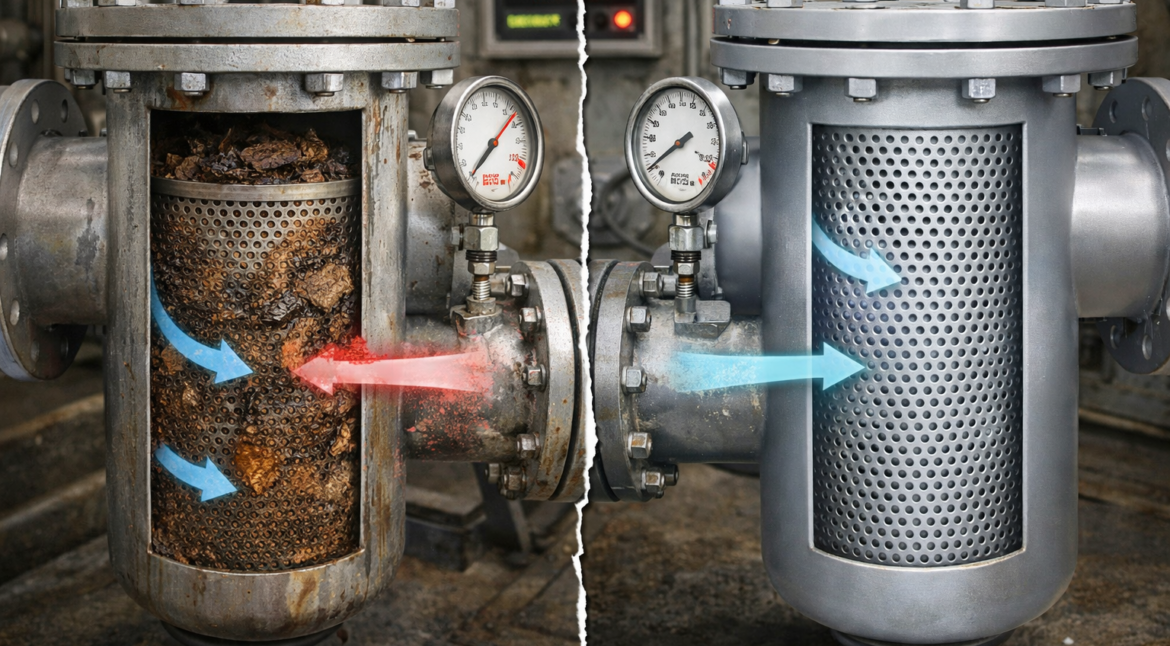
Engineering Troubleshooting Guide for Frequent Basket Strainer Blockage in Pump Protection Systems
Introduction
In many industrial fluid handling systems, basket strainers are installed upstream of pumps as a first-line mechanical protection device. Their function appears straightforward — stop debris before it reaches sensitive rotating equipment. However, in real plant conditions, frequent basket strainer choking can quickly become a recurring operational disturbance rather than a routine maintenance task.
Maintenance teams often begin noticing subtle performance drift. Differential pressure trends slowly upward. Cleaning intervals shorten. Pump behaviour becomes less stable during production peaks. Over time, what initially feels like normal fouling can escalate into suction starvation, cavitation exposure, unplanned stoppages, and rising lifecycle cost.
This troubleshooting guide takes a structured engineering view of why basket strainers choke frequently in pump protection applications. The objective is not only to identify immediate causes but to help reliability teams understand how the restriction develops, how to diagnose it logically, and when continued cleaning is no longer a sustainable solution.
Why Frequent Basket Strainer Choking Becomes a Serious Pump Reliability Issue
A basket strainer should never be treated as a passive accessory. During sustained operation, it becomes a dynamic hydraulic restriction point in the suction system. As contamination accumulates on the mesh, the effective open flow area gradually reduces. This increases suction line resistance and directly influences pump operating stability.
In practical terms, performance deterioration often follows a recognizable pattern:
- Differential pressure across the strainer begins to rise steadily
- Pump suction pressure margin reduces — sometimes unnoticed initially
- Flow stability deteriorates during peak demand conditions
- Pump motor load increases as hydraulic losses build
Operators often notice that even after cleaning, performance recovery is incomplete or short-lived. Production teams may begin scheduling unplanned cleaning shutdowns simply to maintain throughput.
One practical observation from field experience is that repeated choking is frequently tolerated as “normal dirty service behaviour” until pump reliability starts visibly degrading. At that stage, consequences can include:
- Cavitation damage due to NPSH margin reduction
- Mechanical seal distress from hydraulic instability
- Flow imbalance affecting downstream process control
- Higher energy consumption for the same output
Observable Symptoms of Basket Strainer Choking in Pump Protection Applications
Frequent basket strainer blockage rarely develops without measurable signals. Engineers monitoring system behaviour can often detect warning signs well before full suction restriction occurs.
Pressure and Flow Indicators
- Gradual increase in differential pressure across the strainer
- Reduced pump suction pressure during high production load
- Fluctuating discharge flow despite constant pump speed
- Unexpected decline in overall system throughput
Contamination Behaviour Signals
- Faster-than-expected debris accumulation during cleaning inspections
- Formation of compacted sludge layers or fibrous bridging on mesh
- Visible corrosion flakes or scale fragments present in the basket
Mechanical Behaviour Changes
- Audible change in pump sound — often described as a harsher hydraulic tone
- Rising motor current at steady flow conditions
- Mild vibration fluctuations or unstable bearing temperature trends
Operator and Maintenance Signals
- Cleaning frequency increasing from monthly to weekly or even daily
- Temporary bypass use becoming more frequent during peak demand
- Pump trips or alarms triggered during production ramp-up
- Maintenance reports indicating incomplete differential pressure recovery
In many installations, operators intuitively recognize these symptoms but may underestimate their long-term reliability impact.
How Basket Strainer Choking Develops from Hidden Restriction to Pump Breakdown
Understanding the failure timeline helps reliability teams respond before performance loss becomes severe.
Hidden Degradation Phase
Initially, contamination begins accumulating unevenly across the basket surface. Differential pressure may increase only slightly — for example, from 0.1 bar to 0.2–0.25 bar — remaining within perceived acceptable limits. Since pump flow still appears adequate, investigation is often delayed.
Cleaning intervals may shorten informally without structured trend analysis.
Escalation Triggers
Certain operating events can rapidly accelerate choking behaviour:
- Tank bottom disturbance releasing settled solids into suction lines
- Production ramp-up requiring higher flow velocity through the strainer
- Temperature drop increasing fluid viscosity and adhesion tendency
- Process upset introducing unexpected contamination surge
During these periods, the debris layer thickens quickly, restricting flow and reducing available NPSH margin.
Sudden Breakdown Behaviour
Once restriction reaches a critical threshold, suction pressure may drop sharply. Pumps can experience:
- Cavitation onset
- Flow collapse or oscillation
- Emergency shutdown for manual strainer cleaning
This transition from gradual fouling to sudden hydraulic instability is a common pattern in pump protection systems.
Engineering Root Causes Behind Frequent Basket Strainer Blockage
Frequent choking rarely has a single cause. It usually reflects an interaction between contamination characteristics, equipment sizing, installation behaviour, and maintenance practices.
Process Condition Related Causes
High contamination loading is often the dominant contributor. During intermittent transfer operations, solids can settle in pipelines and mobilize when pumping resumes.
During tank unloading, rust flakes accumulated at the vessel bottom enter the suction line, rapidly consuming the strainer’s dirt holding capacity.
Choking events occur repeatedly at startup or after prolonged idle periods.
Basket Strainer Design or Sizing Limitations
If the strainer’s free flow area or dirt holding capacity is insufficient for actual service conditions, restriction develops faster than anticipated.
A strainer originally specified for relatively clean utility service is later used in a slurry or contaminated recycle loop.
Cleaning frequency increases noticeably during production ramp-up or throughput expansion.
Contamination Profile and Micron Rating Mismatch
Particle shape and behaviour influence fouling severity. Fibrous materials may bridge mesh openings, while sticky or polymerizing solids form coating layers.
Polymer gel formation during temperature fluctuation blocks fine mesh baskets.
Mesh appears laminated or smeared rather than filled with discrete particles.
Installation or Hydraulic Disturbance Issues
Flow maldistribution inside the strainer housing can accelerate localized choking.
A short suction spool or abrupt elbow upstream induces swirl, concentrating debris on one side of the basket.
Fouling pattern is uneven, with partial blockage zones.
Maintenance Practice and Cleaning Behaviour
Delayed cleaning allows debris compaction, reducing permeability even after washing.
Slightly deformed or corroded baskets are reinstalled repeatedly to avoid downtime.
Baseline differential pressure gradually increases after each cleaning cycle.
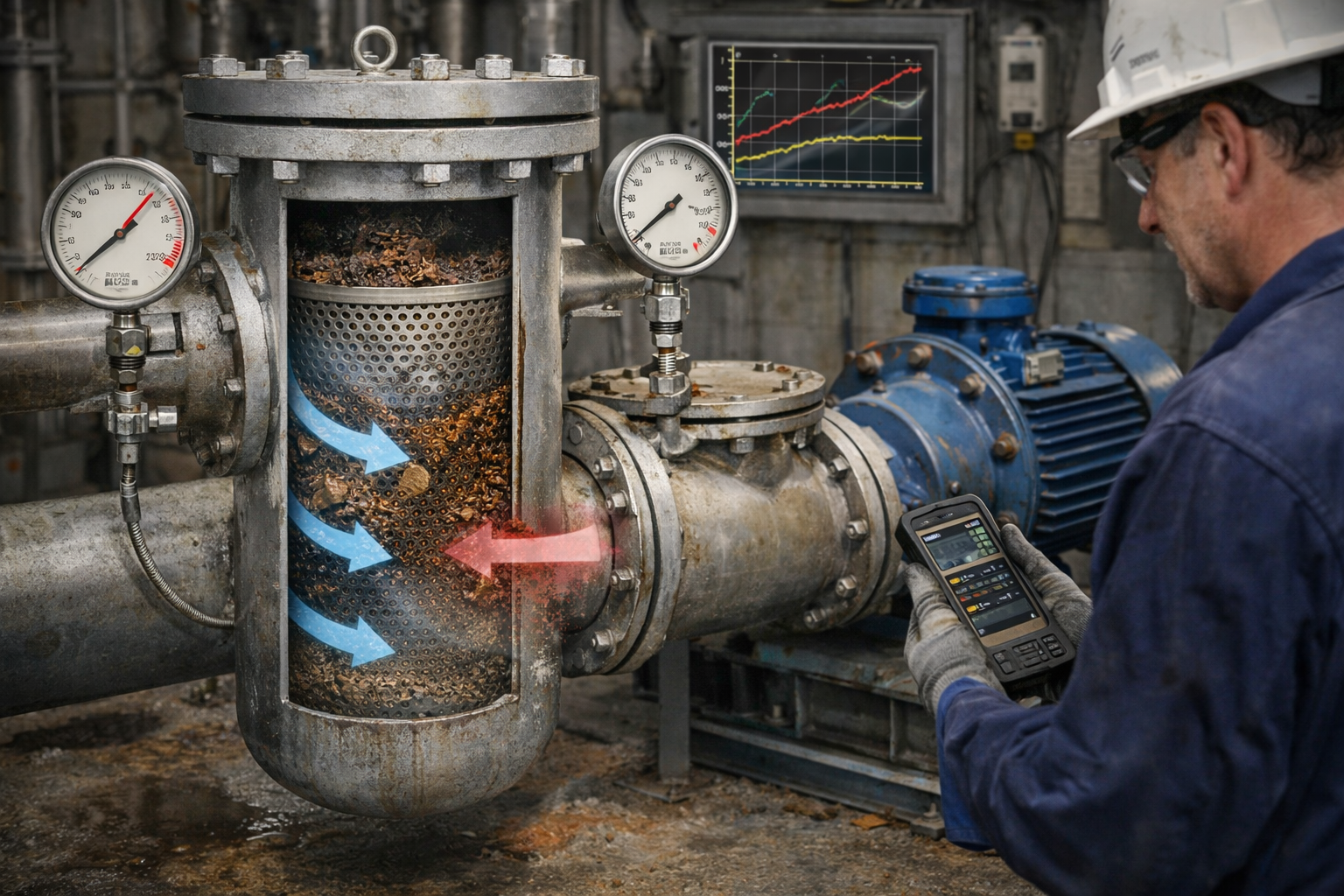
Step-By-Step Troubleshooting Workflow for Frequent Basket Strainer Choking
A systematic diagnostic approach prevents unnecessary component replacement or process disruption.
Step 1 — Visual Inspection
- Check basket integrity, mesh deformation, or corrosion thinning
- Observe contamination type, particle size, and distribution pattern
- Inspect sealing surfaces and gasket positioning
Step 2 — Operating Parameter Verification
- Review differential pressure trend history and alarm thresholds
- Compare actual flow demand with design capacity
- Assess pump suction pressure and NPSH margin behaviour
Step 3 — Isolation or Bypass Testing
- Temporarily bypass the strainer under controlled and safe conditions
- Observe whether pump stability or flow improves
This confirms whether restriction originates from the strainer rather than downstream valves or piping.
Step 4 — Component Condition Assessment
- Inspect for mesh collapse due to suction pulsation or vacuum conditions
- Verify proper basket seating and internal support
- Examine housing internals for debris retention pockets
Step 5 — Corrective Action Sequencing
- Perform thorough cleaning and correct reinstallation
- Reassess micron rating suitability for contamination profile
- Review sizing calculations if choking persists
How Operating Conditions Influence Basket Strainer Choking Severity
Process variability plays a major role in fouling behaviour.
High Flow Demand
Higher velocity increases particle transport but also compacts debris layers against the mesh, accelerating restriction.
Temperature Variation
Viscosity shifts alter particle suspension characteristics. Higher viscosity fluids reduce shear forces that normally help prevent deposition.
Contamination Surge
Unexpected solids influx can rapidly consume available dirt holding capacity, causing sudden differential pressure spikes.
Cyclic Production Loads
During low demand, solids may settle in pipelines. Restart conditions mobilize this material, increasing choking frequency.
Equipment Aging
Corrosion within pipelines or tanks generates additional particulate. Over time, worn baskets may lose structural rigidity, reducing effective open area.
Preventing Frequent Basket Strainer Blockage in Pump Protection Systems
Preventive reliability discipline significantly improves system stability.
- Select strainers with adequate free flow area relative to maximum flow velocity
- Choose micron rating based on contamination behaviour rather than theoretical particle size
- Monitor differential pressure continuously and establish realistic alarm limits
- Implement planned cleaning intervals driven by trend analysis
- Ensure thorough flushing during commissioning or post-maintenance restart
- Train operators to recognize early hydraulic instability signals
In continuous production environments, preventive sizing decisions often have a direct impact on uptime and maintenance workload.
When Cleaning Is Not Enough — Repair vs Replace vs Upgrade Basket Strainer
Frequent choking often prompts a broader engineering decision: continue maintaining the existing strainer or modify the system.
Cleaning Is Sufficient When
- Differential pressure returns to normal baseline after maintenance
- Choking correlates with temporary contamination events
- Pump operates within original design envelope
Replacement Becomes Necessary When
- Mesh deformation, corrosion, or fatigue cracking is evident
- Dirt holding capacity reduces progressively
- Differential pressure recovery becomes incomplete
Upgrade or Redesign Is Logical When
- Chronic choking persists despite disciplined maintenance
- Process throughput increases beyond original design
- Contamination profile shifts toward fibrous or gel-forming solids
- Continuous operation demands duplex or higher-capacity filtration
One practical lifecycle observation is that repeated downtime for cleaning can exceed the capital cost of upgrading suction filtration systems.
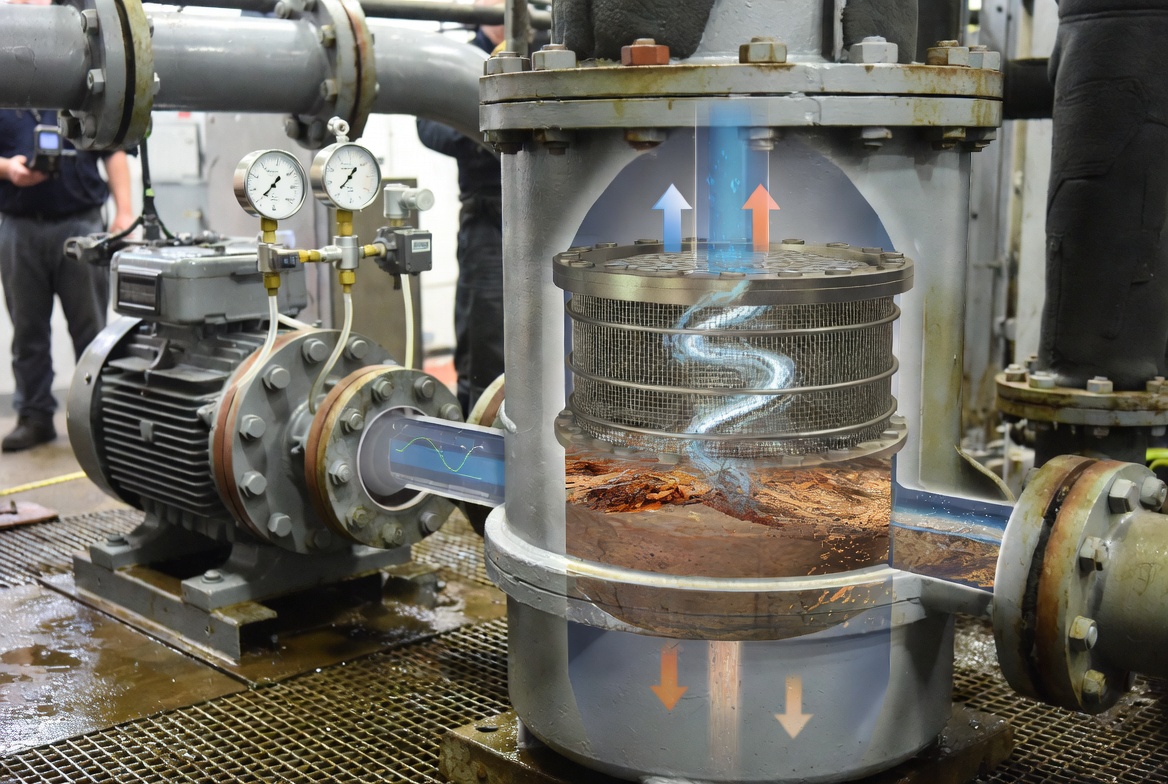
Practical Field Insights from Repeated Basket Strainer Choking Cases
Field investigations reveal recurring patterns:
- Pumps are frequently oversized for future expansion, but strainers remain undersized
- Differential pressure trends are ignored as long as pumps continue operating
- Temporary bypass arrangements gradually become permanent practices
- Startup debris following shutdown is underestimated during commissioning
- Fibrous contamination sources upstream are rarely addressed
These operational behaviours can unintentionally convert manageable fouling into chronic reliability problems.
Conclusion
Frequent basket strainer choking should be viewed as a hydraulic reliability signal rather than a routine maintenance inconvenience. The restriction directly affects suction conditions, pump stability, and overall process throughput.
Systematic troubleshooting — combining symptom recognition, structured root cause investigation, and operating condition analysis — allows engineers to distinguish between temporary contamination events and fundamental design limitations.
By monitoring differential pressure trends, understanding contamination loading behaviour, and making timely decisions on cleaning, replacement, or upgrade strategies, plants can significantly improve uptime and reduce emergency interventions. Ultimately, proactive suction filtration management protects rotating equipment and strengthens process reliability.
FAQ — Basket Strainer Choking Troubleshooting
Sudden DP increase often results from contamination surge events such as tank disturbance, corrosion scale release, or upstream process upset.
Cleaning intervals should be based on DP trend behaviour and contamination loading rather than fixed calendar schedules.
Yes. Overly fine mesh increases suction restriction, reducing NPSH margin and increasing cavitation likelihood.
Frequent choking during peak flow, incomplete DP recovery after cleaning, and unstable pump operation are strong indicators.
Duplex systems enable cleaning without interrupting flow and are often preferred where contamination levels are unpredictable.
Higher flow velocity mobilizes settled solids and compacts debris layers against the mesh surface.
Abrasive particles or large debris can deform or tear mesh, reducing effective filtration performance.
Evaluation involves contamination concentration, expected cleaning interval, flow rate, and acceptable differential pressure limits.