


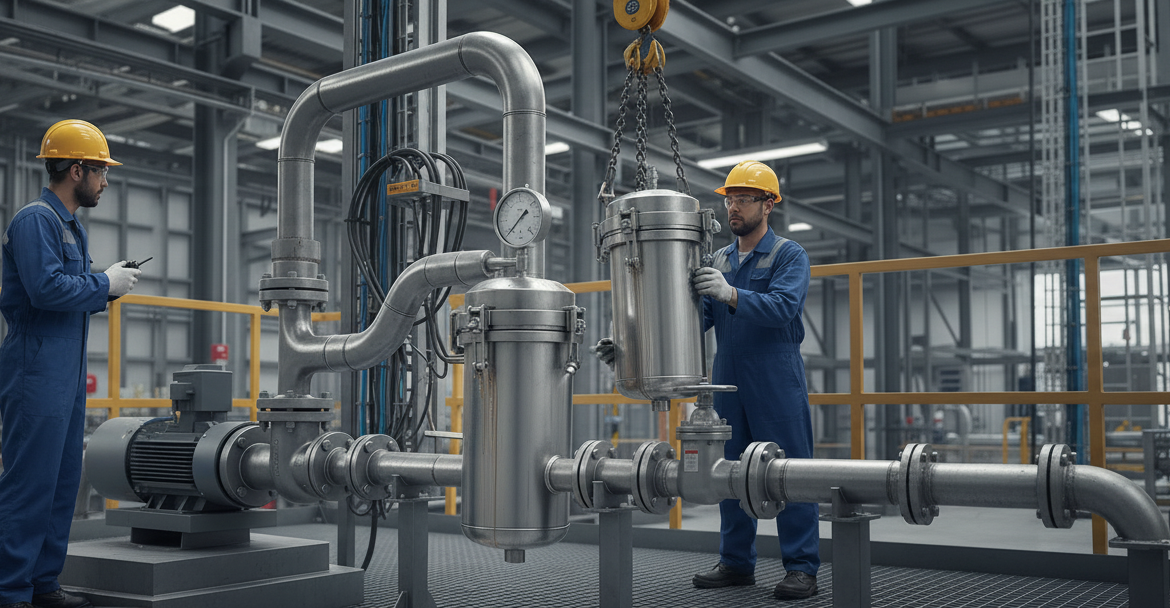
Bag filter housings are widely used across process plants to protect pumps, valves, heat exchangers, and product quality. Under normal conditions, these units operate quietly and reliably, often receiving attention only during routine maintenance. However, when bag filter housing leakage begins to appear — even as minor seal sweating — it typically indicates deeper hydraulic, mechanical, or maintenance-related stresses developing within the system.
In real plant conditions, leakage is frequently treated as a simple gasket issue. Operators may tighten clamps or replace seals, and the line is restarted. But when leakage returns within a few cycles, it becomes important to step back and examine whether pressure behaviour, contamination loading, or system sizing limitations are contributing to progressive reliability degradation.
This guide explains how leakage develops, what measurable symptoms engineers should monitor, how to diagnose root causes systematically, and when repair or equipment upgrade becomes the practical engineering decision.
Understanding Bag Filter Housing Leakage Behaviour in Industrial Filtration
Bag filter housing leakage most often originates at sealing interfaces such as lid flanges, clamp joints, vent connections, or drain ports. The failure mechanism is rarely sudden. During sustained operation, seal compression stability gradually reduces due to thermal cycling, chemical exposure, and fluctuating differential pressure.
As degradation progresses, filtration performance may begin to change in subtle ways:
- Differential pressure variability increases
- Filtration cycle duration becomes shorter
- Minor internal bypass begins to affect contaminant retention
- Pump operation shifts closer to load limits
Operators often notice that these changes occur before visible leakage develops. One practical observation from plant audits is that housekeeping complaints about dampness near filtration skids frequently precede measurable performance instability.
Investigating early prevents escalation into contamination carryover, unstable downstream flow, and increased lifecycle cost.
Observable Symptoms of Bag Filter Housing Leakage Problems
Recognizing realistic plant symptoms helps maintenance teams intervene before unplanned shutdown occurs.
Pressure and Flow Indicators
- Differential pressure readings becoming noisy or trending upward
- Gradual increase in pump motor current during peak production
- Downstream flow instability or fluctuating control valve behaviour
- Reduced throughput when demand increases
Contamination and Filtration Performance Signs
- Particle breakthrough despite visually intact filter bags
- Unexpectedly frequent bag replacement requirement
- Accelerated fouling of heat exchangers or instruments
Mechanical Behaviour Changes
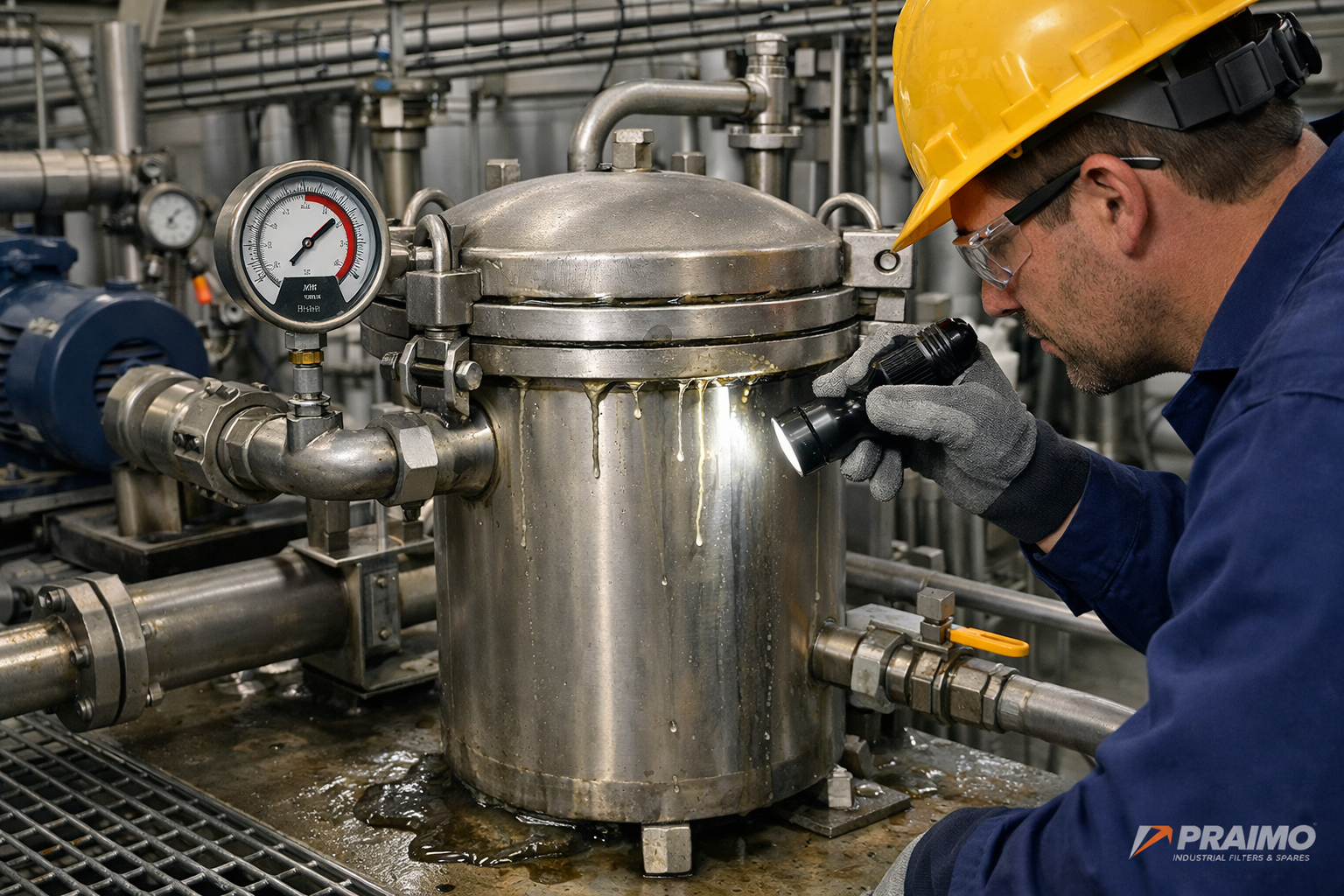
- Seal sweating visible around housing lid or flange
- Dripping or spray developing at high flow demand
- Clamp vibration or progressive loosening
- Slight lid movement during pressure pulses
Operator and Maintenance Signals
- Liquid accumulation below filtration skid
- Repeated clamp tightening during shifts
- Maintenance logs showing recurring gasket replacement
- Leakage appearing mainly during start-up or peak load conditions
In many installations, engineers find it useful to track symptom severity progression. Minor seepage during high flow can develop into continuous leakage once contamination loading or hydraulic stress increases.
How Bag Filter Housing Leakage Develops Over Time
Understanding failure progression improves diagnostic accuracy and reduces unnecessary component replacement.
Hidden Degradation Phase
Initially, elastomeric seals lose resilience due to temperature exposure and chemical compatibility effects. At the same time, uneven contamination loading across the filter bag increases localized pressure stress.
During this phase:
- Differential pressure appears acceptable but fluctuates
- Leakage occurs intermittently
- Temporary maintenance actions restore stability
A common misinterpretation is assuming that fluctuating DP is instrumentation error. In practice, it often reflects developing hydraulic imbalance within the filtration housing.
Escalation Triggers
Leakage becomes more noticeable when operating conditions change, such as:
- Sudden contamination surge events
- Pump ramp-up increasing system flow
- Isolation of parallel filtration units redistributing load
Under these conditions, seal seating surfaces may lift microscopically due to pressure pulsation.
Sudden Breakdown Behaviour
At advanced stages:
- Continuous dripping or spray may develop
- Internal filtration bypass increases contamination risk
- Safety exposure rises, especially in chemical service
Most failures result from cumulative fatigue rather than a single event.
Engineering Root Causes of Bag Filter Housing Leakage
Leakage usually originates from interacting process, mechanical, and maintenance factors.
Process Condition Related Causes
Hydraulic pulsation and viscosity variation significantly influence sealing performance. As fluid viscosity increases, pressure loss across the filter bag rises, increasing internal housing stress.
A batch transfer line handling high-viscosity resin shows leakage only during peak transfer periods.
Leakage reduces when throughput is temporarily lowered.
A practical field insight is that operators sometimes attribute this to “dirty filters,” replacing cartridges unnecessarily without addressing fluid conditioning.
Design or Sizing Related Causes
Undersized housings often operate near pressure limits. Even moderate contamination loading can cause differential pressure spikes.
Single-bag housing installed on line with seasonal production surges.
Chronic leakage persists despite frequent gasket replacement.
In many installations, this becomes visible only after throughput targets increase beyond original design assumptions.
Contamination Profile Mismatch
Sticky or fibrous particles create uneven bag deformation. Abrasive fines may damage sealing surfaces or distort support baskets.
Solvent extraction system experiences leakage after high-solid feed processing.
Seal wear localized to one section of the housing.
Installation or Sealing Mistakes
Improper gasket seating or trapped debris can lead to immediate leakage after restart.
Maintenance shutdown followed by leakage during commissioning.
Leakage improves after careful reassembly.
One practical field insight is that technicians under time pressure may overlook small contamination at flange faces, which later becomes a persistent leakage pathway.
Maintenance Practice Issues
Extending bag change intervals increases differential pressure stress on sealing systems. Reusing compressed gaskets reduces containment reliability.
Maintenance postponed during peak production months.
DP trend shows prolonged plateau before leakage onset.
Stepwise Troubleshooting of Bag Filter Housing Leakage
A logical diagnostic sequence prevents unnecessary downtime.
1. Visual Inspection
- Identify leakage location precisely
- Inspect gasket condition and seating cleanliness
- Observe clamp alignment and mechanical wear
2. Operating Parameter Verification
- Compare actual flow rate with housing design rating
- Review differential pressure history
- Identify pump ramp-up or surge events
3. Isolation or Bypass Testing
- Reduce flow temporarily to observe leakage response
- Isolate parallel filtration lines to confirm load redistribution effects
4. Component Condition Assessment
- Inspect filter bag collapse or distortion
- Verify basket alignment
- Check clamp integrity and hinge fatigue
5. Corrective Action Sequence
- Clean sealing surfaces thoroughly
- Replace gasket and filter bag where DP overload occurred
- Apply uniform tightening sequence
- Stabilize operating conditions before restart
In practice, engineers often find that reducing differential pressure before resealing improves long-term results compared to tightening under full load.
How Operating Conditions Increase Bag Filter Leakage Risk
Operating environment strongly influences leakage severity.
Rapid throughput increases elevate differential pressure and sealing stress, particularly in aging housings.
Thermal cycling can harden elastomers and cause minor structural distortion.
Heavy particulate loading accelerates DP rise and uneven bag deformation.
Frequent start-stop cycles introduce hydraulic shocks and clamp fatigue.
Long-term exposure leads to seating surface wear and corrosion.
Maintenance planners benefit from correlating operating condition changes with leakage history.
Preventing Bag Filter Housing Leakage in Industrial Systems
Practical reliability measures include:
- Selecting housing size with adequate flow margin
- Choosing micron ratings that control DP buildup
- Monitoring differential pressure continuously
- Maintaining commissioning cleanliness
- Training operators to avoid sudden flow ramping
Plants that treat filtration performance as a process stability parameter rather than a consumable expense typically experience fewer chronic leakage events.
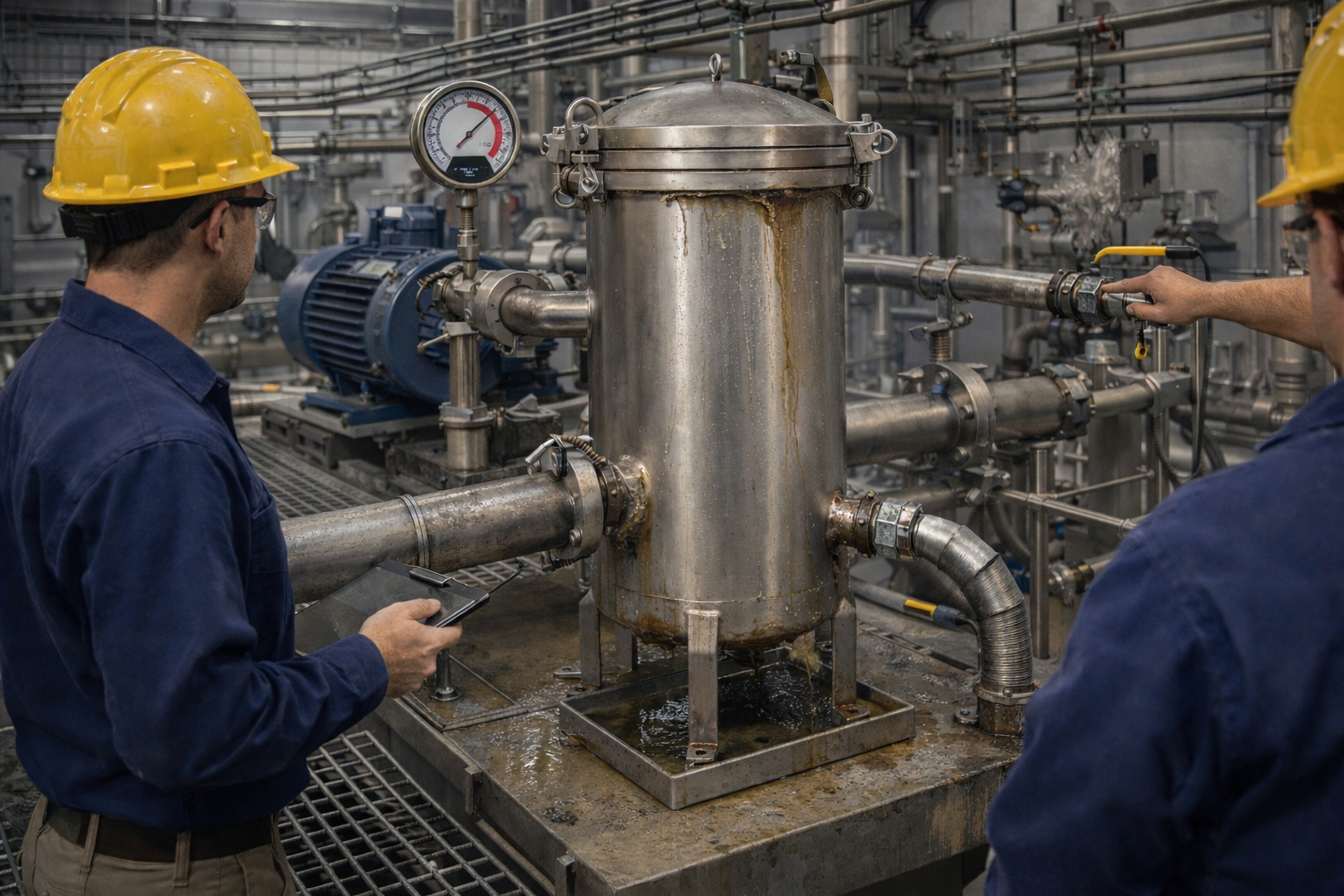
When to Repair, Replace Gasket, or Upgrade Bag Filter Housing
Engineers should evaluate corrective options based on performance trends.
Cleaning or Minor Repair is Sufficient When
- Leakage linked to temporary contamination surge
- DP remains within design range
- Housing structure shows no deformation
Consumable Replacement Becomes Necessary When
- Seal elasticity loss is evident
- Bag collapse contributes to pressure spikes
- Leakage recurs after tightening
System Redesign or Upgrade is Logical When
- Leakage occurs under normal rated operation
- Production expansion increases flow demand
- Maintenance cost and downtime escalate
In many installations, transitioning to multi-bag housings or improved pressure-rated designs provides better lifecycle reliability than repeated repairs.
Practical Plant Lessons from Recurring Bag Filter Leakage Cases
Field investigations reveal common patterns:
- Tightening clamps without reducing DP accelerates seal fatigue
- Leakage often attributed to gasket quality rather than hydraulic overload
- Parallel filtration line isolation can create unexpected surge loading
- Incorrect bag collar selection may prevent proper sealing
- Maintenance teams may overlook DP history when diagnosing leakage
These observations highlight the importance of integrating operational data into troubleshooting decisions.
Conclusion
Bag filter housing leakage is rarely an isolated mechanical defect. More often, it represents an early warning sign of hydraulic instability, contamination stress, or equipment sizing limitations.
Systematic troubleshooting enables engineers to:
- Identify degradation mechanisms before failure escalates
- Protect downstream equipment and product quality
- Reduce filtration system lifecycle cost
Proactive monitoring of differential pressure behaviour and operating conditions supports a transition from reactive repair toward predictive reliability management.
FAQ — Bag Filter Housing Leakage Troubleshooting
Higher flow increases differential pressure across the filter bag, raising internal housing stress and reducing seal compression effectiveness.
Sustained DP exposure accelerates compression set and may allow micro-lifting at sealing interfaces.
Replacement frequency depends on pressure cycles, temperature exposure, and chemical compatibility. DP trend analysis offers better guidance than fixed schedules.
Improper fit can cause uneven loading and distortion, affecting sealing performance.
Not always. Installation quality and contamination surges can contribute. However, recurring leakage under normal conditions often indicates sizing limitations.
Rapid particulate loading increases differential pressure quickly, stressing seals and potentially initiating leakage.
Debris trapped at sealing interfaces or uneven gasket seating can cause leakage once pressure builds.
Indicators include contamination spikes downstream, reduced filtration cycle duration, and unstable differential pressure trends.