


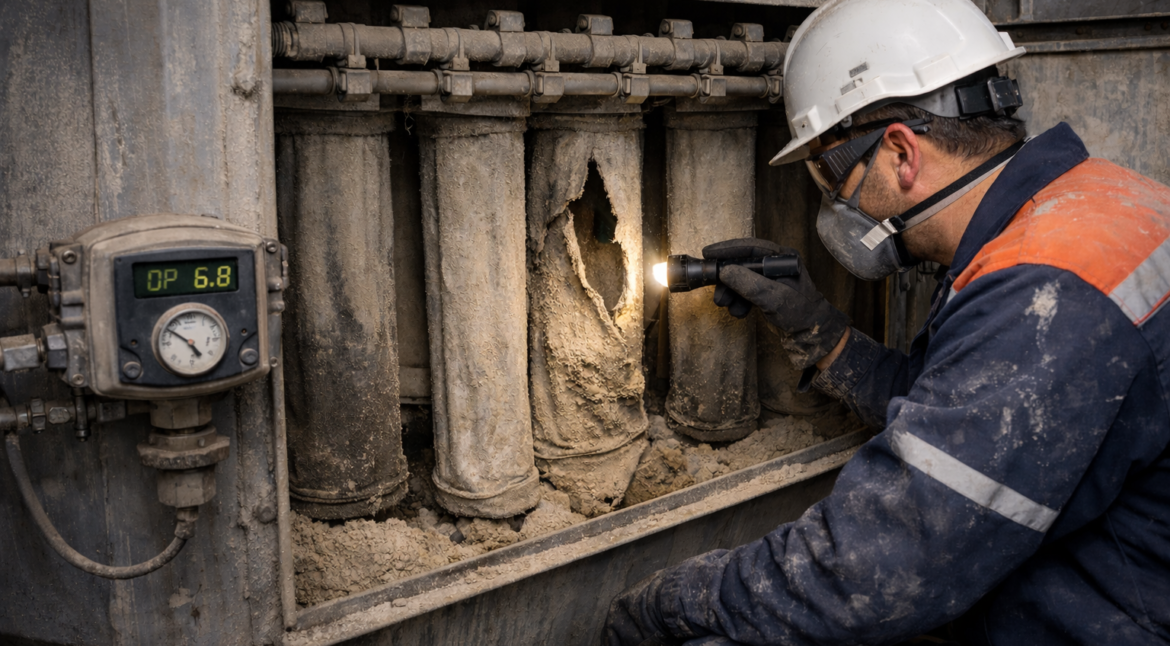
Dust collection systems are often treated as background equipment in many process plants — until a performance deviation suddenly draws attention. One of the most disruptive failures maintenance teams encounter is unexpected bursting or tearing of dust collector filter bags.
In real plant conditions, this issue typically surfaces during peak production demand, after shutdown restarts, or when dust characteristics change without corresponding operating adjustments. When filter bags fail structurally, operators often notice immediate suction reduction, visible emission spikes, and unstable airflow behaviour across multiple extraction points.
Understanding why dust collector filter bags fail, how the degradation develops, and how to troubleshoot the condition methodically is essential for maintaining plant reliability, protecting downstream equipment, and avoiding emergency maintenance escalation.
Understanding Dust Collector Filter Bag Burst Failure
Industrial baghouse filter bags are designed to withstand continuous airflow loading, progressive dust cake formation, and repeated pulse cleaning shocks. During sustained operation, however, multiple stress factors begin to influence fabric integrity and airflow distribution.
Failure rarely occurs as a single sudden event. Instead, performance typically deteriorates through identifiable stages:
- Gradual dust cake thickening increases differential pressure (DP)
- Uneven airflow distribution overstresses specific bags
- Pulse cleaning shock or load surge eventually triggers fabric rupture
Once a bag bursts, dust bypasses the filtration zone and enters clean air pathways. This leads to immediate operational consequences, including:
- Reduced suction effectiveness at pickup points
- Increased fan power consumption due to unstable flow resistance
- Dust carryover into downstream ducts and equipment
One practical observation is that teams often focus only on replacing damaged bags. However, unless airflow behaviour and loading conditions are reviewed, the same failure pattern frequently repeats.
Real Plant Symptoms Before and After Filter Bag Burst
Maintenance teams usually first identify abnormal differential pressure behaviour. Typical indicators include:
- Steadily rising DP trend over multiple shifts
- Sudden DP drop following prolonged high resistance
- Unstable airflow or suction fluctuation at dust pickup hoods
- Increased fan motor current variation
Operators often notice that a sudden DP drop after a long rise is not necessarily an improvement. In many installations, it indicates that structural bag failure has reduced filtration resistance.
Contamination and Emission Signs
When filter bags rupture, filtration efficiency reduces immediately. Observable signals include:
- Visible dust plume at stack outlet
- Dust accumulation in clean air plenum
- Increasing fouling inside downstream ducts
- Dust deposits appearing on nearby equipment surfaces
Environmental compliance alarms or opacity monitors may also trigger alerts during this stage.
Mechanical Behaviour Changes
Airflow instability can influence mechanical system behaviour in subtle ways:
- Fan noise pattern changes due to turbulence or flow redistribution
- Damper response becomes inconsistent during load variation
- Local vibration levels may increase in duct sections
These symptoms are sometimes misinterpreted as fan or structural issues rather than filtration failure.
Maintenance and Operator Signals
Operational feedback often provides early warning signs:
- Continuous or unusually frequent pulse cleaning cycles
- Shortened filter bag replacement intervals
- Increased housekeeping workload around collector areas
- Hopper choking complaints or irregular discharge behaviour
During sustained operation, such behavioural indicators commonly precede catastrophic bag rupture.
How Dust Collector Bag Failure Develops Over Time
Understanding the degradation timeline allows engineers to intervene before sudden failure occurs.
Hidden Degradation Phase
Under normal filtration conditions, dust cake forms uniformly on bag surfaces. If cleaning efficiency declines or airflow distribution becomes uneven, this layer hardens and restricts permeability.
Localized loading zones may develop due to inlet turbulence, hopper discharge inefficiency, or compartment imbalance.
Escalation Triggers
Failure probability increases sharply during certain events:
- Sudden production load increases
- Pulse jet pressure spikes during aggressive cleaning adjustments
- Moisture ingress causing sticky or cohesive dust behaviour
- Dust re-entrainment due to hopper blockage
These triggers elevate mechanical stress on fabric zones that may already be weakened by fatigue or abrasion.
Sudden Breakdown Behaviour
Eventually, tensile strength limits are exceeded. Common rupture patterns include:
- Longitudinal tearing along the bag length
- Seam or snap-band failure near mounting zones
- Collapse followed by burst during pressure reversal
At this stage, emission levels rise rapidly and suction stability deteriorates across the system.
Engineering Root Causes of Dust Collector Filter Bag Rupture
Process Condition Related Causes
High air-to-cloth ratios significantly increase fabric loading stress. When production demand exceeds original collector design assumptions, airflow velocity through bags rises beyond optimal limits.
For instance, during grinding mill surge operation, DP may climb progressively. Maintenance teams frequently observe bag rupture shortly after sustained peak throughput periods.
DP spikes consistently align with production load peaks.
Design or Sizing Related Causes
Undersized baghouses often create chronic airflow maldistribution. Certain compartments experience higher velocity exposure, resulting in repeated localized failures.
This situation is common in retrofit installations where duct routing changes are implemented without recalculating collector capacity.
Repeated bag rupture in the same compartment row.
Contamination Profile Mismatch
Dust characteristics strongly influence filter bag lifecycle. Abrasive particles gradually erode fibers, while hygroscopic powders may form impermeable cakes that resist cleaning.
In cement or silica-heavy applications, filter bags can fail prematurely due to continuous micro-abrasion combined with elevated DP loading.
Hardened dust cake bonded firmly to fabric surface.
Installation or Sealing Mistakes
Improper installation introduces mechanical stress from the beginning of operation. Bags may rub against cage wires or sit unevenly due to incorrect snap-band seating.
During shutdown inspections, teams often identify:
- Misaligned cages
- Damaged mounting components
- Incorrect bag tensioning
Tear located near top cap or cage contact points.
Maintenance Practice Issues
Maintenance timing and cleaning strategy significantly influence reliability. Delayed hopper discharge allows dust to re-entrain, increasing loading intensity.
In some plants, pulse pressure is increased to reduce DP quickly. While effective in the short term, this approach can accelerate fatigue failure.
Rising compressed air consumption trend in pulse system.
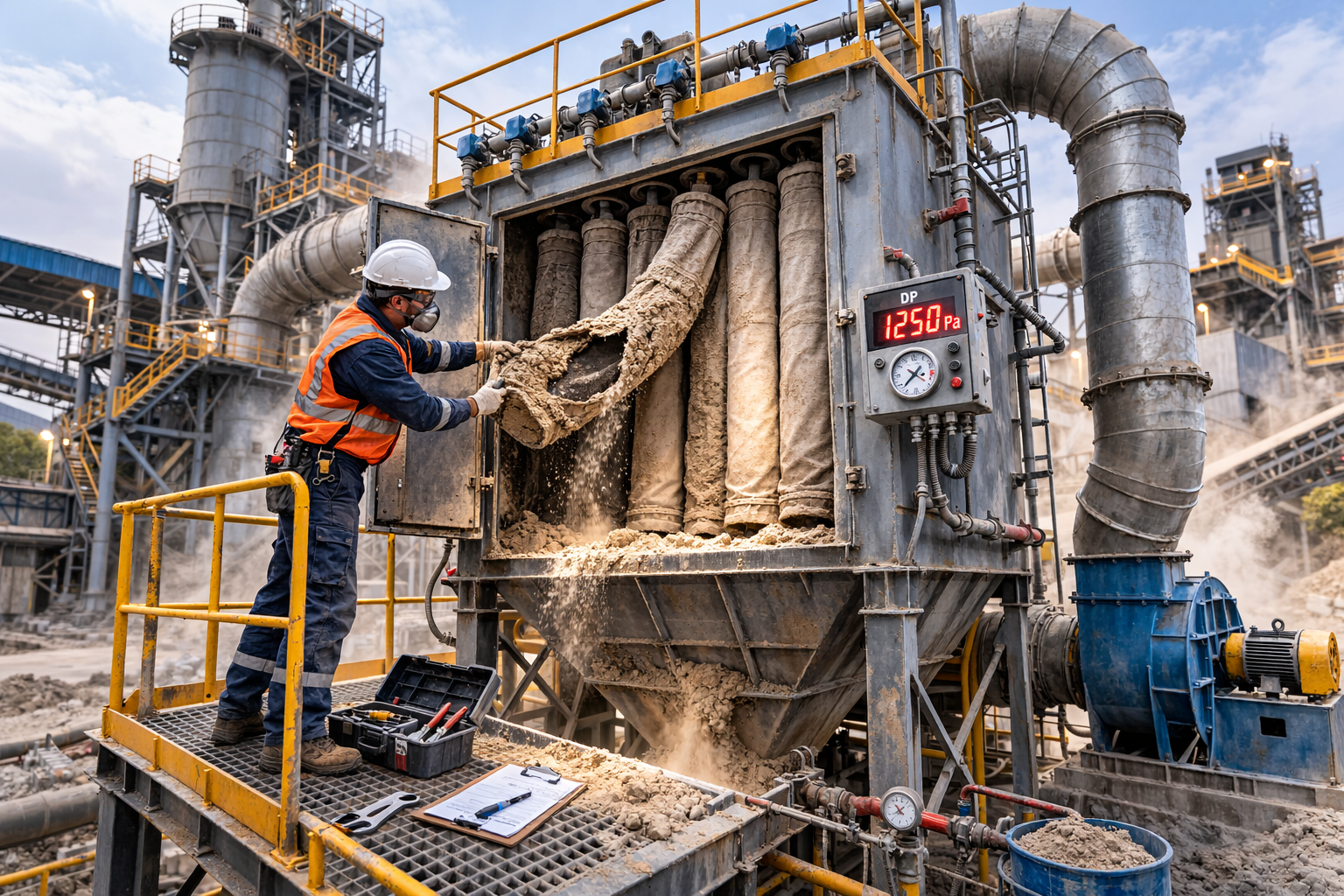
Practical Dust Collector Filter Bag Troubleshooting Workflow
A structured diagnostic sequence helps prevent misinterpretation and unnecessary component replacement.
Step 1 — Visual Inspection
- Check for visible dust emission at stack
- Inspect access doors and flange joints for leakage
- Observe hopper discharge condition
Step 2 — Differential Pressure Verification
- Compare current DP trend with historical baseline
- Identify sudden drops or abnormal escalation patterns
Step 3 — Airflow and Fan Load Review
- Analyse fan motor current behaviour
- Confirm damper positioning and suction stability
Step 4 — Hopper and Dust Handling Check
- Look for bridging or choking
- Verify rotary valve or screw conveyor operation
Step 5 — Pulse Cleaning System Assessment
- Measure header pressure consistency
- Check pulse valve sequencing response
Step 6 — Compartment Isolation Testing
- Isolate suspect compartments where possible
- Observe DP stabilization response
Step 7 — Physical Bag Inspection
- Examine fabric integrity
- Inspect cage corrosion, deformation, or sharp edges
Step 8 — Corrective Action Decision
- Clean or regenerate blinded bags
- Replace structurally damaged consumables
- Adjust airflow balance or pulse parameters
Why Bag Failure Risk Increases Under Certain Operating Conditions
Higher airflow increases tensile loading on fabric and accelerates dust cake buildup.
Thermal cycling gradually weakens stitching zones and reduces fabric flexibility.
Heavy dust loading events overwhelm cleaning cycles, causing rapid DP escalation.
Frequent start-stop operation introduces pressure pulsation fatigue.
Deformed cages and worn seals create uneven airflow exposure zones.
Preventing Dust Collector Filter Bag Failure
Reliable operation depends on disciplined monitoring and correct design assumptions:
- Select appropriate air-to-cloth ratio during system design
- Track DP trends rather than reacting only to alarm thresholds
- Optimize pulse pressure and cleaning frequency
- Implement scheduled inspection routines
- Maintain hopper cleanliness and discharge efficiency
- Train operators to recognize airflow instability signals
In many installations, consistent monitoring practices alone significantly extend filter bag service life.
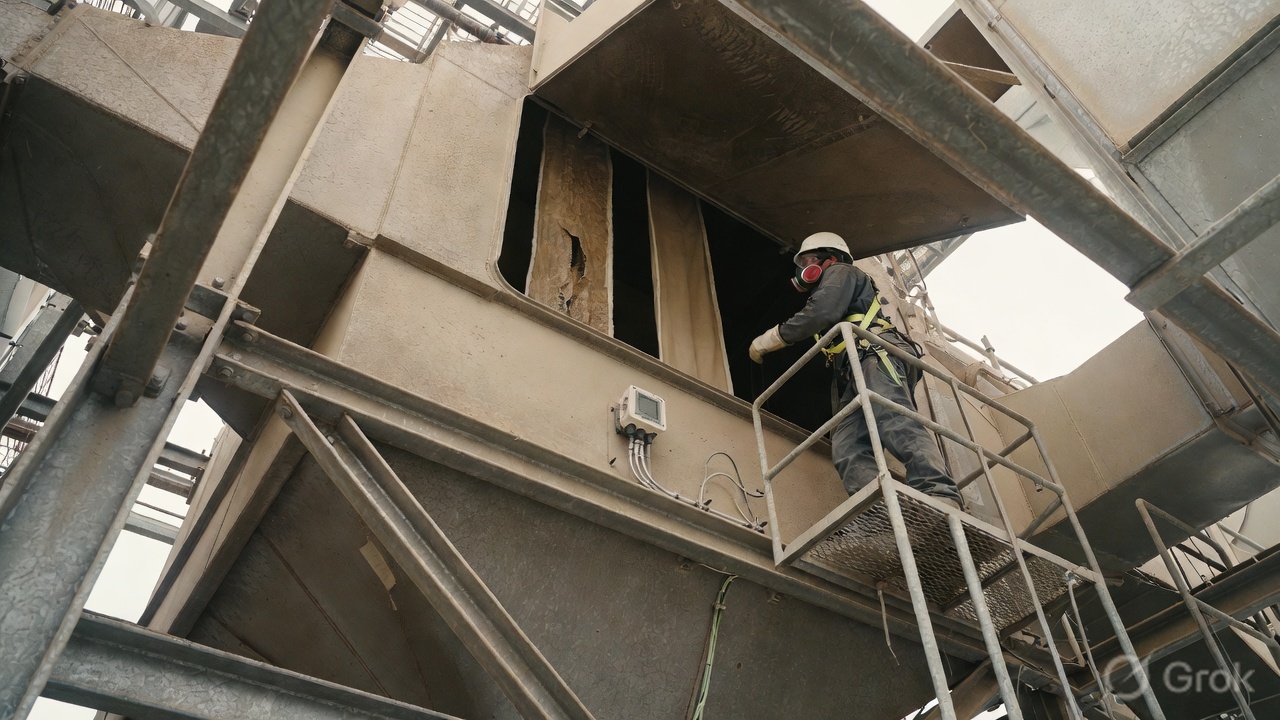
When to Repair, Replace or Upgrade Dust Collector Filter Bags
Cleaning or Repair Indicators
- Early-stage dust blinding
- Localized DP increase without structural damage
Replacement Indicators
- Visible tearing or seam deterioration
- Repeated premature failures
- Emission spikes even after cleaning
System Upgrade Indicators
- Chronic high DP despite new bags
- Production expansion beyond design airflow capacity
- Persistent compartment-level failures
In such cases, airflow redistribution, collector resizing, or improved fabric material selection often delivers better lifecycle performance.
Practical Field Insights — Common Plant Mistakes
One recurring observation across many plants is the tendency to focus on immediate DP reduction rather than root cause identification. Increasing pulse pressure or accelerating bag replacement schedules may provide temporary relief but rarely stabilizes long-term performance.
Other overlooked triggers include:
- Ignoring hopper choking warnings
- Mixing different filter bag materials within the same collector
- Operating collectors during heavy dust dumping activities
- Skipping airflow balancing after duct modification
These behaviours introduce hidden stress conditions that progressively shorten filter bag life.
Conclusion
Dust collector filter bag bursting is seldom an isolated consumable failure. It is more often the outcome of gradual performance degradation, operating condition stress, or underlying system design limitations.
A systematic troubleshooting approach — beginning with DP trend interpretation and extending to airflow diagnostics and physical inspection — enables maintenance teams to identify true failure drivers. Proactive monitoring and disciplined operating practices not only reduce emergency replacements but also improve overall plant reliability and environmental compliance.
In many real-world scenarios, understanding how dust collection systems respond to changing process conditions marks the transition from reactive maintenance to predictive reliability management.
FAQ — Dust Collector Filter Bag Troubleshooting
Sudden bursting typically follows prolonged high differential pressure combined with airflow surge or pulse cleaning shock that exceeds weakened fabric strength.
A sudden DP drop after extended resistance often indicates bag rupture or bypass leakage allowing unrestricted airflow.
Service life varies based on dust abrasiveness, airflow loading, temperature exposure, and maintenance discipline.
Yes. Excessive pulse pressure creates repeated mechanical shock that accelerates fabric fatigue and seam failure.
Emission monitoring, DP anomaly tracking, and compartment isolation testing can help identify failure zones.
Improper permeability selection can accelerate cake formation or allow abrasive penetration, both influencing bag lifecycle.
If airflow imbalance or hopper discharge issues remain unresolved, new bags may choke quickly and reduce system performance.
Moisture can harden dust cake, increasing resistance and creating tensile overload during cleaning cycles.