


In real plant conditions, a rising differential pressure (DP) across cartridge filters is rarely just a routine maintenance signal. More often, it reflects developing hydraulic resistance, contamination upset, or a filtration system operating closer to its limits than originally assumed. Maintenance engineers typically encounter this behaviour during peak production demand, after plant restart, or when batch transfer performance begins slowing without any obvious mechanical failure.
Left unchecked, increasing pressure drop can gradually reduce throughput, raise pump load, allow contamination carryover, and shorten cartridge life. This troubleshooting guide focuses on how cartridge filter pressure drop increases in industrial systems, how the degradation pattern develops, and how engineers can stabilize performance using structured diagnostic thinking.
Understanding Why Cartridge Filter Pressure Drop Increases in Industrial Systems
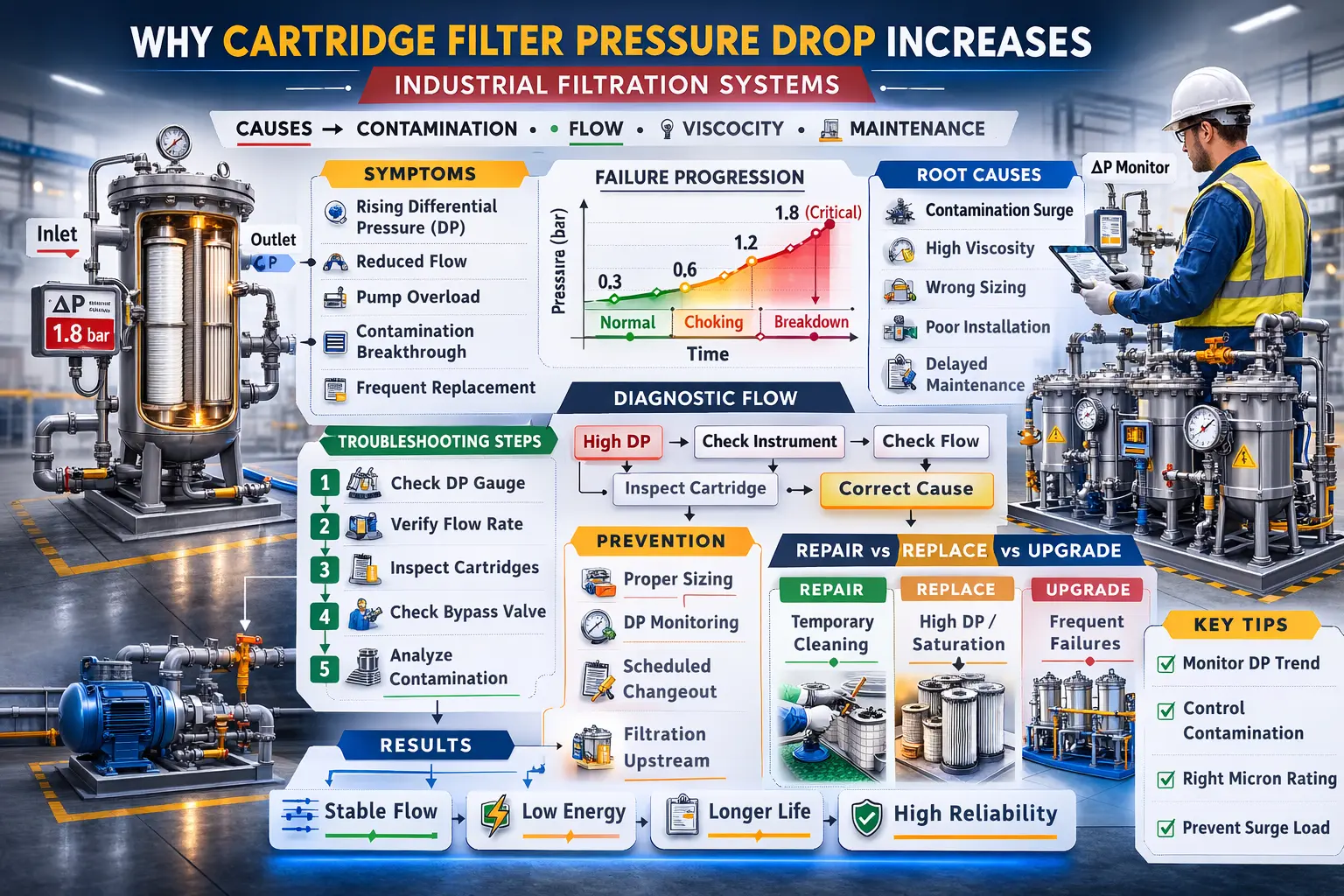
Cartridge filters inherently create resistance as fluid passes through the media structure. Over sustained operation, suspended solids accumulate within pores and pleats, increasing hydraulic resistance. Initially, the system often masks this behaviour. Pumps compensate by increasing discharge pressure, or control valves open further to maintain flow.
Operators often notice that everything appears normal until DP reaches a critical level. At that stage:
- Downstream flow becomes unstable
- Transfer times increase noticeably
- Pump efficiency begins to decline
- Cartridge replacement intervals shorten
One practical observation is that DP rise is frequently accepted as “normal fouling,” delaying investigation until production impact becomes visible. In reality, DP trend behaviour is one of the earliest reliability indicators in liquid filtration systems.
Observable Symptoms of High Differential Pressure in Cartridge Filter Housings
Pressure and Flow Indicators
- Gradual upward trend in differential pressure readings over operating cycles
- Reduced downstream flow despite constant pump speed or valve position
- Flow control valve oscillation or unstable pressure regulation
- Longer time required for tank filling or batch charging
Contamination Behaviour
- Unexpectedly fast cartridge choking compared to historical trend
- Contamination breakthrough when media structure deforms under load
- Higher particle counts detected in downstream equipment
Mechanical System Changes
- Rising pump motor current or increased discharge pressure
- Audible turbulence or flow noise inside filter housing
- Minor gasket sweating or flange leakage due to pressure stress
Operational and Maintenance Signals
- Frequent operator attention required for DP alarms
- Increased maintenance work orders for cartridge changeout
- Production scheduling disruptions caused by filtration bottlenecks
In many installations, operators first report “flow feels slower” long before DP alarms trigger. This subjective observation often precedes measurable hydraulic restriction.
How Cartridge Filter Pressure Drop Problems Develop Over Time
Operational and Maintenance Signals
During sustained operation, fine particles form a thin cake layer on cartridge surfaces. Flow redistributes unevenly across pleats, concentrating load in specific zones. DP rise is gradual and may remain within acceptable limits for extended periods.
Escalation Triggers
The situation can destabilize rapidly when system conditions change. Common triggers include:
- Contamination surge from upstream equipment wear or process upset
- Viscosity increase due to temperature variation or batch formulation change
- Sudden increase in flow demand during production ramp-up
These factors accelerate pore blockage and reduce effective filtration area.
Sudden Breakdown Behaviour
Once resistance crosses a threshold:
- DP increases sharply, sometimes within a single shift
- Pumps begin operating near overload conditions
- Downstream flow collapses or becomes highly unstable
- Cartridge deformation or pleat collapse may occur
In continuous plants, this behaviour can escalate into unplanned shutdown or batch rejection.
Engineering Root Causes of Rising Pressure Drop in Cartridge Filtration
Process Condition Related Causes
Changes in fluid properties can significantly influence filtration performance.
Higher viscosity increases frictional resistance through media pores. Even a moderate temperature drop can reduce permeability enough to raise DP.
Resin or polymer transfer lines often experience DP spikes during cold start operations when fluid conditioning is incomplete.
DP rises while contamination trend remains stable, and pump discharge pressure increases to compensate.
A practical field insight is that operators sometimes attribute this to “dirty filters,” replacing cartridges unnecessarily without addressing fluid conditioning.
Design or Sizing Related Causes
Filtration systems operating with limited safety margin are more vulnerable to choking.
High face velocity across cartridges reduces dirt holding capacity and accelerates cake formation.
A single housing designed for nominal flow struggles during seasonal demand peaks or production expansion.
DP increase is strongly correlated with high flow demand periods.
In many installations, this becomes visible only after throughput targets increase beyond original design assumptions.
Contamination Profile Mismatch
Particle characteristics play a decisive role in filtration behaviour.
Fibrous, sticky, or deformable particles can form dense impermeable layers that block pores rapidly.
Metallic fines from pump wear or upstream agitation equipment suddenly increase contamination loading.
Cartridge saturation occurs much earlier than expected despite unchanged micron rating.
Maintenance teams sometimes misinterpret this as cartridge quality variation rather than contamination source change.
Installation or Sealing Mistakes
Assembly quality directly affects flow distribution inside the housing.
Improper cartridge seating creates localized high-velocity zones, leading to uneven fouling.
After routine shutdown maintenance, DP increases faster during subsequent operation.
Inspection reveals non-uniform fouling patterns or distorted seals.
A common oversight is insufficient torque control or misaligned support plates during hurried restart activities.
Maintenance Practice Issues
Operational behaviour can significantly influence filtration reliability.
Delayed replacement or reuse of saturated cartridges reduces effective filtration area.
Cost-saving initiatives extend cartridge usage cycles beyond recommended DP thresholds.
Each new operating run shows progressively shorter filtration life.
In real plant environments, this often develops gradually until spare consumption suddenly increases.
Stepwise Troubleshooting Guide for High DP in Cartridge Filters
A structured diagnostic approach helps isolate the real cause before replacing components.
Step 1 — Visual Inspection
- Check housing flanges and vents for leakage or trapped air
- Confirm bypass valves are fully closed and correctly tagged
- Verify DP gauges, impulse lines, or transmitters are not clogged
Instrumentation drift is a surprisingly common source of false troubleshooting escalation.
Step 2 — Operating Parameter Verification
- Compare actual flow rate against design specification
- Evaluate temperature trends affecting viscosity
- Review recent contamination events or upstream maintenance
Step 3 — Isolation or Bypass Testing
- Temporarily isolate filter housing where process permits
- Observe whether downstream flow and pressure stabilize
This helps confirm whether restriction originates within the filtration stage.
Step 4 — Component Condition Assessment
- Examine cartridge fouling distribution
- Check seal integrity and seating alignment
- Look for structural collapse or pleat deformation
Step 5 — Corrective Action Sequence
- Replace saturated cartridges
- Restore correct flow control settings
- Investigate contamination source and upstream equipment condition
Prioritization is important during emergency response. In most breakdown scenarios, confirming bypass position and verifying DP instrumentation should be among the first checks.
How Operating Conditions Influence Cartridge Filter Pressure Drop
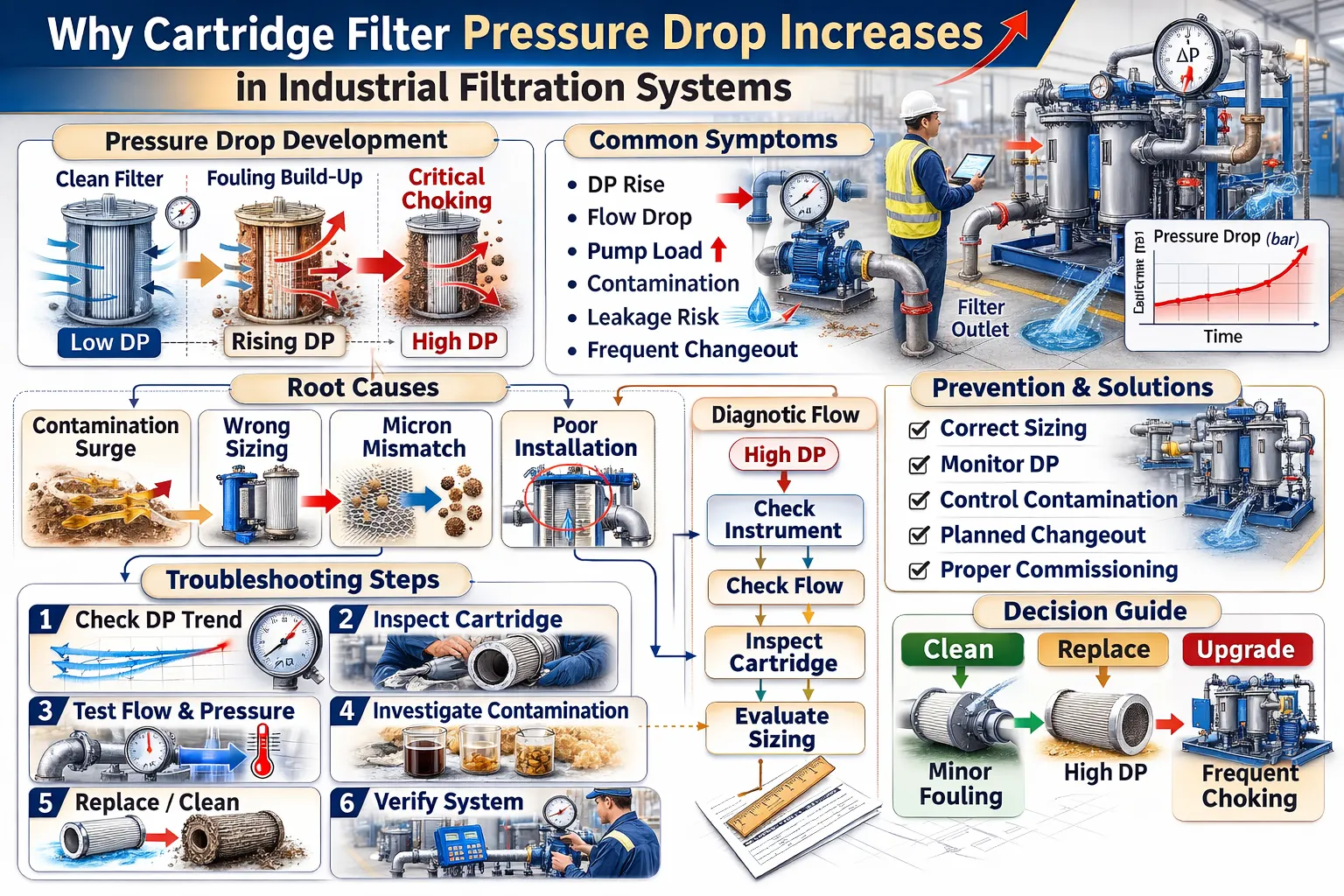
Higher velocity forces particles deeper into media structure, accelerating blockage and increasing DP rate.
Cooling increases fluid viscosity. Even a small change can raise resistance significantly in fine filtration stages.
Unexpected solids loading can overwhelm dirt holding capacity within hours, particularly in batch upset conditions.
Start-stop cycles disturb settled cake layers, redistributing debris unevenly and reducing predictable filtration life.
Corroded housing internals, worn pumps, or degraded seals introduce hydraulic disturbances that affect filtration efficiency.
One practical observation is that aging skids often show inconsistent DP behaviour across parallel housings due to internal distribution changes.
Preventing Frequent Pressure Drop Issues in Industrial Filtration Systems
Preventive strategies can significantly improve lifecycle performance and reduce emergency interventions.
- Select filtration area with adequate safety margin for peak demand
- Choose micron ratings based on contamination analysis rather than conservative assumption
- Monitor DP trends continuously rather than reacting only to alarm thresholds
- Maintain disciplined cartridge change scheduling based on performance history
- Perform thorough flushing during commissioning and restart
- Train operators to recognize early DP drift and flow instability
Plants that implement structured DP monitoring often reduce spare consumption and production disruption noticeably.
When to Clean, Replace Cartridge Filters, or Upgrade Filtration Systems
Cleaning may be viable when DP rise is linked to short-term contamination surge and media integrity remains intact.
Replacement becomes necessary when media saturation trends shorten operating cycles or structural deformation appears.
Upgrade discussions typically emerge when:
- Repeated choking occurs during peak production
- Pump overload events increase maintenance burden
- Production expansion demands higher flow capacity
In many cases, engineering teams evaluate lifecycle cost versus reliability improvement before moving toward larger housings, duplex systems, or higher dirt holding cartridges.
Common Plant Mistakes That Accelerate Cartridge Filter Pressure Drop
Field experience frequently highlights overlooked behaviours:
- Ignoring gradual DP drift until alarm threshold is reached
- Selecting overly fine micron ratings “for safety”
- Underestimating contamination spikes during startup
- Inadequate flushing allowing debris to reach cartridges
- Operating with bypass open during emergency without subsequent inspection
These patterns often contribute more to filtration instability than component limitations themselves.
Conclusion
Rising pressure drop in cartridge filtration systems is rarely caused by a single factor. It typically reflects an interaction between contamination dynamics, operating condition changes, design limitations, and maintenance behaviour.
By applying systematic troubleshooting — beginning with symptom observation and progressing toward root cause analysis — engineers can restore stable filtration performance, protect pumps from overload, and maintain consistent production throughput. Proactive monitoring and realistic sizing remain essential for preventing repeated choking and controlling lifecycle cost.
FAQ — Cartridge Filter Pressure Drop Troubleshooting
Sudden DP rise often follows contamination surge, viscosity change, or rapid increase in flow demand exceeding filtration capacity.
Yes. Excessively fine micron selection reduces dirt holding capacity and accelerates blockage under heavy contamination conditions.
Acceptable limits depend on design, but sustained operation near maximum DP rating indicates risk of media deformation or flow restriction.
Higher hydraulic resistance forces the pump to generate additional pressure to maintain flow, increasing motor load.
Uneven fouling patterns, unexpected contamination downstream, and abnormal DP trends after maintenance can indicate sealing problems.
Yes. Increased viscosity reduces permeability and raises DP even without additional particle loading.
Replacement intervals should be based on DP trend analysis and operating history rather than fixed schedules.
Duplex systems are typically evaluated when continuous operation is essential and frequent choking disrupts production stability.